
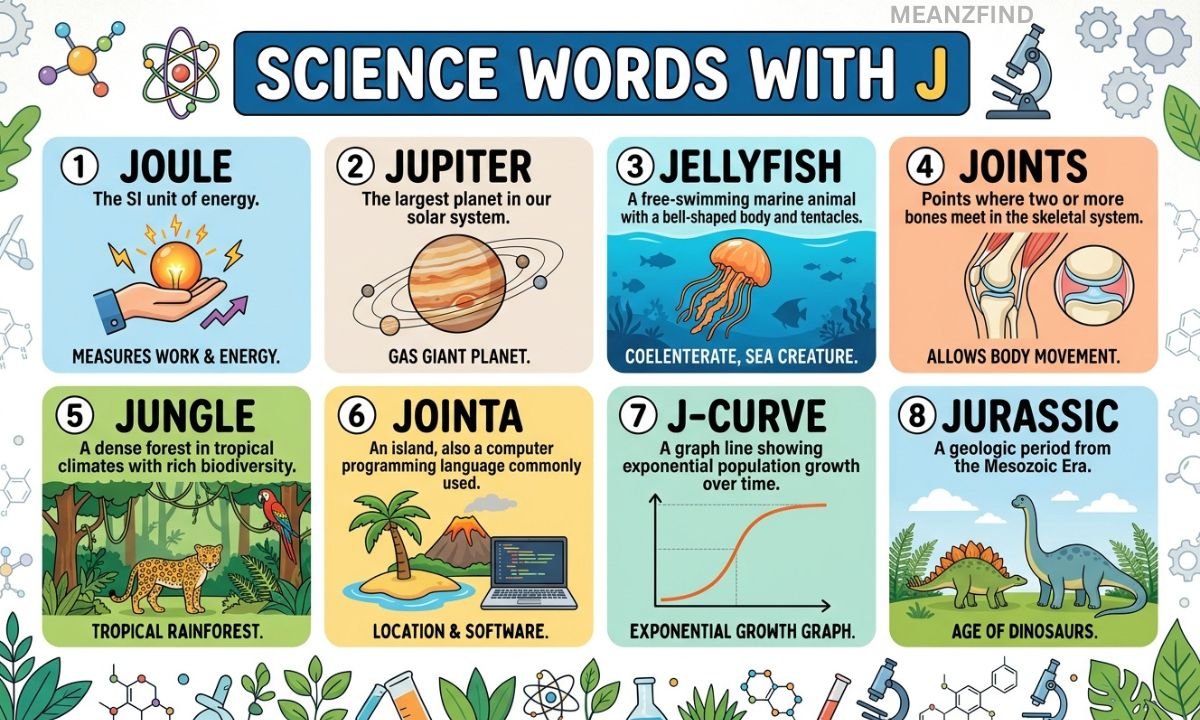
Science is full of interesting words. Some of these words are hard to say. Others are easy but have deep meanings. Today we will look at science words that start with J.
The letter J is not very common in science. But it still gives us some cool words. These words come from biology, chemistry, physics, and space science. Each one has its own story.
Learning new words helps you understand science better. It also helps in school tests and daily talks. Kids, students, and even teachers can enjoy this list. You will find simple meanings and easy examples too.
In this article, we will explain each word in a clear way. You do not need to be a science expert to understand them. Just read, learn, and have fun. Let’s explore science words that start with J.
Why the Letter J Is Special in Science
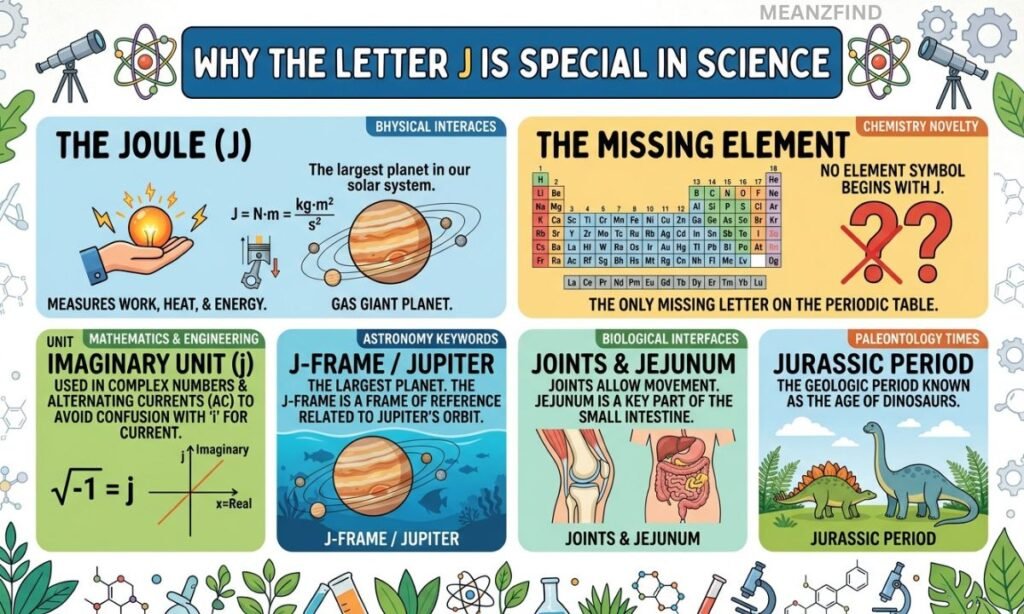
The letter J does not show up in science as often as letters like C or S. But the J words that do exist are powerful. They come from physics, biology, space science, and even engineering.
Some J words describe energy. Some describe weather. Some describe body parts. Others describe planets and rocks from millions of years ago. This list covers all of them in simple words.
You will also find easy tables, clear examples, and short explanations. This makes the words easy to remember for school, homework, or general knowledge.
Complete List of Science Words That Start With J
Here is a quick table before we go into detail. This helps you see all the words at a glance.
| Science Word | Field of Science | Simple Meaning |
| Joule (J) | Physics | Unit used to measure energy |
| Jet Stream | Earth Science | Fast-moving air high in the sky |
| Jupiter | Space Science | The largest planet in our solar system |
| Jurassic | Earth Science / Biology | A time period when dinosaurs lived |
| J-Curve | Economics / Science | A graph shape showing a dip then a rise |
| Joule-Thomson Effect | Physics | Gas cooling or heating when its pressure changes |
| Joints (Anatomy) | Life Science / Biology | Places where two bones meet |
| Joule per Second (Watt) | Physics | A unit that measures power |
| J-Integral | Fracture Mechanics | A method to study cracks in materials |
| J-Protein | Biology | A helper protein inside living cells |
Now let’s understand each word one by one, in very easy language.
Joule (J) – The Unit of Energy
A joule is a unit used to measure energy. Scientists use it to show how much work is done or how much heat is produced.
Think of it like this: when you lift a small book, you use energy. That energy can be measured in joules.
Simple example: Turning on a small light bulb for one second uses about one joule of energy.
The joule is named after James Prescott Joule, a scientist who studied heat and energy.
Jet Stream – Fast Winds in the Sky
The jet stream is a narrow band of very strong wind. It moves high above the Earth, usually where airplanes fly.
Jet streams move from west to east in most parts of the world. They can affect weather, temperature, and even flight time.
Simple example: A flight from New York to London is often faster than London to New York. This happens because the plane uses the jet stream to fly with the wind.
Jet streams are stronger in winter and weaker in summer.
Jupiter – The Largest Planet
Jupiter is the biggest planet in our solar system. It is so large that more than 1,300 Earths could fit inside it.
Jupiter is made mostly of gas. It does not have a solid surface like Earth. It also has a giant storm called the Great Red Spot.
Simple example: If Earth were the size of a coin, Jupiter would be the size of a basketball.
Jupiter has many moons. Scientists have found over 90 moons circling this giant planet.
Jurassic – A Time of Dinosaurs
Jurassic is the name of a time period in Earth’s history. It happened about 200 to 145 million years ago.
During the Jurassic period, huge dinosaurs like the Brachiosaurus and Stegosaurus lived on Earth. Plants and forests also covered much of the land.
Simple example: The movie “Jurassic Park” gets its name from this time period, since it features dinosaurs from that era.
Scientists learn about the Jurassic period by studying fossils found in rocks.
J-Curve – A Special Graph Shape
A J-Curve is a graph that first goes down and then rises sharply, forming a shape like the letter J.
It is used in economics, but it also appears in some scientific and medical studies. It shows a pattern where things get worse briefly before improving quickly.
Simple example: A new medicine might not work well at first, but soon it becomes very effective. This pattern can look like a J-Curve on a graph.
The J-Curve helps scientists and researchers predict future trends based on early data.
Joule-Thomson Effect – Gas Temperature Change
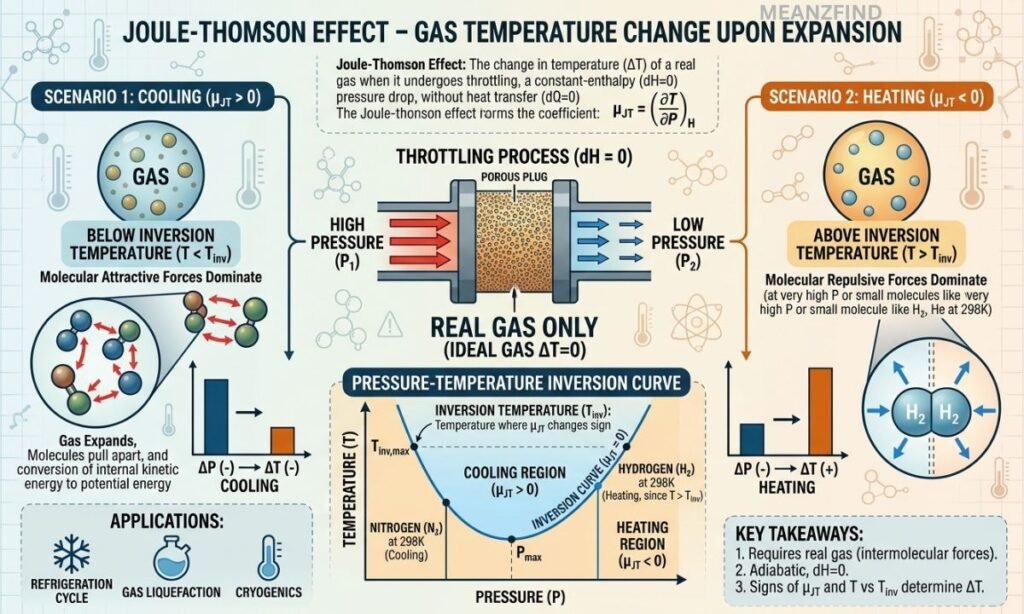
The Joule-Thomson Effect happens when a gas changes temperature as its pressure changes, without adding or removing heat.
This effect is used in refrigerators and air conditioners. When gas expands, it usually cools down.
Simple example: This is part of the reason your refrigerator stays cold inside, since gas inside the cooling system expands and drops in temperature.
This effect was discovered by James Joule and William Thomson, two scientists from the 1800s.
Joints (Anatomy) – Where Bones Meet
A joint is a place in the body where two or more bones connect. Joints allow the body to move and bend.
There are different types of joints. Some allow a lot of movement, and some allow very little.
Simple example: Your knee, elbow, and shoulder are all joints. They let you walk, throw a ball, and lift objects.
Types of Joints in the Human Body
| Joint Type | Example in Body | Movement Allowed |
| Hinge Joint | Elbow, knee | Moves in one direction |
| Ball and Socket Joint | Shoulder, hip | Moves in many directions |
| Pivot Joint | Neck | Allows turning motion |
| Gliding Joint | Wrist | Allows sliding movement |
| Fixed Joint | Skull | Allows no movement |
Joints are protected by cartilage, which acts like a cushion between bones.
Joule per Second (Watt) – Measuring Power
A watt is a unit of power. It tells us how fast energy is used or produced. One watt equals one joule of energy used every second.
This word connects closely to the joule, since power is really just energy used over time.
Simple example: A 60-watt light bulb uses 60 joules of energy every second it is switched on.
Electric bills often use a bigger version of this unit called a kilowatt, which equals 1,000 watts.
J-Integral – Studying Cracks in Materials
The J-Integral is a method used in engineering and physics to study how cracks grow in materials like metal or plastic.
Engineers use this idea to check if a material is strong enough or if it might break under pressure.
Simple example: Before building a bridge, engineers may use the J-Integral method to make sure the metal will not crack under heavy weight.
This concept helps prevent accidents in buildings, airplanes, and machines.
J-Protein – A Helper Inside Cells
A J-Protein is a type of protein found inside living cells. It helps other proteins fold into the right shape.
Proteins must be folded correctly to work properly. If they fold wrong, the cell may not function well.
Simple example: Think of a J-Protein like a helper who folds laundry correctly, so each piece of clothing works the way it should.
J-Proteins are important in keeping cells healthy and functioning smoothly.
Physical Science Words That Start With J
Physical science studies energy, matter, and forces. Here are the main J words from this field.
- Joule – A unit of energy.
- Joule per Second (Watt) – A unit of power.
- Joule-Thomson Effect – Temperature change in gases.
- J-Curve – A graph pattern used in scientific data.
- J-Integral – A method used to study material cracks.
These words are often used in physics classes, engineering projects, and energy studies.
Science Words That Start With J With Meaning (Quick Reference)
Here is a simple meaning-based list for fast learning and revision.
| Word | Meaning in One Line |
| Joule | Unit that measures energy |
| Jet Stream | Fast wind high in the sky |
| Jupiter | The largest planet |
| Jurassic | A dinosaur-era time period |
| J-Curve | A graph shaped like the letter J |
| Joule-Thomson Effect | Gas temperature change with pressure |
| Joints | Places where bones meet |
| Watt | Unit that measures power |
| J-Integral | A crack-study method in materials |
| J-Protein | A helper protein in cells |
Environmental Science Words That Start With J
Environmental science studies the Earth, weather, and nature. The jet stream is the main J word connected to this field.
- Jet Stream – Affects weather patterns, storms, and even climate shifts across the globe.
Some environmental scientists also study the Jurassic period to understand how Earth’s climate has changed over millions of years. Ancient plants and rocks from this time help scientists compare old climates with today’s climate.
Life Science Words That Start With J
Life science studies living things, including humans, animals, and plants. Two important J words belong here.
- Joints – Body parts that allow movement.
- J-Protein – A protein that helps cells work correctly.
Both of these words connect to how living bodies function, from tiny cells to full body movement.
Earth Science Words That Start With J
Earth science studies rocks, weather, and the planet’s history. These J words fit best in this category.
- Jet Stream – A weather-related wind pattern.
- Jurassic – A period in Earth’s geological history.
- Jupiter – Though a planet, it is often studied alongside Earth science in space-related lessons.
Earth science often connects to space science, since both study natural systems on a large scale.
Science Words That Start With J in Biology
Biology is the study of living organisms. Here are the main biology-related J words.
- Joints – Important for body movement and skeletal studies.
- J-Protein – Important for cell biology and genetics.
- Jurassic – Often studied in biology when learning about dinosaurs, fossils, and extinct species.
These words are useful for students studying human anatomy, cell biology, or prehistoric life.
Simple Comparison: Which Field Does Each Word Belong To?
This table below gives you a full overview so you can revise everything quickly.
| Word | Physical Science | Life Science | Earth Science | Space Science |
| Joule | Yes | |||
| Jet Stream | Yes | |||
| Jupiter | Yes | |||
| Jurassic | Yes | Yes | ||
| J-Curve | Yes | |||
| Joule-Thomson Effect | Yes | |||
| Joints | Yes | |||
| Watt | Yes | |||
| J-Integral | Yes | |||
| J-Protein | Yes |
Tips to Remember Science Words That Start With J
Learning new words becomes easy with small tricks. Here are some simple tips.
- Connect words to real life. Think of a light bulb when you hear “joule” or “watt.”
- Use pictures in your mind. Imagine dinosaurs when you think of “Jurassic.”
- Group similar words together. Keep energy words like Joule, Watt, and Joule-Thomson Effect in one group.
- Practice with examples. Say the word in a sentence to remember it better.
- Review often. Look at the tables above once a day for a week.
These small steps make science vocabulary stick in your memory for a long time.
FINAL WORDS
& Examples”
We have now learned many science words that start with J. Each word has its own meaning and use. Some come from physics, some from biology, and some from space science. Together, they show how wide science really is.
Learning these words is not hard. You just need simple examples to remember them. Words like joule, jet stream, and joint are easy once you know their meaning. Practice makes them stick in your mind.
This list can help students in school projects. It can also help teachers explain topics in a fun way. Even parents can use these words to teach kids at home. Science becomes easier when words are broken down simply.
You do not need to memorize everything at once. Learn a few words each day. Slowly, your science vocabulary will grow. Soon, these J words will feel like old friends.
We hope this list made science words with J simple and clear. Keep exploring new words every day. Curiosity is the first step to learning. Keep reading, keep asking, and keep discovering science.
FAQs
What is a science word for J?
Joule is a common science word starting with J. It measures energy used or produced in physics.
What does the letter J stand for in science?
In science, J usually stands for Joule, the unit of energy. It is also used as a symbol in some physics formulas.
What are 5 science words?
Five simple science words are Energy, Force, Cell, Gravity, and Atom. Each one describes a basic idea used across different science subjects.
What are 10 science words?
Ten easy science words are Energy, Force, Cell, Atom, Gravity, Joule, Orbit, Fossil, Molecule, and Ecosystem. These cover physics, biology, and earth science.
What is J in chemistry?
In chemistry, J often represents Joule, used to measure heat or energy in reactions. It can also appear as a symbol in certain constants or equations.
What are some good J words?
Good science J words include Joule, Jupiter, Jet Stream, Joints, and Jurassic. Each one belongs to a different area of science.
Can you give me 50 scientific words with meanings?
That’s a large list best shown as a full table rather than two lines. I can build a complete 50-word list with meanings as a separate section or article if you’d like.
What are scientific words a to z?
Scientific words from A to Z include terms like Atom, Bacteria, Cell, DNA, Energy, and continue through to Zygote. Each letter usually has at least one or two common science terms.
What are some interesting words that begin with the letter J?
Interesting J words include Jupiter, Jurassic, Jet Stream, and Joule. They come from space science, earth science, and physics.
What is science in 20 words?
Science is the study of nature, matter, and energy through observation, experiments, and evidence to understand how the world works.
What are 10 unique words?
Ten unique science words are Photosynthesis, Ecosystem, Gravity, Molecule, Osmosis, Velocity, Bacteria, Nucleus, Friction, and Evolution. These are used across biology and physics.
What are 10 simple words?
Ten simple science words are Sun, Water, Plant, Animal, Air, Heat, Light, Rock, Sound, and Energy. These are easy for young students to understand.