
You have probably seen the word “chama” in a chat, a news story, or a song. It looks simple, but it can mean different things. The meaning depends on the language and the place. That is why many people search for it.
In Swahili, “chama” means a group, a club, or an association. In Kenya, it often means a small savings group. Members put in money together and help each other grow it. In Portuguese, “chama” means a flame or fire. In some parts of Latin America, it is also a casual word for a friend or a young person.
This guide explains each meaning in plain words. You will learn where the word comes from and how people use it today. You will also see simple examples to help you use it with confidence. Let’s start with the basic definition.
Chama Meaning – Quick Definition
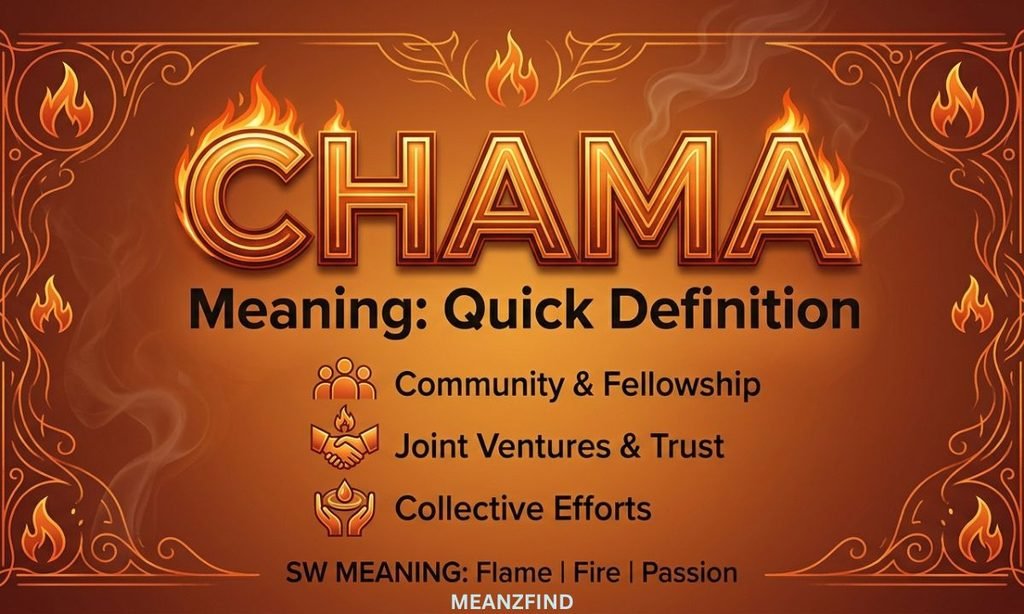
Chama has more than one meaning. The meaning depends on the language and the setting.
- In Portuguese: “chama” means a flame or fire.
- In Portuguese slang (UFC and sports): it works like a shout, similar to “let’s go!” or “come on!”
- In Swahili (East Africa): a chama is a group, club, or association. In Kenya, it usually means a savings group.
- In some Latin American slang: it can be a casual word for a friend or a young person.
The shortest answer is this: chama means “flame” in Portuguese, “group” in Swahili, and “let’s go!” in sports slang.
Simple Quoted Examples
Here are short examples. Each one shows a different meaning.
- “The candle gave off a small chama.” (Portuguese meaning: flame)
- “Chama! Finish him!” (hype meaning: let’s go)
- “Our chama meets every first Saturday.” (Swahili meaning: savings group)
- “She is my chama from school.” (slang meaning: friend, in some regions)
You can see that one word does four jobs. Always look at the sentence around it.
Chama Meaning
Let’s look at each meaning slowly. This will help you pick the right one fast.
1. Chama as “Flame”
This is the oldest and most basic meaning in Portuguese. A “chama” is the bright, glowing part of a fire. You can see it on a candle, a stove, or a campfire.
People also use it in a figure-of-speech way. They talk about the “flame of love” or the “flame of hope.” In English, we do the same thing. We say “a spark of hope” or “burning desire.”
2. Chama as “Let’s Go!”
This is the meaning that went viral online. People shout “Chama!” to show energy, courage, and excitement. It feels like a battle cry.
You can think of it as an English phrase like:
- “Let’s go!”
- “Bring it on!”
- “Come on!”
- “Fire it up!”
The flame idea fits well. A flame is hot and strong. So the shout carries the same feeling.
3. Chama as “Group” or “Savings Circle”
In East Africa, “chama” means a group of people who join for a shared goal. Most often, the goal is money. Members add a fixed amount each month. Then the group saves, lends, or invests the money.
This kind of group builds trust. Members help each other in good times and bad times.
4. Chama as Friend or Young Person
In parts of Latin America, “chama” can be a casual word for a young woman or a close friend. It sounds friendly and relaxed. People use it mostly in speech, not in formal writing. The exact feel can change from one country to another.
Origin & Background of Chama
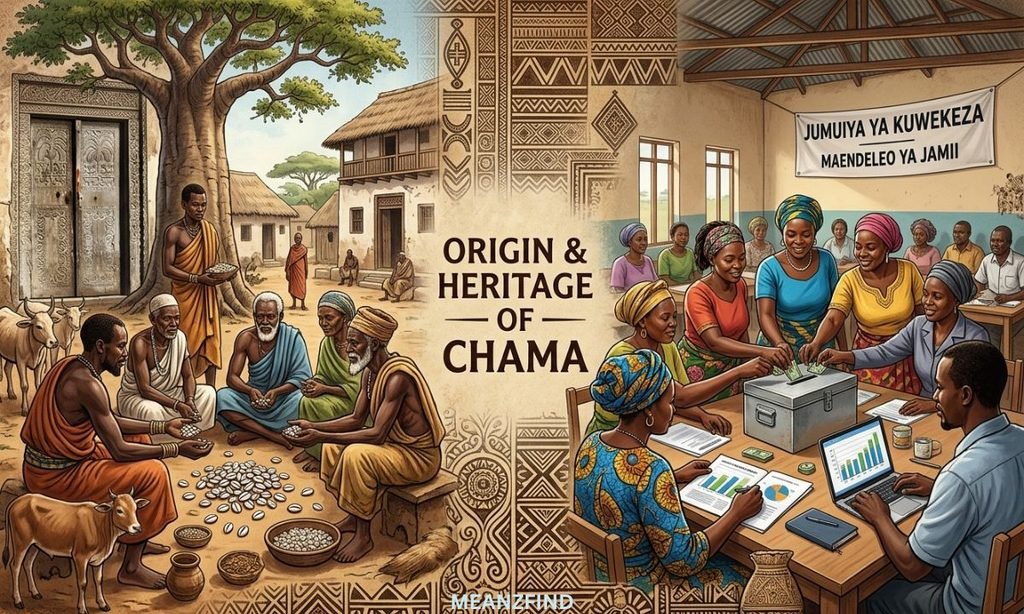
The word comes from different roots. That is why the meanings look so different. Two words share the same spelling by chance. They grew up in two separate parts of the world.
The Swahili Roots
Swahili is spoken across East Africa. The Swahili word “chama” means a society, party, or organization. It can describe a political party. It can also describe a small club or a community group.
Over time, the word took on a money meaning in Kenya. A chama became a go-to way for friends, neighbors, and coworkers to save together. Many families trust this system more than banks.
The Portuguese Roots
The Portuguese word “chama” means flame. It is linked to the Latin word for fire. Spanish has a close cousin, “llama,” which means the same thing. These words belong to the same language family.
The Portuguese verb “chamar” means “to call.” The word “chama” is also a form of this verb. So in Portuguese, “chama” can mean “calls” or “call!” This is one reason the slang use feels like a call to action. Someone is calling you to join the fun.
The Slang Growth
Slang grows when people use words in new ways. Brazilian speakers used “chama” as a shout of energy. Sports fans, music fans, and social media users picked it up. Then a famous fighter made it known to the whole world. We will talk about that later in this guide.
Real-Life Conversations (How People Actually Use It)
Words come alive in real chats. Here are three simple examples.
WhatsApp Chat (Friends Planning a Game Night)
Sam: Who is ready for game night on Friday?
Ali: Me! I’ll bring snacks.
Zara: I’ll bring the cards. Chama! 🔥
Sam: Haha, let’s go then!
Ali: Friday is going to be so good.
What it means here: Zara uses “Chama!” to show excitement. She is saying “Let’s go!” It is a short, happy shout.
Instagram DM (Fitness Progress)
Lina: I just finished my 5K run. First time ever!
Omar: No way! Chama! 💪
Lina: I’m so proud of myself.
Omar: You should be. Keep going!
What it means here: Omar uses “Chama!” to cheer Lina on. It is like saying “Well done, keep it up!” The word carries support and energy.
TikTok Comments (Business Motivation)
User 1: Started my small online shop today. Wish me luck.
User 2: Chama! You’ve got this.
User 3: Day one is the hardest. Keep pushing.
User 1: Thank you all! Chama! 🔥
What it means here: The comments are full of hype. “Chama” is a friendly boost for someone who just started something new.
Emotional & Psychological Meaning
Words can change how we feel. “Chama” is a good example. It carries a spark.
The Feeling of Fire
A flame is a symbol of life. It gives light and heat. When you hear “Chama!”, your mind may link it to energy and courage. That is why it works so well as a hype word.
Motivation and Belonging
When a group shouts the same word, people feel united. Fans in a crowd feel like one team. Friends in a chat feel closer. This sense of belonging is a strong, positive feeling.
Confidence Boost
Short, strong words can lift your mood. Saying “Chama!” before a big task can give you a little push. Many people use it like a mini pep talk. It tells your brain: “It’s time to act.”
The Calm Side of the Word
Not every use of “chama” is loud. A savings chama is calm and steady. It is about trust, planning, and safety. So the word can mean both fire and security, depending on the setting.
Usage in Different Contexts
The same word can sound different in different places. Here is how it works in everyday life.
Social Media
Social media is the biggest home of the hype meaning. You will see it in:
- Comment sections under sports clips
- Captions on workout photos
- Replies to a friend’s good news
- Memes and short videos
People often add a fire emoji 🔥. It matches the flame meaning perfectly.
Friends & Relationships
Among friends, “chama” is warm and playful. You can use it to:
- Start a plan (“Chama, let’s go out tonight!”)
- Cheer for a friend (“Chama, you did it!”)
- Join in on a joke
In some regions, friends may use it to call a close friend. Be sure you know the local feel before you use it that way.
Work or Professional Settings
At work, the hype meaning is usually too casual. A formal email should not say “Chama!” to a boss or client.
But the group meaning is very common in business talk in Kenya. People might say, “Our chama bought a plot of land last year.” In that case, it is a professional and respected word.
You may use the hype meaning in a relaxed team chat. Only do it if your team already talks in a fun, casual way.
Casual vs Serious Tone
| Tone | How “Chama” Sounds | Example |
| Casual | Fun, loud, friendly | “Chama! Let’s win this!” |
| Serious | Calm, trusted, planned | “I attend my chama meeting on Sunday.” |
| Poetic | Soft, deep, artistic | “A small chama lit the dark room.” |
Common Misunderstandings
People often mix up the meanings. Let’s clear up the biggest mistakes.
It Does NOT Mean “Call Me”
Some people think “chama” always means “call me.” That is not how people use it in the slang sense. When someone shouts “Chama!” at a fight or in a chat, they are not asking for a phone call.
Here is the small catch. The Portuguese verb “chamar” does mean “to call.” So in normal Portuguese sentences, “chama” can mean “calls” or “call.” But as hype slang, it is just a shout of excitement. Don’t answer a hype “Chama!” by phoning the person.
It’s Not an Insult
“Chama” is not a rude word. It does not target anyone. It is friendly, positive, and full of energy. Nobody should feel hurt when they hear it.
The only time it might feel odd is when you use a slang meaning in the wrong place. For example, using it for a person in a region where it is not common might cause confusion.
It’s Not Always About Fire Literally
Yes, the base meaning is “flame.” But the slang use has nothing to do with real fire. When a fan shouts “Chama!”, nobody expects a candle to appear. The word is just a symbol of energy.
Don’t Use It in Sensitive Situations
Hype words are for happy moments. Avoid “Chama!” when:
- Someone shares sad news
- A person is grieving
- A serious problem is being discussed
- You are in a formal meeting
Reading the mood is the key. A shout of joy does not fit a sad moment.
Comparison Table
Here is a simple table to compare all the main meanings at a glance.
| Meaning | Language | Region | Tone | Example |
| Flame or fire | Portuguese | Brazil, Portugal | Neutral or poetic | “A chama da vela” (the candle’s flame) |
| “Let’s go!” / “Come on!” | Portuguese slang | Brazil, global sports fans | Hype, casual | “Chama! Keep going!” |
| Group or society | Swahili | East Africa | Neutral, formal | “She joined a women’s chama.” |
| Savings circle | Swahili / Kenyan English | Kenya, East Africa | Serious, trusted | “Our chama saves every month.” |
| Friend or young person | Spanish slang | Parts of Latin America | Friendly, casual | “Ese chama es mi amigo.” |
| Calls / call! | Portuguese verb form | Portuguese speakers | Neutral | “Ele chama o amigo.” |
Key Insight:
Never guess the meaning of “chama” from the word alone. Read the setting. If the chat is about sports or fun, it means “let’s go.” If the talk is about money and members, it means a savings group. If the story is about a candle or fire, it means a flame.
Variations & Types of Chama (10 Forms)
Here are ten common forms of the word. Each one has its own feel.
- The Flame Chama. This is the Portuguese noun for fire. It is used in stories, songs, and poems.
- The Hype Chama. This is the shout “Chama!” It shows energy and excitement.
- The Fighter’s Chama. This is the version made popular in the UFC. It is a victory call and a sign of confidence.
- The Group Chama. In Swahili, this is any club, society, or association.
- The Savings Chama. This is a group where members add money regularly. They support each other with loans and shared savings.
- The Investment Chama. This is a stronger version of the savings group. Members pool money to buy land, shares, or small businesses.
- The Friendly Chama. In some Latin American slang, this is a casual word for a friend or young person.
- The Meme Chama. This is the online version. Fans use it in videos, edits, and jokes. It often comes with fire emojis.
- The Name Chama. Some people, brands, or places use “Chama” as a name. In this case, it may have no slang meaning at all.
- The Verb Chama. In regular Portuguese, “chama” can be a form of the verb “to call.” This is a plain grammar use, not slang.
How to Respond When Someone Says “Chama”
You do not need a perfect answer. A short, matching reply works. Here are some ideas by style.
Casual Replies
Keep it light and quick.
- “Chama! Let’s go!”
- “Right behind you!”
- “Yes, let’s do it!”
- “Haha, I’m ready!”
- “Say less. Let’s go.”
Funny Replies
Add a little humor to keep the mood fun.
- “Chama! I’ll bring the marshmallows.”
- “Fire emoji activated. 🔥”
- “Hold on, let me find my superhero cape.”
- “I was born ready, but I forgot my shoes.”
- “Chama! My snacks are also ready.”
Mature / Confident Replies
Use these when you want to sound calm and strong.
- “Let’s get it done.”
- “Thanks. I appreciate the energy.”
- “I’m ready. Let’s make it happen.”
- “Good call. Let’s stay focused.”
- “Together, we can do this.”
Private or Respectful Replies
Use these in one-on-one chats or with people you don’t know well.
- “Thank you for the support.”
- “I appreciate that. It means a lot.”
- “That’s kind of you. I’ll keep going.”
- “Thanks! I’ll do my best.”
- “Good to hear. Let’s talk more soon.”
You can also just ask, “Do you mean ‘let’s go’?” Asking is not rude. It shows you care about understanding.
Regional & Cultural Usage
Language moves around the world. “Chama” has been picked up in many places.
Western Culture
In the US, UK, Canada, and Australia, most people met the word through sports. Fans of mixed martial arts started repeating it. It shows up in comment sections, gym talk, and sports bars.
Many Western speakers use it with no deep knowledge of Portuguese. They know it means “let’s go,” and that is enough. Some also know the Kenyan savings meaning from news, finance talk, or travel.
Asian Culture
In Asian countries, “chama” is not a traditional word in most major languages. Fans of combat sports learned it from videos and fights. They use it as a fan shout or a fun online word.
It can also appear as a name or a brand in some places. In such cases, it may not have the slang meaning. When in doubt, check the context.
Middle Eastern Culture
In Middle Eastern countries, the word has no old, deep meaning in local languages. Its spread comes mostly from sports fans and social media. Younger fans may use it in chats and posts, usually in the hype sense.
People in these regions often mix English, Arabic, and other slang online. So “chama” sits easily next to other shared internet words.
Global Internet Usage
The internet turns local words into global ones. “Chama” is a great case.
- It is short and easy to say.
- It sounds strong and energetic.
- It fits well with videos and clips.
- It travels fast through memes.
Today, you can see it in fan pages, workout videos, gaming clips, and short-form content. Most people use it as a friendly shout.
Chama Meaning UFC
In the UFC world, “Chama!” is a battle cry. Fans shout it when a fighter lands a big strike. Commentators and viewers repeat it online after exciting moments.
Why It Fits Fighting
A fight is full of heat and pressure. The flame idea matches that feeling. “Chama” says: “The fire is on. It’s time.”
How Fans Use It
- They shout it in the crowd.
- They post it under fight clips.
- They add it to highlight videos.
- They use it as a hashtag or caption.
The word made many people curious about Portuguese. Lots of fans started to search for its meaning. That is one reason this word now gets so many searches.
Chama Meaning Poatan
“Poatan” is the fight name of Alex Pereira. Fans often search “chama” and “Poatan” together. So let’s separate the two words clearly.
What “Poatan” Means
“Poatan” comes from the Tupi language, an indigenous language of Brazil. It is commonly explained as meaning “stone hands.” The nickname fits his style, because he is well known for powerful punches and kicks.
Pereira also proudly shows respect for his Pataxó roots. This ties his nickname to his culture and history.
What “Chama” Means for Poatan
“Chama” is not his nickname. It is his catchphrase. It is something he says. It is not what people call him.
Think of it like this:
| Word | What It Is | Meaning |
| Poatan | Nickname | “Stone hands” (Tupi) |
| Chama | Catchphrase | “Let’s go!” / “Come on!” |
A Common Mistake
Some low-quality pages online say “Poatan” means “flame” or “fire.” That is wrong. “Flame” belongs to the word “chama,” not to “Poatan.” Keep the two ideas apart, and you will avoid the confusion.
Chama Meaning Alex Pereira
Now let’s focus on the fighter himself. Alex Pereira is a Brazilian fighter. He started in kickboxing and later moved to mixed martial arts. He became known as a UFC champion. Fans love his calm face, his strong left hook, and his fast finishes.
How He Uses “Chama”
He uses the word as a shout of energy and confidence. In simple terms, it means “let’s go!” or “come on!” He may say it before a fight, after a win, or when he wants to hype the crowd. Fans picked it up and repeated it back to him.
When he was asked about the word in interviews, the answer was simple. It is a fun, energetic word. It does not carry a hidden or secret message.
Why It Became Famous
There are a few clear reasons:
- It is short. One word is easy to remember.
- It sounds strong. The sound is sharp and punchy.
- It fits his style. His fighting is bold and fiery.
- It is easy to repeat. Fans can shout it together.
- It spread online. Clips and memes carried it everywhere.
How Fans Use It Today
Fans use “chama” as a way to show love for him and the sport. You will see it under his fight videos, on fan posts, and in jokes. Some people even shout it at the gym. It has become part of fight culture.
FINAL WORDS
The word “chama” can mean different things. In Swahili, it means a group or association. In Kenya, it often means a savings group where members pool money. In Portuguese, it means a flame, and in some Latin American slang, it can mean a friend.
The origin of the word explains these meanings. The Swahili “chama” comes from East African culture, where people value working together. The Portuguese “chama” comes from the Latin word for fire. These roots are very different, even though the spelling is the same.
Context is the key to understanding it. If you see “chama” in a story about money or investing, it likely means a savings group. If you see it in a poem or a song, it may mean a flame. If you hear it in casual talk in parts of Latin America, it may mean a friend.
Now you know what “chama” means and how people use it. Always check the setting before you decide which meaning fits. Use the word with care, and it will help you understand people better. Share this guide with anyone who is curious about it.
FAQs
What does chama mean in UFC?
In the UFC, “chama” is a shout of energy that means “let’s go!” or “come on!” Fans and fighters use it to hype a big moment, like a strong strike or a win.
What does “chama” mean in English?
In English, “chama” means “flame” or “fire,” because that is its Portuguese meaning. In slang, it also means “let’s go!” and in Swahili it means a “group” or “savings circle.”
Who says chama?
Alex Pereira, the Brazilian UFC fighter, made the word famous with his catchphrase. His fans, other MMA followers, and Portuguese speakers also say it.
How do you say chama in English?
You say it as “SHAH-mah,” with a soft “sh” sound at the start. In English, you can swap it for “let’s go!” or “come on!” in the slang sense, or “flame” for the literal one.
Which UFC fighter is Chama?
No UFC fighter is named Chama. It is the catchphrase of Alex Pereira, who fights under the nickname “Poatan.”
What is Alex Pereira’s nickname?
Alex Pereira’s nickname is “Poatan.” It comes from the Tupi language and is commonly explained as meaning “stone hands.”
What does “chama” mean in slang?
In slang, “chama” means “let’s go!” or “bring it on!” and shows excitement or support. In some parts of Latin America, it can also be a casual word for a friend or young person.