
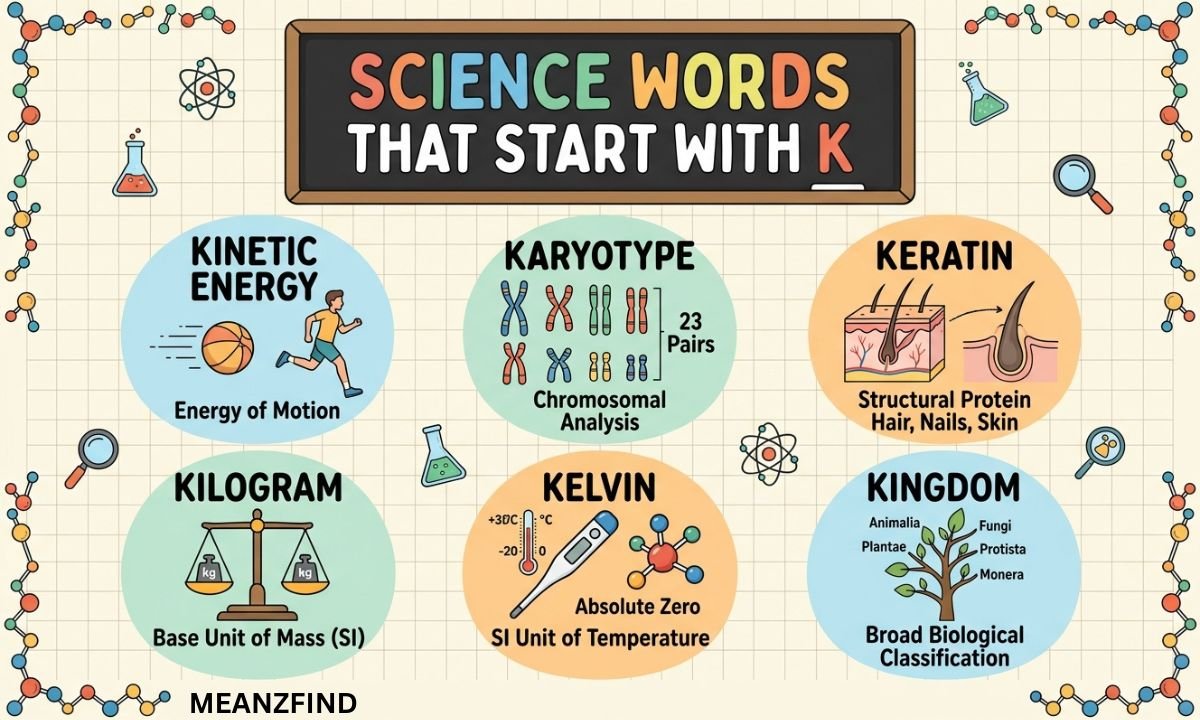
Science is full of interesting words. Many of these words help us understand the world around us. Some science words start with the letter K. These words are used in biology, chemistry, physics, and other fields.
Learning new science words can be fun and easy. Words like “kinetic,” “karyotype,” and “kelvin” are common in science books. Each word has its own meaning and use. Knowing these words helps students do better in science class.
This article will share a list of science words that start with K. Each word will come with a simple definition. We will also give easy examples to help you understand. This will make learning fun and simple.
Whether you are a student, teacher, or just curious, this list is for you. You will learn new words in a short time. These words are useful for tests, projects, and daily learning. Let’s explore science words that start with K.
What Makes K Words Special In Science
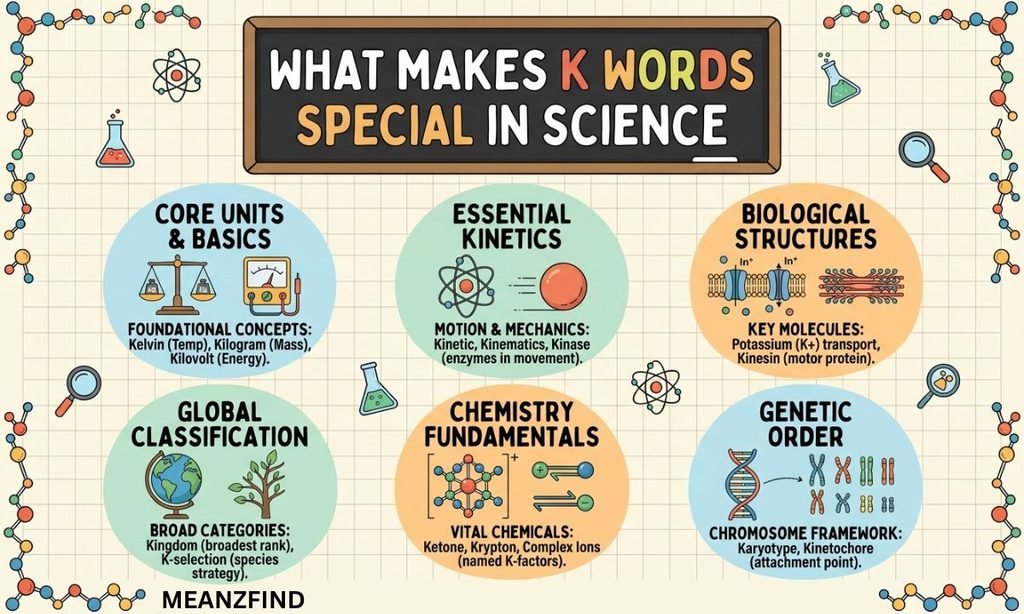
Science has thousands of words. Only a small number start with the letter K. This makes K words feel rare and special.
Many K words come from Greek or German roots. For example, “Kelvin” comes from a scientist’s name. “Krebs Cycle” also comes from a scientist named Hans Krebs. Knowing where a word comes from can help you remember its meaning.
K words show up in many branches of science. You will find them in biology, chemistry, physics, earth science, and even computer science. This article covers all of these areas in one place.
Earth Science Words That Start With K
Earth science is the study of our planet. It includes rocks, weather, oceans, and space. Here are some important K words from earth science.
Karst
Karst is a type of land. It forms when water slowly dissolves rock like limestone. This creates caves, sinkholes, and underground rivers.
Karst landscapes look bumpy and full of holes. Many famous cave systems form in karst areas. Farmers sometimes struggle to grow crops on karst land because water drains away too fast.
Kame
A kame is a small hill made of sand and gravel. Glaciers leave kames behind as they melt. You can find kames in places that had ice ages long ago.
Kames look like little bumps on flat land. Scientists study kames to learn how old glaciers moved. They help us understand Earth’s icy history.
Katabatic Wind
A katabatic wind is a strong wind that blows down a slope. Cold, heavy air rushes down from mountains or glaciers. This wind can be very fast and cold.
Katabatic winds happen a lot in Antarctica. They can reach speeds like a storm. Pilots and sailors watch out for these winds because they can be dangerous.
Kelvin Scale (In Earth Science Context)
The Kelvin scale measures temperature. Earth scientists use it to study very cold places like the poles or outer space. Zero on the Kelvin scale is called “absolute zero,” the coldest possible temperature.
Physical Science Words That Start With K
Physical science includes physics and chemistry. It studies matter, energy, and how things move. Below are the most important K words in this field.
Kelvin
Kelvin is a unit used to measure temperature. It is named after Lord Kelvin, a Scottish scientist. Scientists prefer Kelvin because it starts at absolute zero, the lowest temperature possible.
Simple Example: Water freezes at 273 Kelvin and boils at 373 Kelvin.
Kelvin is used a lot in science experiments. It helps scientists compare temperatures accurately, especially in space and chemistry labs.
Kinetic Energy
Kinetic energy is the energy of motion. Anything that moves has kinetic energy. The faster something moves, the more kinetic energy it has.
Simple Example: A moving car, a flying ball, and a running dog all have kinetic energy.
Kinetic energy depends on two things: speed and mass (how heavy something is). Heavier and faster objects have more kinetic energy.
Kilogram
A kilogram is a unit used to measure mass. Mass tells us how much matter is in an object. One kilogram equals 1,000 grams.
Simple Example: A bag of sugar often weighs about one kilogram.
Scientists use kilograms in almost every experiment. It is one of the most basic units in the metric system.
Kilowatt
A kilowatt is a unit of power. It measures how fast energy is used or created. One kilowatt equals 1,000 watts.
Simple Example: Many home appliances, like heaters, use kilowatts to show their power.
Kilojoule
A kilojoule measures energy, just like a calorie. It is often used to show how much energy is in food. One kilojoule equals 1,000 joules.
Krypton
Krypton is a gas found in small amounts in the air. It does not react easily with other elements. This is why scientists call it a “noble gas.”
Simple Example: Krypton is used inside some light bulbs to make them glow brighter.
Chemistry and Biology Words That Start With K
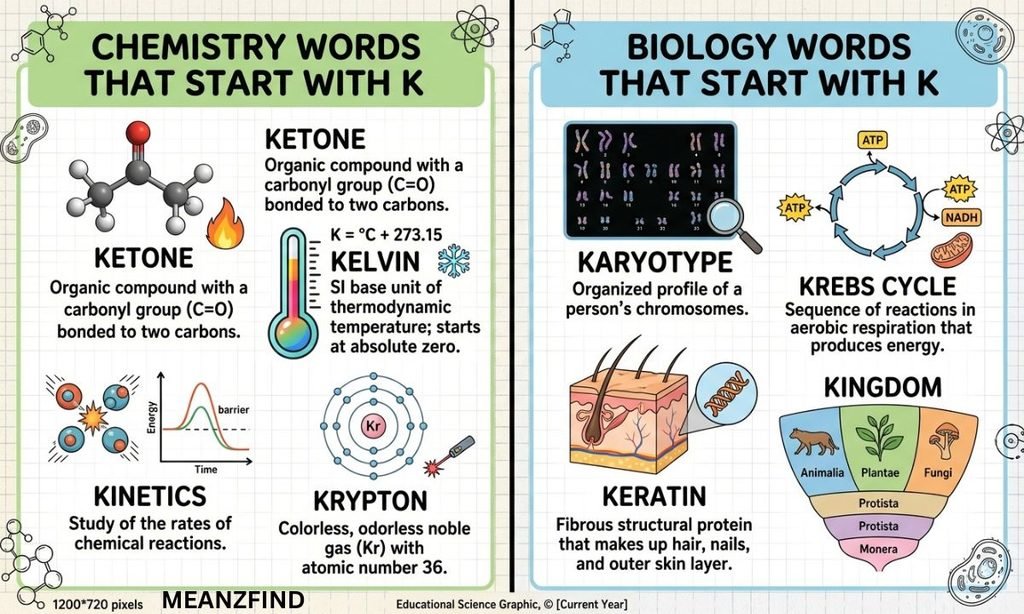
Chemistry and biology explain living things and the materials that make up our world. These K words are common in science classrooms.
Karyotype
A karyotype is a picture of all the chromosomes in a cell. Chromosomes carry genetic information. Doctors use karyotypes to check for genetic problems.
Simple Example: A karyotype test can show if a baby has an extra chromosome.
Karyoplasm
Karyoplasm is the liquid inside the nucleus of a cell. It is also called nucleoplasm. This liquid holds the chromosomes and helps the cell function properly.
Karyoplasm supports important activities inside the nucleus. Without it, the cell could not copy its DNA correctly.
Karyokinesis
Karyokinesis is the division of a cell’s nucleus. It happens during cell division. This process makes sure each new cell gets the correct number of chromosomes.
Simple Example: Karyokinesis happens before a cell splits into two new cells.
Krebs Cycle
The Krebs Cycle is a series of chemical reactions inside cells. It helps turn food into energy. This cycle is also called the citric acid cycle.
Simple Example: Your body uses the Krebs Cycle every day to create energy from the food you eat.
The Krebs Cycle happens inside tiny parts of the cell called mitochondria. Scientists call mitochondria the “powerhouse of the cell.”
Keratin
Keratin is a strong protein. It makes up hair, nails, and the outer layer of skin. Keratin protects the body from damage.
Simple Example: Your fingernails are hard because they are made of keratin.
Kymograph
A kymograph is an old scientific tool. It records changes over time, like muscle movement or blood pressure. Scientists used it before computers existed.
Kymography
Kymography is the process of using a kymograph. It records and studies motion or pressure changes. This method helped early scientists study the human body.
Kinase
A kinase is a type of enzyme. Enzymes help speed up chemical reactions in the body. Kinases add a small chemical group called a phosphate to other molecules.
Simple Example: Kinases help control how cells grow and communicate.
Kingdom
In biology, a kingdom is a large group used to classify living things. Scientists divide life into kingdoms like Animalia, Plantae, and Fungi.
Simple Example: Humans belong to the Animal Kingdom.
Computer Science Words That Start With K
Computer science also has its own set of K words. These terms are useful for students learning about technology.
Kernel
A kernel is the core part of a computer’s operating system. It controls how software and hardware work together. Without a kernel, a computer could not run properly.
Simple Example: When you turn on your computer, the kernel starts working immediately.
Kilobyte
A kilobyte is a unit used to measure data. It is a small amount of storage space. One kilobyte equals 1,024 bytes.
Simple Example: A short text file might be a few kilobytes in size.
Key (In Computer Science)
A key is a piece of information used to lock or unlock data. Keys are important in computer security and coding.
Simple Example: A password can act like a key to protect your account.
Keyword
A keyword is a special word used in programming languages. Keywords have a fixed meaning and cannot be used as regular variable names.
Simple Example: In many programming languages, words like “if” and “for” are keywords.
Knowledge Base
A knowledge base is a collection of information stored for computers to use. It helps computer programs answer questions and solve problems.
Simple Example: Some smart assistants use a knowledge base to answer your questions.
Quick Reference Table: Science Words Starting With K
| Word | Science Field | Simple Meaning |
| Kelvin | Physics | Unit for measuring temperature |
| Kinetic Energy | Physics | Energy of motion |
| Kilogram | Physics | Unit for measuring mass |
| Kilowatt | Physics | Unit for measuring power |
| Krypton | Chemistry | A noble gas |
| Karyotype | Biology | Picture of chromosomes |
| Karyoplasm | Biology | Liquid inside the nucleus |
| Karyokinesis | Biology | Division of the nucleus |
| Krebs Cycle | Biology | Process that creates energy in cells |
| Keratin | Biology | Protein in hair, skin, and nails |
| Kymograph | Biology | Tool that records body changes |
| Kingdom | Biology | Large group for classifying life |
| Karst | Earth Science | Land shaped by dissolved rock |
| Kame | Earth Science | Hill made by melting glaciers |
| Katabatic Wind | Earth Science | Strong wind flowing downhill |
| Kernel | Computer Science | Core of an operating system |
| Kilobyte | Computer Science | Small unit of data storage |
| Keyword | Computer Science | Special programming word |
Science Words That Start With K By Grade Level
Different grades learn different science words. Below is a simple guide for teachers, parents, and students.
Science Words That Start With K – 5th Grade
Fifth-grade students usually learn simple and easy-to-understand K words. These words connect to basic physics and biology lessons.
- Kinetic Energy
- Kilogram
- Keratin
- Kingdom
- Kilobyte
These words are perfect for young learners. They connect to everyday life, like moving objects, weight, and hair or nails.
Science Words That Start With K – 6th Grade
Sixth-grade science becomes a little more detailed. Students start learning about cells, energy units, and Earth’s surface.
- Kelvin
- Karyotype
- Karst
- Kame
- Kernel
At this stage, students begin to understand more scientific processes, not just definitions.
Science Words That Start With K – 7th Grade
Seventh-grade science introduces harder biology and chemistry topics. Words become more advanced and connect to cell activity and energy processes.
- Krebs Cycle
- Karyoplasm
- Karyokinesis
- Kinase
- Katabatic Wind
These words require a deeper understanding of how living things and natural processes work.
List Of Science Words That Start With K (Complete List)
Here is a full list of science words that start with K, all in one place for easy reference.
- Kelvin
- Kinetic Energy
- Kilogram
- Kilowatt
- Kilojoule
- Krypton
- Karyotype
- Karyoplasm
- Karyokinesis
- Krebs Cycle
- Keratin
- Kymograph
- Kymography
- Kinase
- Kingdom
- Karst
- Kame
- Katabatic Wind
- Kernel
- Kilobyte
- Key
- Keyword
- Knowledge Base
Fun Facts About K Words In Science
Learning fun facts makes science words easier to remember. Here are a few interesting facts.
- The Kelvin scale has no negative numbers. Zero Kelvin is the coldest possible temperature in the universe.
- Krebs Cycle is named after Hans Krebs, who won a Nobel Prize for discovering it.
- Keratin is so strong that it is also found in animal horns, claws, and feathers.
- Karst landscapes cover about 20 percent of the Earth’s land surface.
- Kilobytes were once a big deal, but today’s computers use much larger units like gigabytes and terabytes.
Why Learning K Words Helps Students
Learning science words builds strong reading and thinking skills. It also helps students understand textbooks and tests more easily.
K words often connect big ideas in a small package. For example, “Kinetic Energy” explains motion in just two simple words. Learning these terms helps students explain science ideas clearly.
Teachers can use this list to create quizzes, worksheets, or classroom games. Students can use flashcards to remember each word and its meaning. Repeating words often helps them stick in memory.
FINAL WORDS
Science words that start with K are more common than you might think. They appear in biology, chemistry, physics, and even geography. Each word carries a special meaning. Learning them helps you understand science better.
We covered many useful words in this article. Terms like “kinetic energy,” “karyotype,” and “kelvin” are just a few examples. Each one plays an important role in its subject. These words are not hard to learn once you know their meaning.
Simple definitions make science words easy to remember. Real-life examples help you use them correctly. This is why we added examples with each word. It helps students connect ideas with real situations.
You can use this list for school work, quizzes, or general knowledge. Teachers can also use it to explain topics in a simple way. Parents can help their kids learn new words too. This list is useful for all age groups.
Science is easier when words are broken down simply. We hope this list helped you learn new K words in science. Keep exploring and learning new terms every day. Small steps like this build strong science knowledge over time.
FAQs
What does K stand for in science?
In science, K most often stands for Kelvin, the unit used to measure temperature. It can also stand for kilo, meaning one thousand, as in kilogram or kilometer.
What are 5 science words?
Five common science words are energy, atom, cell, gravity, and force. These words appear across physics, chemistry, and biology lessons.
What does K stand for in biology?
In biology, K often represents potassium, an important mineral found in cells and blood. K can also stand for Kingdom, a major group used to classify living things.
What is K in terms of physics?
In physics, K usually stands for Kelvin, the scale used to measure temperature starting from absolute zero. K can also represent kinetic energy in certain physics equations.
What are 10 science words?
Ten common science words include atom, energy, force, cell, gravity, mass, matter, molecule, reaction, and velocity. These words are used across almost every branch of science.
What are 10 unique words?
Ten unique and less common words include karyotype, kymograph, katabatic, karst, kame, keratin, kinase, kilojoule, krypton, and karyoplasm. These words are unusual but important in specific science topics.
What is K in chemistry?
In chemistry, K stands for potassium, an element found on the periodic table. K can also represent the equilibrium constant, used to describe chemical reactions.
What is K in full?
K is often short for Kelvin, a unit of temperature named after Lord Kelvin. In other contexts, K stands for kilo, meaning one thousand units.
What is the full form of K in science?
The full form of K in science is usually Kelvin, used to measure temperature accurately. Depending on the subject, K can also mean kilo or potassium.