
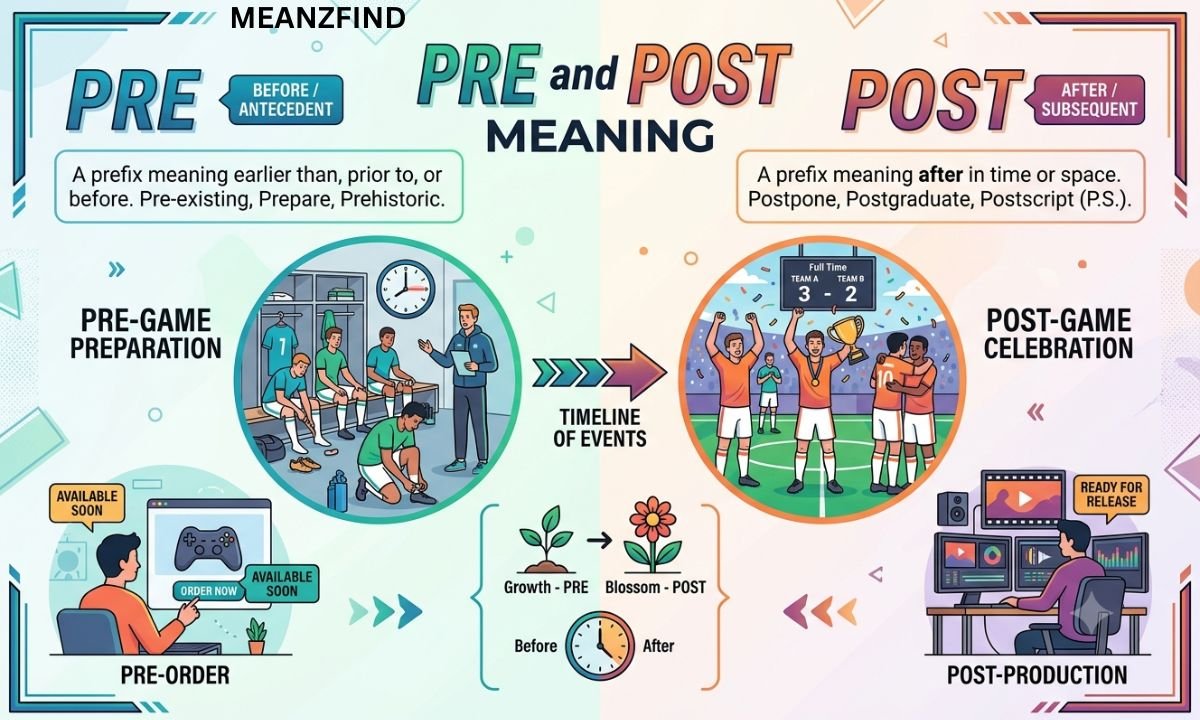
We use the words “pre” and “post” almost every day. They help us talk about time in a simple way. “Pre” means before something happens. “Post” means after something happens. These two words are actually prefixes, not full words on their own.
You will find “pre” and “post” in many common words. For example, “preview” means to see something before it happens. “Postpone” means to move something to a later time. Once you understand this simple rule, many new words become easy to figure out. This makes reading and speaking English much smoother.
In this article, we will break down the meaning of “pre” and “post” in an easy way. We will also share real examples so you can use them correctly. By the end, you will feel confident using these prefixes in daily conversations. Whether you are a student or just curious, this guide is made for you.
What Does Post Mean?
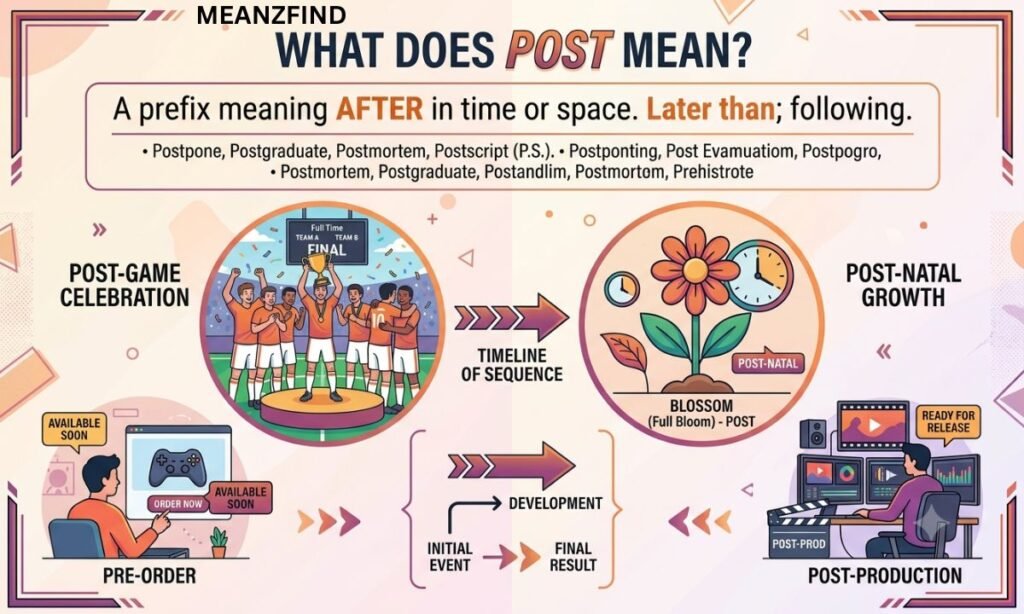
The word “post” is a small word, but it does a big job. “Post” means after something happens. It shows that one thing comes later than another thing.
We often add “post” to the front of other words. This changes the meaning slightly. It adds the idea of “coming after” to that word.
For example, “post-game” means after the game. “Post-war” means after the war ended. Once you know this rule, many words become easy to understand.
“Post” is also used as a word on its own. A “post” can mean a letter you send. It can also mean something you share online, like a photo or a message.
Importance of Pre and Post
Learning “pre” and “post” is important for clear communication. These two words help us talk about time without confusion. They tell us exactly when something happens compared to another event.
Here is why these words matter so much:
- They help in giving clear instructions
- They make reading and writing easier
- They are used in school, work, and daily life
- They appear often in medical and business language
- They help avoid mistakes in timing and planning
Without “pre” and “post,” we would need longer sentences to explain the same idea. These short prefixes save time and make speech simple. That is why they show up everywhere, from newspapers to doctor visits.
Pre and Post Meaning in Daily Life
We use “pre” and “post” more than we realize. These words fit into normal conversations without any effort. Think about your own day, and you will spot them easily.
“Pre” is used when we plan or prepare for something. It tells us that an action happens before the main event. “Post” is used when we talk about results or effects. It tells us that an action happens after the main event.
Both words help us organize our thoughts. They also help us plan our time better. This is why parents, teachers, and workers use these words so often.
Examples of Pre in Daily Life
Here are some simple examples of “pre” that we hear often:
- Pre-breakfast walk – a walk taken before eating breakfast
- Pre-departure checklist – things checked before leaving on a trip
- Pre-wedding photoshoot – photos taken before the wedding day
- Pre-order – buying something before it is officially released
- Pre-heat the oven – warming the oven before cooking
These examples show that “pre” always points backward in time. It tells us what happens first.
Examples of Post in Daily Life
Now let us look at simple examples of “post”:
- Post-dinner walk – a walk taken after dinner
- Post-holiday mood – how someone feels after a holiday ends
- Post-party cleanup – cleaning done after a party is over
- Post office – a place where letters and packages are sent
- Social media post – something shared online for others to see
These examples show that “post” always points forward in time, but only after something has already happened.
Pre and Post Meaning in Education
Schools and colleges use “pre” and “post” a lot. Teachers use these words to describe steps in learning. Students hear them almost every day without noticing.
“Pre” is used for anything that happens before a lesson or exam. “Post” is used for anything that happens after a lesson or exam. This helps teachers plan lessons in a clear order.
Here are common examples in education:
| Term | Meaning |
| Pre-school | School for children before regular schooling starts |
| Pre-test | A test taken before teaching a topic |
| Pre-requisite | Something needed before starting a course |
| Post-test | A test taken after teaching a topic |
| Post-graduate | Studies done after finishing a graduate degree |
Teachers often compare “pre-test” and “post-test” scores. This helps them see how much a student has learned. It is a simple but powerful way to measure progress.
Pre and Post Meaning in Business
Business people use “pre” and “post” to talk about plans and results. These words help in meetings, reports, and daily office talk. They also help in marketing and sales planning.
“Pre” is used when talking about steps before launching a product or starting a project. “Post” is used when talking about results after the launch or project ends.
Pre Examples
- Pre-launch marketing – advertising done before a product is released
- Pre-order sales – orders taken before the product is available
- Pre-meeting notes – notes prepared before a business meeting
- Pre-budget planning – planning money matters before making a budget
- Pre-approval – approval given before a final decision
Post Examples
- Post-launch review – checking how well a product did after release
- Post-sale service – help given to customers after they buy something
- Post-meeting report – a summary written after a meeting ends
- Post-merger changes – changes made after two companies join together
- Post-payment confirmation – a message sent after payment is received
Businesses depend on these words to track progress. Comparing “pre” and “post” data helps companies know if their plans worked well.
Pre and Post Meaning in Medicine
In medicine, “pre” and “post” are used constantly. Doctors and nurses use these words every single day. They help describe steps before and after treatment.
“Pre” refers to anything happening before a medical procedure. “Post” refers to anything happening after a medical procedure. This helps doctors keep patient care organized and safe.
Examples of Pre in Medicine
- Pre-op – before an operation or surgery
- Pre-natal care – health care given before a baby is born
- Pre-medication – medicine given before a procedure
- Pre-diagnosis – early signs checked before a full diagnosis
- Pre-surgery instructions – guidelines given before surgery
Examples of Post in Medicine
- Post-op – after an operation or surgery
- Post-natal care – health care given after a baby is born
- Post-treatment recovery – healing time after treatment ends
- Post-surgery diet – food guidelines given after surgery
- Post-vaccination effects – how the body reacts after a vaccine
Doctors often use these words with patients directly. For example, they may say, “Follow this post-op care plan carefully.” This makes instructions clear and easy to follow.
Pre and Post Meaning in Technology
Technology also uses “pre” and “post” in many ways. Software developers, gamers, and tech companies use these words often. They help explain steps in building and releasing products.
“Pre” is used for stages before a product is finished or released. “Post” is used for stages after release, especially updates and fixes.
Common examples include:
- Pre-release version – a version of software tested before the final release
- Pre-installed apps – apps already added to a device before you buy it
- Post-update bugs – problems that appear after a software update
- Post-launch support – help given to users after a product launches
- Pre-loaded software – programs added to a computer before selling it
These words help tech teams talk clearly about timelines. They also help users understand what stage a product is in.
Pre vs Post Meaning in Social Media
Social media has given new life to the word “post.” On platforms like Instagram, Facebook, and X, “post” means sharing content. It could be a photo, video, or written update.
“Pre,” on the other hand, is used to describe actions taken before sharing something. This includes editing, planning, or scheduling content.
Here is a simple comparison:
| Term | Meaning in Social Media |
| Pre-post editing | Editing a photo or video before sharing it |
| Pre-scheduled post | A post set to publish at a future time |
| Post engagement | Likes, comments, and shares after posting |
| Post analytics | Data collected after a post goes live |
| Post-worthy content | Content good enough to be shared publicly |
Social media creators often plan their “pre-post” steps carefully. This includes writing captions and choosing the right time to post. After sharing, they check “post” results like views and comments.
Pre and Post Meaning in Tagalog Sentence
In Tagalog, “pre” and “post” are often borrowed directly from English. Filipino speakers mix these words into regular Tagalog sentences. This is very common in casual conversations.
For example:
- “Pre-meeting pa lang, busy na siya.” (Even before the meeting, she was already busy.)
- “Post-exam, gusto ko nang matulog.” (After the exam, I just want to sleep.)
- “Pre-order muna tayo bago maubos ang stock.” (Let’s pre-order before the stock runs out.)
- “Post ko na lang sa social media mamaya.” (I’ll just post it on social media later.)
This mixing of English and Tagalog is called “Taglish.” It shows how flexible language can be in daily conversations. Many young Filipinos use “pre” and “post” naturally without even thinking about it.
Key Differences Between Pre and Post
Understanding the difference between these two words is simple once broken down. Here is an easy comparison table:
| Feature | Pre | Post |
| Meaning | Before | After |
| Time direction | Points backward | Points forward |
| Common use | Planning, preparation | Results, effects |
| Example word | Pre-view | Post-view |
| Medical use | Before surgery | After surgery |
| Education use | Before lesson | After lesson |
| Business use | Before launch | After launch |
The biggest difference is simple: “pre” always comes first, and “post” always comes second. Once you remember this, you will never confuse the two words again.
Pre and Post Meaning in English
In the English language, “pre” and “post” are known as prefixes. A prefix is a small part added to the beginning of a word to change its meaning. These two prefixes deal specifically with time.
“Pre” comes from an old Latin word meaning “before.” “Post” also comes from Latin, meaning “after.” English borrowed both words a long time ago and still uses them today.
They are attached to many English words, such as:
- Prepare, preview, prevent
- Postpone, postscript, post-mortem
Learning these prefixes helps students build a bigger vocabulary. Once you know “pre” means before and “post” means after, you can guess the meaning of many new words. This is a useful skill for reading and writing better English.
Common Misunderstandings About Pre and Post
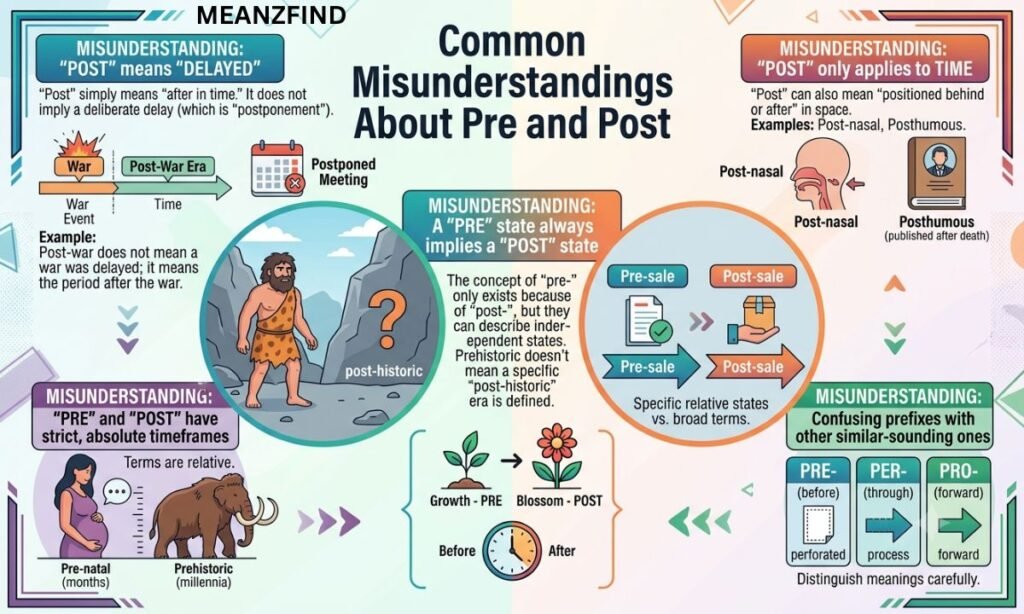
Many people mix up “pre” and “post” without realizing it. This usually happens because both words are short and look similar in writing. Let’s clear up the most common mistakes.
Mistake 1: Thinking “post” always means social media “Post” existed long before social media. It has always meant “after” in the English language. Social media just gave it a popular new use.
Mistake 2: Using “pre” and “post” interchangeably Some people use these words without thinking about actual timing. Always ask yourself: does this happen before or after the main event?
Mistake 3: Forgetting the hyphen rule Many “pre” and “post” words use a hyphen, especially with newer or less common words. For example, “pre-order” and “post-surgery” often need a hyphen for clarity.
Mistake 4: Confusing “post” as a noun and prefix “Post” as a noun can mean a job position, a pole, or an online share. As a prefix, it always means “after.” Context helps tell these apart.
Being aware of these mistakes helps you use “pre” and “post” correctly. With a little practice, these small errors disappear completely.
Pre and Post Meaning in Tagalog
In the Philippines, “pre” and “post” have become part of everyday language. Many Filipinos use these English prefixes directly in Tagalog conversations. This blending makes communication faster and more relatable for younger generations.
“Pre” in Tagalog conversations usually means the same as in English: before something happens. “Post” also keeps its English meaning: after something happens, or sharing something online.
Some common phrases include:
- “Pre-birthday celebration” – a small celebration before the actual birthday
- “Post ko sa Facebook” – I will post it on Facebook
- “Pre-flight checklist” – things to check before a flight
- “Post-storm cleanup” – cleaning done after a storm
This shows how English words can blend naturally into other languages. It also proves that “pre” and “post” are useful worldwide, not just in English-speaking countries.
What is Pre and Post Meaning?
To sum up the core idea simply: “pre” means before, and “post” means after. These two prefixes describe timing in almost every part of life. They are used in homes, schools, hospitals, offices, and even online.
Both words are short, but their impact on communication is huge. They allow us to describe events with just one small addition to a word. This makes speaking and writing faster and clearer for everyone.
Whether you are checking a “pre-flight” list or writing a “post-workout” review, these words guide your understanding of time. Once you master “pre” and “post,” you unlock the meaning of hundreds of other words too.
Final
Understanding “pre” and “post” is not hard once you know the basic rule. “Pre” always points to something before an event. “Post” always points to something after an event. This small trick can help you understand many new words. It also makes your English sound more natural and clear.
These prefixes are used in daily life, school, work, and even medical talks. You may hear words like “pre-test” or “post-test” quite often. Knowing their meaning helps you follow instructions correctly. It also helps you avoid confusion in important situations. This knowledge is truly useful for everyday communication.
We hope this guide made the meaning of “pre” and “post” simple and clear. Now you can use these words with more confidence. Try spotting them in books, news, or conversations around you. The more you notice them, the easier they become. Keep practicing, and soon it will feel like second nature.
FAQs
Does Post Mean Before or After?
“Post” means after, not before. It shows that something happens once an earlier event has already finished.
Is Post before or after?
Post always comes after. It never points to something happening earlier in time.
What does pre and post mean?
“Pre” means before an event, and “post” means after an event. Together, they help us describe the order of things clearly.
What does pre mean and post mean?
“Pre” means something happens first, before the main event. “Post” means something happens later, once the event is done.
What is pre and post example?
“Pre-wedding” means before the wedding, like a photoshoot done early. “Post-wedding” means after the wedding, like a thank-you party for guests.
Does post mean before or after?
“Post” only means after. It never describes something that happens before an event.
Is pre or post first?
“Pre” always comes first in time. “Post” always comes second, after “pre.”
Is post or pre before?
“Pre” is before, and “post” is after. They are opposite in meaning and timing.
What does pre mean?
“Pre” means before something happens. It shows preparation or action taken ahead of an event.
What does post mean?
“Post” means after something happens. It shows a result or action taken once an event is over.