

Have you ever paused mid-sentence, unsure whether to say “well deserve” or “well deserved”? You’re not alone. This is one of the most common mixups in everyday English, and even confident writers get tripped up by it sometimes.
The confusion usually happens because both phrases sound similar and are used in praise or recognition. People often say things like “a well deserve reward” when they actually mean “a well deserved reward.” Small mistake, but it changes the grammar completely.
The good news is that the rule behind this is actually quite simple once you understand it. It all comes down to how the word is used in a sentence, whether as a verb or as a descriptive word. Once you get the pattern, you’ll never mix it up again.
In this article, we’ll break down the correct usage in plain and easy language. You’ll see real examples, learn why “well deserved” is almost always the right choice, and understand exactly when to use it. By the end, you’ll be able to use it correctly without a second thought.
Understanding the Core Confusion of Well Deserve or Well Deserved
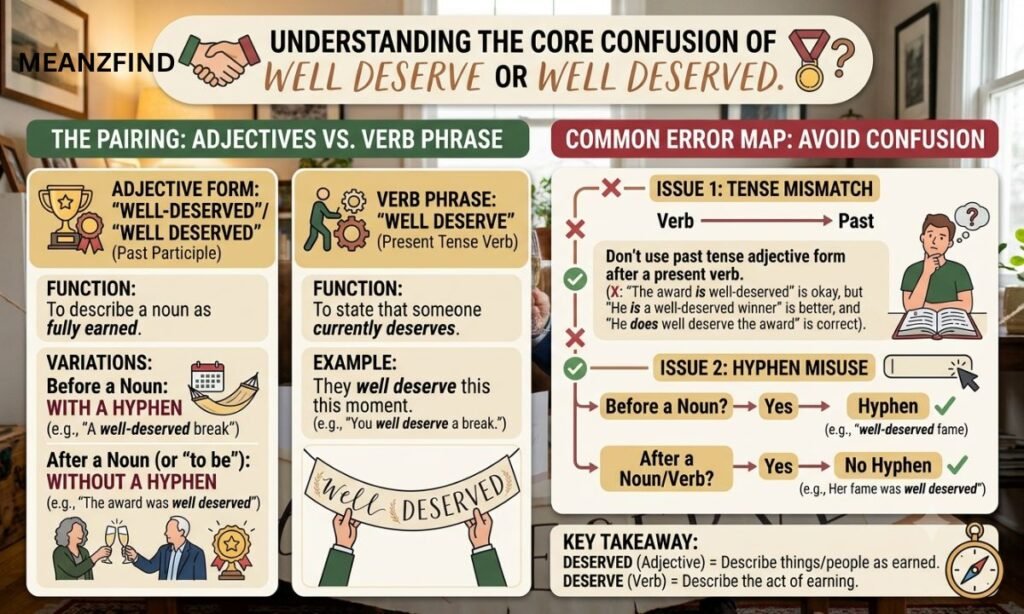
Many people get stuck between “well deserve” and “well deserved.” They look almost the same, so the mix-up feels natural. But only one of them is grammatically correct in most sentences.
The confusion happens because “deserve” is a verb, and verbs change form depending on how we use them. When we add “well” before it, the form of the verb matters a lot. This small detail changes the entire meaning of the sentence.
Most native speakers use “well deserved” without even thinking about it. Non-native speakers, however, often write “well deserve” by mistake. Once you understand the grammar rule, this mistake becomes very easy to avoid.
The Correct Phrase: Well Deserved
The correct phrase is “well deserved.” This is the standard form used in books, newspapers, and everyday speech. You will almost never see “well deserve” used correctly in a sentence.
“Well deserved” works because it uses the past participle form of the verb “deserve.” Past participles are commonly used as adjectives in English. That is exactly what happens here.
Think of other similar words like “well done,” “well known,” and “well built.” All of these use the past participle form after “well.” “Well deserved” follows the same pattern.
Well Deserved: Meaning and Usage
“Well deserved” means that someone or something has earned a reward, praise, or result through hard work or good behavior. It shows that the outcome is fair and expected. Nothing about it feels accidental or unfair.
We use “well deserved” to describe things like:
- A prize
- A promotion
- A rest
- Praise
- Success
- Punishment (in a negative sense)
This phrase always comes after a helping verb or before a noun. For example, “The award is well deserved” or “a well deserved reward.” Both forms are grammatically correct and commonly used.
Examples of Using Well Deserved in a Sentence
Seeing real examples makes any grammar rule easier to understand. Here are some simple sentences using “well deserved” correctly.
- Her promotion was well deserved after years of hard work.
- The team enjoyed a well deserved victory after a tough season.
- He took a well deserved break after finishing the project.
- The praise she received was completely well deserved.
- Winning the competition felt like a well deserved reward.
Notice how “well deserved” fits smoothly in each sentence. It can appear after “was,” “is,” or “felt,” and it can also sit directly before a noun. This flexibility makes it useful in many types of writing.
Is Well Deserve Ever Correct?
This is where most learners get confused. “Well deserve” is not grammatically correct when used in the same way as “well deserved.” You cannot say “a well deserve reward” or “the success is well deserve.”
However, “deserve” by itself is correct when used as a normal present-tense verb. For example, “You deserve a break” is correct English. The mistake only happens when people try to combine “well” with the base form “deserve” instead of “deserved.”
So remember this simple rule:
- ❌ Well deserve (Incorrect when paired with “well” as a descriptive phrase)
- ✅ Well deserved (Correct in almost every situation)
- ✅ Deserve (Correct alone, without “well” attached directly before a noun)
Well Deserved as an Adjective Phrase
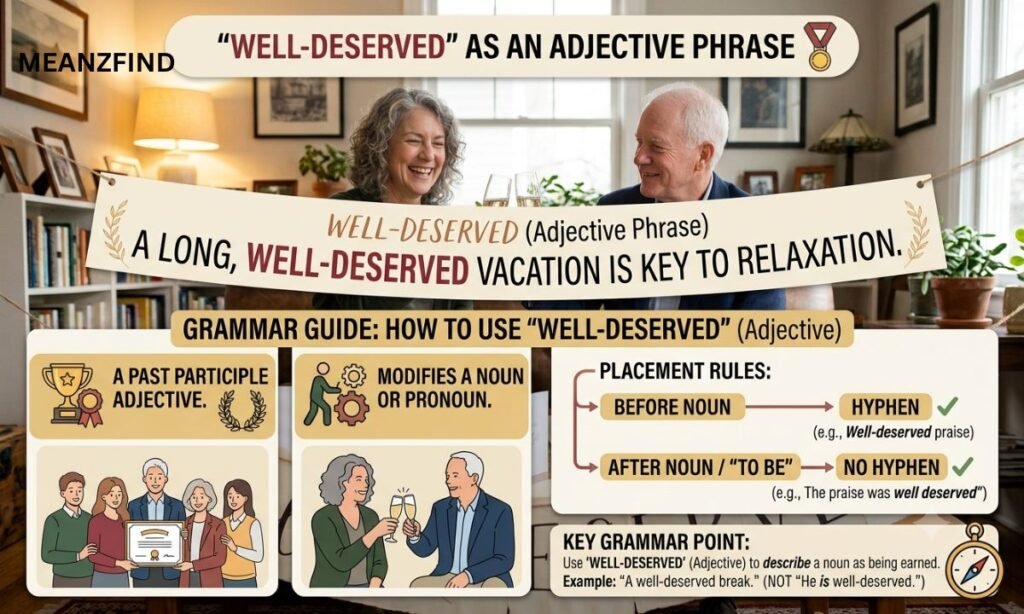
“Well deserved” acts as an adjective phrase in most sentences. Adjective phrases describe nouns and give more detail about them. In this case, it tells us that something was earned fairly.
An adjective phrase usually appears in two positions:
Before a noun: A well deserved rest.
After a linking verb: The rest was well deserved.
Both positions are correct, and native speakers use them interchangeably depending on the sentence structure. This flexibility is one reason “well deserved” appears so often in daily conversation and writing.
Well Deserved vs Well Deserve in Spoken English
In spoken English, people sometimes drop the “-ed” sound because it blends with the next word. This can make “well deserved” sound like “well deserve” when spoken quickly. However, in writing, the “-ed” must always be included.
Here is a quick comparison table to make this clearer:
| Aspect | Well Deserved | Well Deserve |
| Grammatical Correctness | Correct | Incorrect |
| Common Usage | Very common | Rarely used correctly |
| Sentence Position | Before or after noun | Not used this way |
| Spoken English | Sounds slightly shortened | Often a mistake in writing |
| Formal Writing | Always used | Never used |
This table shows why “well deserved” should always be your first choice, especially in formal or written English.
Why Native Speakers Prefer Well Deserved
Native English speakers naturally choose “well deserved” because it matches familiar grammar patterns they learned from childhood. They are used to combining “well” with past participles, so the phrase feels automatic.
Another reason is exposure. Native speakers hear and read “well deserved” repeatedly in movies, books, news articles, and daily conversations. This repeated exposure trains their brain to use the correct form without thinking.
Non-native speakers may not have this same level of exposure, which leads to more mistakes. Practicing with real sentences, like the ones in this article, helps build the same natural instinct.
Well Deserved Treat Meaning
The phrase “well deserved treat” means a small reward given to someone after hard work, patience, or good behavior. It usually refers to something enjoyable, like food, a gift, or a fun activity.
For example:
- “After a long week, she gave herself a well deserved treat.”
- “The children got a well deserved treat for finishing their homework early.”
This phrase is often used in a warm, friendly tone. It shows appreciation for effort, and people commonly use it in both casual conversations and motivational writing.
Well Deserved or Well Earned
Many people wonder if “well deserved” and “well earned” mean the same thing. They are very close in meaning, but there is a small difference between them.
| Phrase | Main Focus | Example |
| Well Deserved | Fairness and merit | A well deserved break after stress |
| Well Earned | Effort and hard work | A well earned salary increase |
“Well deserved” focuses more on fairness, while “well earned” focuses more on the effort behind the result. In many situations, though, both phrases can be used to mean nearly the same thing.
How to Remember the Difference Easily
If you struggle to remember which form to use, try these simple memory tricks. They are easy to recall, even for young learners.
- Match it with “well done.” Since “done” is a past participle, remember that “deserved” follows the same rule.
- Think of the ending “-ed” as a signal of completion. Something was earned, and it is now finished and confirmed.
- Say the sentence out loud. “Well deserved reward” sounds smooth, while “well deserve reward” sounds incomplete.
Using these small tricks repeatedly will help this rule stick in your memory permanently.
Common Mistakes to Avoid
Even careful writers sometimes slip up with this phrase. Here are the most common mistakes people make:
- Using “well deserve” instead of “well deserved” before a noun
- Forgetting the “-ed” ending in fast or casual writing
- Mixing up “deserve” and “deserved” in past-tense sentences
- Overusing “well deserved” when a simpler word like “earned” would fit better
- Placing “well deserved” incorrectly in a sentence structure
Avoiding these mistakes will instantly improve your writing and make it sound more professional and polished.
Well-Deserved Synonym
Sometimes, using different words can make your writing more interesting. Here are some common synonyms for “well deserved”:
- Earned
- Merited
- Rightful
- Justified
- Warranted
- Fitting
These words can replace “well deserved” in many sentences without changing the overall meaning. For example, “a well deserved reward” can also be written as “an earned reward” or “a rightful reward.”
Well-Deserved in a Sentence
Let’s look at a few more natural examples to strengthen your understanding. These sentences use “well-deserved” with a hyphen, which is common when it appears directly before a noun.
- She finally took a well-deserved vacation after months of stress.
- The company gave him a well-deserved bonus for his outstanding performance.
- Their well-deserved fame came after years of dedication.
- It was a well-deserved win after such a hard match.
- The teacher gave the student well-deserved recognition for her effort.
Notice how the hyphen connects “well” and “deserved” when the phrase comes directly before a noun. This is a small style choice, but many professional writers follow it for clarity.
Final Words
So, to sum it up: “well deserved” is the grammatically correct form, while “well deserve” is a common mistake. Remembering this small difference can instantly improve the way you speak and write. It’s a tiny fix that makes a big impact.
Language mistakes like this are completely normal, and almost everyone makes them at some point. What matters is learning from them and using the correct form going forward. With a little practice, this rule will become second nature to you.
Next time you want to praise someone or something, just remember to add that “-ed.” Say “well deserved success” or “well deserved rest,” and you’ll always sound clear and correct. It’s a small change, but it shows attention to detail.
Grammar doesn’t have to be complicated or stressful. Learning simple rules like this one can boost your confidence in both speaking and writing. So go ahead, use “well deserved” the right way, and wear that correct grammar like a badge of honor.
FAQs
Is It Correct to Say “well deserve” in a Sentence?
No, “well deserve” is not grammatically correct in this form. The correct phrase is always “well deserved.”
Can “well deserved” Be Used Before a Noun?
Yes, “well deserved” can be used before a noun, like “a well deserved reward.” It works perfectly as an adjective in this position.
Is it “well deserved” or “well deserve”?
“Well deserved” is the correct form to use. “Well deserve” is a common mistake and should be avoided.
Is it okay to say “well deserved”?
Yes, “well deserved” is completely correct and widely used in both spoken and written English. It sounds natural in almost every sentence.
Which is correct, “deserve” or “deserved”?
Both are correct, but they are used differently. “Deserve” is present tense, while “deserved” is past tense or used as an adjective.
Is it okay to say “congratulations, well deserved”?
Yes, this phrase is correct and commonly used to praise someone’s achievement. It means the person truly earned their success.
How to congratulate someone with “well deserved”?
You can say, “Congratulations, this success is well deserved!” This shows genuine appreciation for their hard work.
How do you say “well deserved”?
It is pronounced as “wel dih-ZURVD,” with stress on the second word. The “-ed” ending is pronounced like a soft “d” sound.