
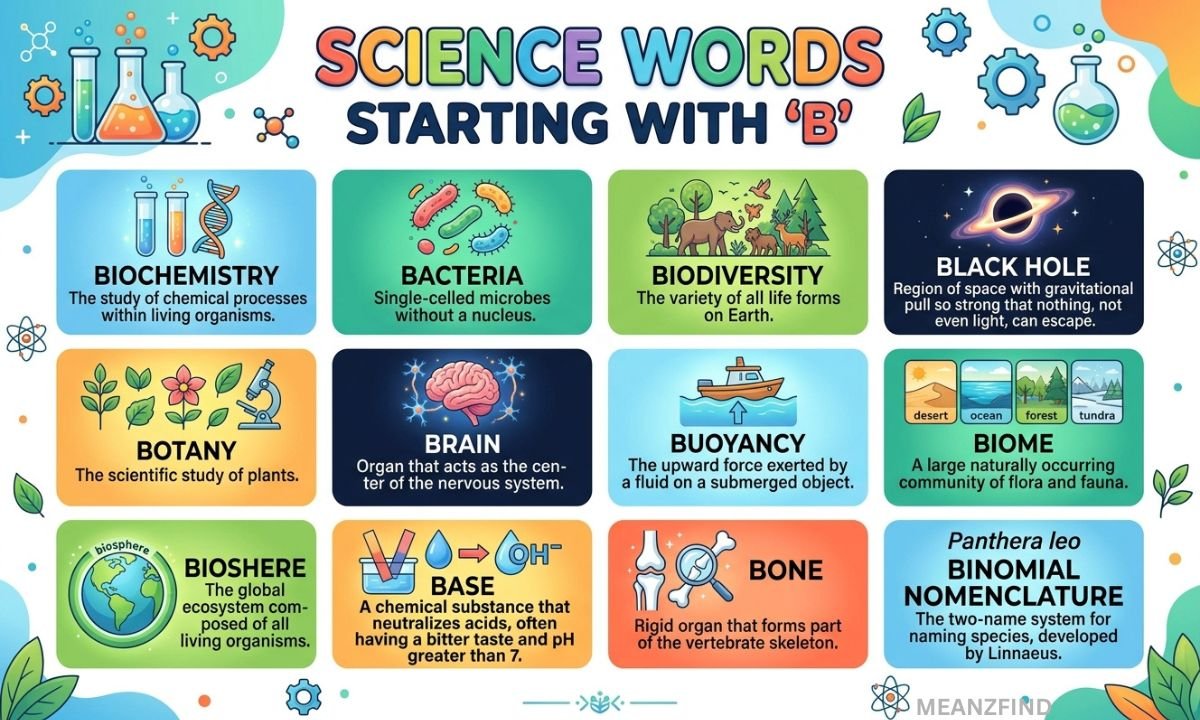
Science is full of interesting words, and many of them start with the letter B. From tiny living things to big ideas about the universe, “B” words appear in almost every science topic. Learning these words can help students understand lessons better and feel more confident in class.
This list brings together common science words that start with B, along with easy meanings. Words like biology, bacteria, and boiling point are used often in school subjects. Knowing these words makes reading science books and doing experiments much simpler.
Whether you are a student, a teacher, or just curious about science, this guide is for you. Each word is explained in simple language so it is easy to remember. By the end, you will have a clear list of “B” science words ready to use anytime.
What Are Science Words That Start With B?
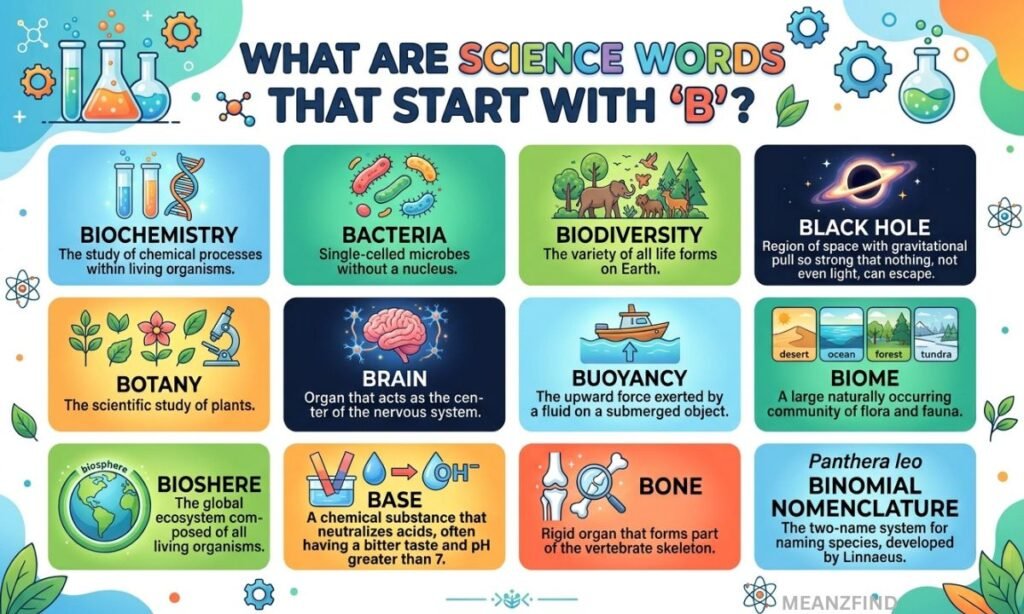
Science words that start with B are terms used in different branches of science, like biology, chemistry, physics, and earth science. These words help students describe living things, natural events, and scientific facts in a clear way.
Some B words are simple, like “boiling.” Others are a bit harder, like “biomagnetism.” This article explains all of them in easy language so every student can understand and use them with confidence.
You will find words grouped by subject, so it is easy to find what you need. Whether you are studying for a test or just curious about science, this list has you covered.
Why Learning Science Vocabulary Matters
Science vocabulary is the building block of every science lesson. Without knowing key words, it is hard to understand textbooks, follow class lectures, or answer exam questions correctly.
Here is why learning these words is important:
- It helps students read science books with better understanding.
- It builds confidence during science tests and quizzes.
- It makes science experiments easier to explain and follow.
- It prepares students for higher classes where science gets more detailed.
- It helps in everyday life, like understanding weather, health, and nature.
Once a student learns the meaning of a word, that word stays useful for years. Science vocabulary grows step by step, and letter B alone offers a huge range of useful terms.
Complete List of Science Words That Start With B
Below is a simple table with common science words starting with B, their meaning, and the branch of science they belong to. This table works as a quick reference guide.
| Word | Simple Meaning | Branch of Science |
| Biology | Study of living things | Life Science |
| Biochemistry | Study of chemicals inside living things | Life Science / Chemistry |
| Biotechnology | Using living things to make useful products | Applied Science |
| Biodiversity | Variety of living things in an area | Life Science |
| Bacteriology | Study of bacteria | Life Science |
| Behavioral Science | Study of how living things act and react | Life Science / Social Science |
| Boiling Point | Temperature where a liquid turns into gas | Physical Science |
| Biomagnetism | Magnetic fields made by living things | Physical Science / Life Science |
| Botany | Study of plants | Life Science |
| Bond Energy | Energy needed to break a chemical bond | Chemistry |
| Burning | A chemical reaction that releases heat and light | Chemistry |
| Base Pair | Two matching parts of DNA | Life Science |
| Buffer Solution | A liquid that keeps pH level steady | Chemistry |
| Biome | A large natural area with its own climate and living things | Earth Science / Life Science |
| Barometer | A tool used to measure air pressure | Earth Science |
| Bedrock | Solid rock layer under soil | Earth Science |
| Basin | A bowl-shaped area of land where water collects | Earth Science |
| Big Bang | The event believed to have started the universe | Physical Science |
| Buoyancy | The force that makes objects float in liquid | Physical Science |
| Battery | A device that stores and gives out electrical energy | Physical Science |
This list gives a quick overview, but let’s explore each area in more detail below.
Life Science Words That Start With B
Life science, also called biology, studies living things such as plants, animals, and humans. Many important B words come from this branch of science.
Biology
Biology is the study of all living things. It looks at how plants, animals, and humans grow, survive, and reproduce.
Biology helps us understand our own bodies too. From blood cells to bones, biology explains how life works at every level.
Biochemistry
Biochemistry studies the chemical processes that happen inside living things. It explains how food turns into energy inside our bodies.
This branch connects biology and chemistry together. Every heartbeat and breath involves biochemistry working behind the scenes.
Biotechnology
Biotechnology uses living things, like bacteria or plants, to create useful products. Medicines, vaccines, and even some foods are made using biotechnology.
This branch of science solves real-world problems. Scientists use biotechnology to grow better crops and treat diseases.
Biodiversity
Biodiversity means the variety of living things found in one place. A rainforest, for example, has very high biodiversity because so many species live there.
High biodiversity keeps nature balanced and healthy. Protecting biodiversity is important for the future of our planet.
Bacteriology
Bacteriology is the study of bacteria, which are tiny living organisms. Some bacteria are helpful, while others can cause sickness.
Scientists who study bacteria are called bacteriologists. Their work helps doctors understand and fight infections.
Behavioral Science
Behavioral science studies how living things behave and why they act certain ways. It looks at animal habits as well as human actions.
This field mixes biology with psychology. It helps explain things like why birds migrate or why people form habits.
Botany
Botany is the science of plants. It studies how plants grow, make food, and survive in different environments.
Botanists study everything from tiny mosses to giant trees. Botany also helps farmers grow healthier crops.
Base Pair
A base pair is two matching parts inside DNA that hold genetic information together. Base pairs are like the rungs of a ladder inside our cells.
Every living thing has base pairs in its DNA. They carry the instructions that make each creature unique.
Biome
A biome is a large area of land with its own climate, plants, and animals. Deserts, forests, and grasslands are all examples of biomes.
Each biome has living things adapted to survive there. Studying biomes helps scientists understand how climate affects life.
Earth Science Words That Start With B
Earth science studies our planet, including rocks, weather, oceans, and space. Several useful B words belong to this branch.
Barometer
A barometer is a tool used to measure air pressure. Weather scientists use barometers to predict rain, storms, or sunny days.
When air pressure drops quickly, it often means a storm is coming. Barometers have been used for centuries to study weather patterns.
Bedrock
Bedrock is the solid rock layer found beneath soil and loose rock. It forms the base of the Earth’s surface almost everywhere.
Bedrock supports the weight of mountains and buildings. It also plays a big role in how landforms are shaped over time.
Basin
A basin is a low area of land where water collects and flows together. Rivers often begin high in the mountains and end in a basin.
River basins support farming and wildlife. They also help scientists track how water moves across the Earth.
Biome (Earth Science View)
While biome is studied in life science, it is also an earth science topic because climate shapes it. Rainfall, temperature, and location decide what kind of biome forms in an area.
Earth scientists study biomes to understand global climate patterns. This connects weather, land, and living things together.
Big Bang
The Big Bang is the scientific idea that explains how the universe began. Scientists believe the universe started from a single point and has been expanding ever since.
This theory helps explain why stars and galaxies are moving apart. It is one of the biggest ideas in all of science.
Physical Science Words That Start With B
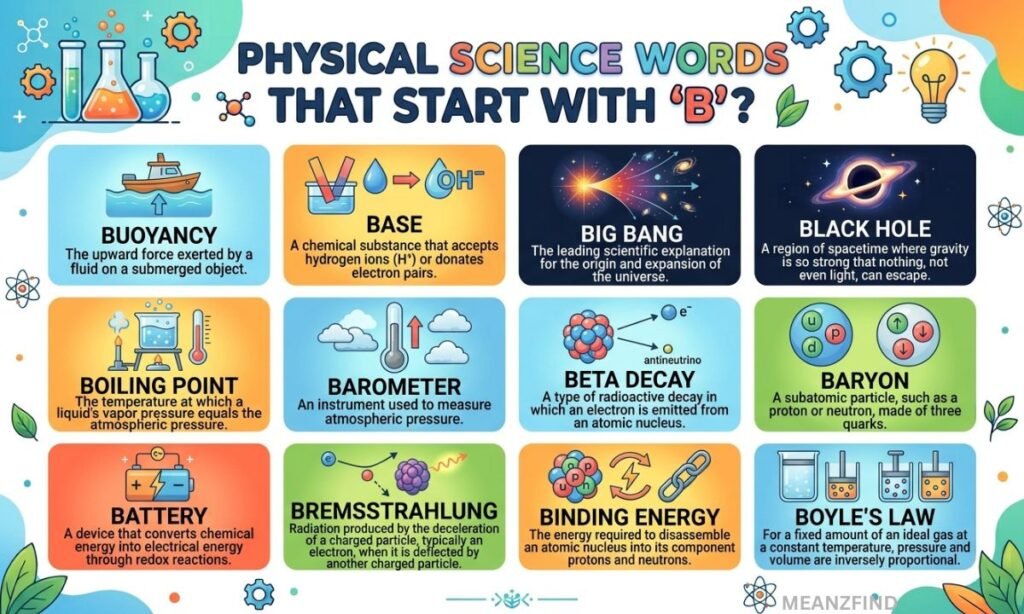
Physical science includes physics and chemistry. It studies matter, energy, forces, and how things react with each other.
Boiling Point
Boiling point is the temperature at which a liquid changes into a gas. Water, for example, boils at 100 degrees Celsius at sea level.
Every liquid has its own boiling point. This concept is used in cooking, science experiments, and even weather studies.
Biomagnetism
Biomagnetism is the study of magnetic fields created by living things. Even the human brain and heart produce very tiny magnetic signals.
Doctors use biomagnetism to study brain activity without surgery. This field mixes biology and physics in an interesting way.
Bond Energy
Bond energy is the amount of energy needed to break a chemical bond between atoms. Strong bonds need more energy to break than weak ones.
Understanding bond energy helps scientists predict how chemicals react. It plays a big role in chemistry experiments and industries.
Burning
Burning is a chemical reaction where a substance combines with oxygen to release heat and light. This process is also called combustion.
Wood burning in a fire is a common example. Burning always needs fuel, oxygen, and heat to continue.
Buffer Solution
A buffer solution is a special liquid that keeps its pH level steady, even when small amounts of acid or base are added. It resists sudden changes in acidity.
Buffer solutions are important in labs, medicine, and even inside our blood. Our body uses natural buffers to stay healthy.
Buoyancy
Buoyancy is the force that pushes objects upward in a liquid or gas. It is the reason boats float on water.
An object floats when buoyancy is stronger than gravity. This idea explains why heavy ships can still stay on the surface of the ocean.
Battery
A battery is a device that stores chemical energy and turns it into electrical energy. It powers phones, toys, cars, and many other devices.
Batteries work through a chemical reaction inside them. Without batteries, many everyday devices would not function.
Science Words That Start With B for 5th Grade
Younger students need simple and clear science words. Below is a list perfect for 5th-grade learners.
- Bacteria – Tiny living things too small to see without a microscope
- Boil – To heat a liquid until it turns into gas
- Body – The physical structure of a living thing
- Blood – The red liquid that flows through our body and carries oxygen
- Bone – Hard parts inside the body that support and protect it
- Breathing – The process of taking in air and letting it out
- Bud – A small part of a plant that grows into a leaf or flower
- Biosphere – The part of Earth where living things exist
These words are the foundation for future science learning. They connect to daily life, making them easy to remember.
Science Words That Start With B for 6th Grade
By 6th grade, students are ready for slightly more detailed science words. Here is a helpful list.
- Biodiversity – Variety of living things in one place
- Biome – A large natural region with its own climate and life
- Boiling Point – Temperature where liquid becomes gas
- Buoyancy – Force that helps objects float
- Base – A substance that reacts with acids and has a pH above 7
- Barometer – Tool that measures air pressure
- Bond – A connection between atoms in a molecule
- Biosphere – Earth’s zone that supports life
At this stage, students start connecting science words to real experiments and lab work. This builds a stronger science foundation.
Science Words That Start With B for 8th Grade
By 8th grade, science vocabulary becomes more advanced. Students explore deeper ideas in biology, chemistry, and physics.
- Biotechnology – Using living things to create useful products
- Biochemistry – Study of chemical processes in living things
- Bacteriology – Study of bacteria
- Bond Energy – Energy needed to break a chemical bond
- Buffer Solution – Liquid that keeps pH steady
- Base Pair – Matching parts of DNA
- Behavioral Science – Study of actions and reactions of living things
- Big Bang Theory – Scientific idea about how the universe began
These words prepare students for high school science classes. They also help build strong critical thinking skills.
Comparison Table: Life Science vs Earth Science vs Physical Science B Words
| Category | Example Words | Focus Area |
| Life Science | Biology, Botany, Bacteriology, Base Pair, Biodiversity | Living things and their processes |
| Earth Science | Barometer, Bedrock, Basin, Big Bang, Biome | Earth, weather, and space |
| Physical Science | Boiling Point, Bond Energy, Buoyancy, Battery, Burning | Matter, energy, and chemical reactions |
This table makes it easy to see how B words are spread across different science fields. It also helps students quickly find the right word for their subject.
Easy Tips to Remember Science Words Starting With B
Learning new words becomes easier with simple tricks. Try these tips to remember B science words faster.
- Group words by subject – Study biology words together, then move to physics or earth science words.
- Use flashcards – Write the word on one side and the meaning on the other side.
- Make simple sentences – Use each word in a sentence to understand it better.
- Connect words to real life – Think of boiling water or a battery in a toy to remember meanings.
- Practice with quizzes – Test yourself often to check how many words you remember.
- Draw pictures – Simple drawings can help explain hard words like biome or buoyancy.
These small steps make science vocabulary much easier to master. Over time, these words will feel natural to use.
How Teachers Can Use This B Words List
Teachers can turn this list into fun classroom activities. Simple games make learning science vocabulary enjoyable for students.
- Create a spelling bee using science words that start with B.
- Ask students to match words with their meanings.
- Use flashcards for quick vocabulary quizzes.
- Assign short projects, like explaining “biodiversity” with pictures.
- Create crossword puzzles using this word list.
FINAL WORDS
Science words that start with B cover a huge part of what we learn in school. From tiny bacteria to big ideas like biodiversity, these words show up again and again in books and lessons. Knowing them well makes science feel less confusing and more fun.
This list was made to help students learn in a simple way. Instead of hard definitions, each word was explained using easy sentences. This makes it easier to remember and use the words correctly in class or homework.
Learning new words takes practice, so don’t worry if some feel new at first. Try using each word in your own sentence to understand it better. The more you practice, the more natural these science words will feel.
Teachers and parents can also use this list as a simple teaching tool. It works well for quizzes, spelling practice, or quick revision before exams. A short list like this can save time while still covering important topics.
In the end, learning science words starting with B is a small step that brings big results. These words build a strong base for future science lessons. Keep this list handy, revisit it often, and watch your science vocabulary grow with ease.
FAQs
What are 50 science words?
Fifty science words are a mix of common terms like atom, cell, energy, gravity, and force used across biology, chemistry, and physics. They cover basic ideas taught from primary school through high school science classes.
What are 10 science words?
Ten common science words include matter, energy, cell, atom, force, gravity, mass, molecule, reaction, and organism. These are among the most frequently used terms in early science education.
What are some words for science?
Common words linked to science include experiment, hypothesis, theory, research, and observation. These terms describe how scientists study and explain the natural world.
What are scientific words A to Z?
Scientific words A to Z include terms like atom, biology, cell, DNA, energy, force, gravity, and so on through zoology. Each letter connects to important ideas across different branches of science.
What are 15 fields of science?
Fifteen fields of science include biology, chemistry, physics, astronomy, geology, ecology, botany, zoology, genetics, meteorology, oceanography, physiology, microbiology, anatomy, and psychology. Each field studies a different part of nature or life.
What are 10 examples of science?
Ten examples of science include biology, chemistry, physics, astronomy, geology, botany, zoology, ecology, genetics, and meteorology. Each one focuses on a specific area, like living things, matter, or the environment.
What is science A to Z?
Science A to Z refers to organizing scientific topics and vocabulary alphabetically, from astronomy to zoology. It helps students explore science subjects in a structured, easy-to-follow order.
What is a hard science word?
A hard science word is a term that is complex or technical, like biomagnetism, photosynthesis, or thermodynamics. These words often need extra explanation because they describe advanced scientific ideas.
What is a bigger word for science?
A bigger or more formal word for science can be “natural philosophy” in older texts or simply “the sciences” when referring to multiple fields together. Academic writing sometimes uses “scientific study” as an alternative phrase.
What are 20 branches of science?
Twenty branches of science include biology, chemistry, physics, astronomy, geology, ecology, botany, zoology, genetics, microbiology, meteorology, oceanography, physiology, anatomy, psychology, sociology, biochemistry, biotechnology, immunology, and neuroscience. Together, they cover living things, matter, energy, Earth, and behavior.
What are the 50 types of scientists?
Fifty types of scientists include biologists, chemists, physicists, astronomers, geologists, botanists, zoologists, ecologists, microbiologists, and meteorologists, among many others. Each scientist specializes in studying a specific part of nature, life, or the universe.
What are the ABCs of science?
The ABCs of science refer to basic scientific concepts organized by letter, like atom, biology, and cell for the early alphabet. This method helps young learners build science vocabulary step by step.