

You see “TTY” in a text and wonder what it means. You are not alone. TTY meaning is simple. It stands for “talk to you.” People use it to say they will speak with someone soon. It is often a short way to end a chat. Many people also use it as a short form of TTYL, which means “talk to you later.”
You can find TTY on text messages, Snapchat, Instagram, and TikTok. It is quick and casual. Friends use it when they are busy or about to leave. It sounds friendly and light. In this guide, you will learn the full form, how people use it, and how to reply the right way.
What Does TTY Mean?
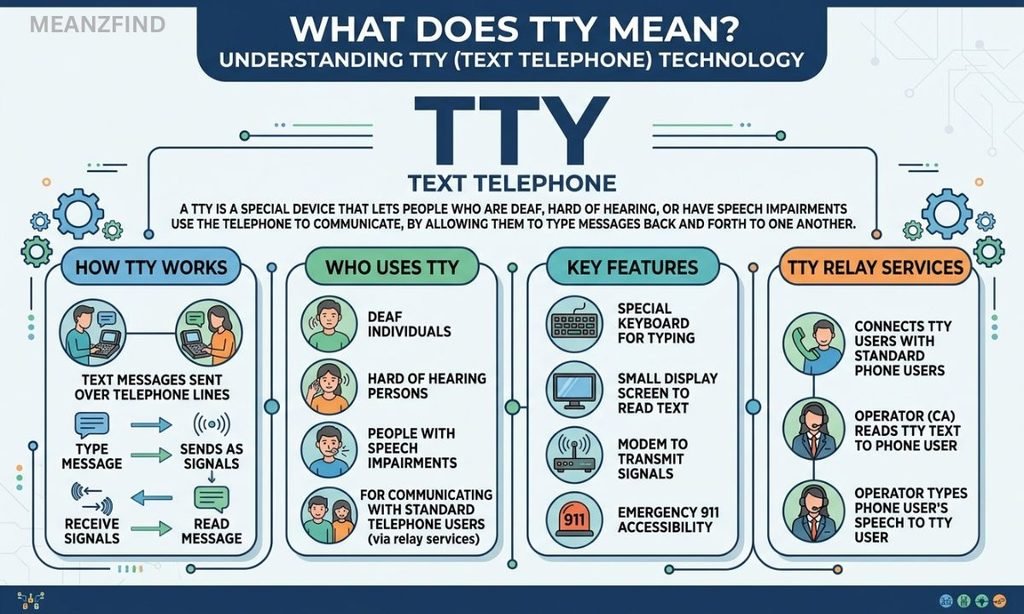
TTY can mean two very different things. In the world of phones and accessibility, TTY stands for teletypewriter. It is a device that lets people type messages over a phone line. In texting and social media, TTY usually means “talk to you.”
So the right answer depends on where you see it. A deaf person calling a doctor uses the first meaning. A teenager ending a chat on Snapchat uses the second. This guide explains both, step by step, in plain words.
Quick answer:
- Phone or accessibility meaning: TTY = teletypewriter, a text telephone for people who are deaf, hard of hearing, or have speech difficulties.
- Text slang meaning: TTY = “talk to you,” often a short form of TTYL (“talk to you later”).
- Computer meaning: TTY = a terminal, the text window used on Linux and Unix systems.
What Is a TTY Device?
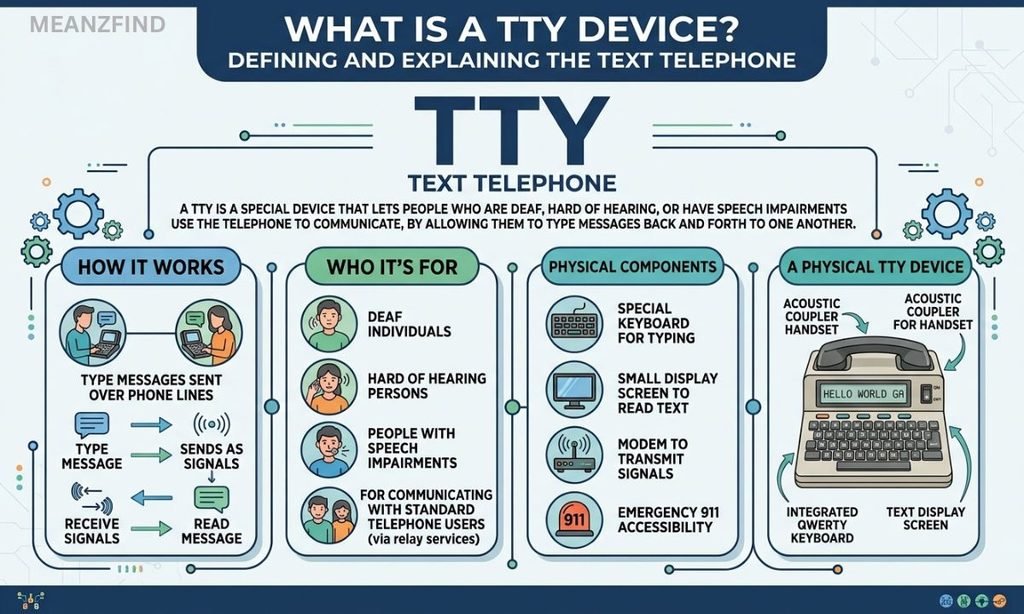
A TTY device is a machine with a keyboard and a small screen. You type a message, and the other person reads it on their own TTY. It sends text through a normal phone line instead of voice.
People use a TTY when speaking or hearing on the phone is hard. It gave deaf and hard of hearing people a way to make phone calls long before smartphones existed.
The word “TTY” comes from “teletype,” an old machine that sent typed messages over wires.
TTY vs TDD: Are They the Same Thing?
Mostly, yes. TDD means telecommunications device for the deaf. TTY means teletypewriter. Both names point to the same kind of text phone.
Many deaf people prefer “TTY” today. They say “TDD” focuses on deafness only, while a TTY also helps people with speech disabilities. In the United States, laws and phone companies mostly use the word TTY.
| Term | Full Form | Meaning |
| TTY | Teletypewriter | Text telephone device |
| TDD | Telecommunications Device for the Deaf | Older name for the same device |
| Text telephone | Plain-English name | Same device, simple wording |
The History of TTY Technology

The story starts in the 1960s. A deaf scientist named Robert Weitbrecht built a device that turned typed letters into sound tones. His invention, called an acoustic coupler, let old teleprinters talk over a phone line. A deaf orthodontist named James Marsters and a deaf engineer named Andrew Saks helped bring the idea to life.
The first deaf-to-deaf phone call using this system happened in the mid 1960s. After that, the network grew. Phone companies, schools, and deaf clubs began to use TTYs.
In the 1970s and 1980s, smaller and cheaper TTYs arrived with built-in screens. Then relay services started, and hearing people could finally call deaf people through a helper. Later, laws like the Americans with Disabilities Act (ADA) pushed phone networks to support text calling.
Today, the internet has replaced most old TTY machines. But the idea lives on in phone settings and in newer tools like RTT.
How Does TTY Work?
A TTY turns each letter you type into a pair of sound tones. The phone line carries those tones. The TTY on the other end hears the tones and turns them back into letters on the screen.
Here is the simple flow:
- You type a letter.
- Your TTY changes it into tones.
- The tones travel through the phone line.
- The other TTY reads the tones.
- The letter shows up on their screen.
Both sides must use a TTY, or the call must go through a relay service. A normal phone cannot read these tones by itself.
The Parts of a TTY Machine
- Keyboard: You type your message here.
- Display screen: Shows what you and the other person type. Some older models print on paper.
- Modem: The part that turns letters into tones and back.
- Acoustic coupler or phone jack: Connects the TTY to a phone. Older models use two rubber cups that hold a phone handset. Newer ones plug straight into a line.
- Power source: A plug or batteries.
Baudot Code, ASCII and 45.5 Baud
TTYs use special codes to turn letters into signals. The oldest and most common is Baudot code. It runs at 45.5 baud, which means about 45 signals every second. It is slow, but it works well on weak phone lines.
Some TTYs also support ASCII, the same code that computers use. ASCII runs faster, at 110 or 300 baud. But the two codes do not match. A Baudot TTY cannot talk to an ASCII-only TTY.
| Code | Speed | Notes |
| Baudot | 45.5 baud | Most common in the US |
| ASCII | 110 or 300 baud | Faster, less common |
Turbo Code and Auto ID
Turbo Code is a feature on some TTYs that lets two machines type faster than normal. It works only if both machines support it. It can also let one person interrupt the other, which makes talking feel more natural.
Auto ID helps a TTY figure out which code the other machine uses. If the two machines do not match, Auto ID fixes the problem so the call can still work.
GA and SK: TTY Etiquette
TTY calls have their own manners. Because the line works one side at a time, people use short codes to show who should type next.
- GA means Go Ahead. It says, “I am done, your turn.”
- SK means Stop Keying. It says, “I am done with this call.” You may see GA to SK at the end.
- Q or ? shows a question.
- XXX means “Sorry, I made a mistake.”
- HD means “Hold.”
A TTY call might start like this: “HELLO GA” and end with “BYE SKSK.”
Why Turn-Taking Slows Things Down
On a basic TTY, both people cannot type at the same time. If both type at once, the letters mix up and become unreadable. That is why GA exists.
This turn-taking makes a call slower than a voice call. A one-minute chat by voice can take five minutes on a TTY. It also stops people from jumping in with quick questions. Modern tools like RTT fix this problem.
What Is a TTY Number?
A TTY number is a phone number that a TTY can call. Businesses, schools, hospitals, and government offices often list one next to their voice number. You may see it written as “TTY: 1-800-XXX-XXXX.”
Some places use one number for both voice and TTY. Others have a separate TTY line. If you do not see one, you can use the relay service to call a normal number.
TTY Relay Services and 711
A TTY relay service is a free service that connects deaf or hard of hearing people with hearing people. A trained helper, called a communications assistant, sits in the middle. The assistant types what the hearing person says and speaks what the TTY user types.
In the United States, you can reach the relay service by dialing 711. It works much like 911 or 411. It is free, and it is available all day, every day.
How a TTY Relay Call Works
- The TTY user dials 711 or a relay number.
- The relay assistant answers and asks for the number to call.
- The assistant calls the hearing person.
- The hearing person talks. The assistant types it.
- The TTY user reads the message and types a reply.
- The assistant reads the reply out loud.
The assistant keeps the call private. The assistant does not change or add anything.
How to Use 711 in the United States
- Pick up your phone or TTY.
- Dial 711.
- Tell the assistant the number you want to reach.
- Type or speak, based on your setup.
- Say GA when you finish a turn.
If you want to call someone from a regular phone who uses a TTY, you can also dial 711 and ask to reach them.
What Is TTY Mode on a Phone?
TTY mode is a setting on your phone. It lets the phone work with a TTY device, or lets you use text-based calling features. Turning it on changes how the phone sends and receives sound.
Most people who see this setting never need it. It is made for people who plug a TTY into their phone or use software that works like one.
TTY Modes Explained
| Mode | What It Does | Who It Helps |
| TTY Off | Normal phone use | Most people |
| TTY Full | You type and read all text | Deaf or hard of hearing users who cannot speak or hear |
| TTY HCO (Hearing Carry Over) | You listen by voice but type your reply | Users who can hear but have trouble speaking |
| TTY VCO (Voice Carry Over) | You speak but read the reply as text | Users who can speak but have trouble hearing |
Why Does My Phone Have a TTY Option?
Phone makers must support accessible calling. That is why the TTY option sits in the settings of almost every smartphone. It is there in case someone needs it. It does not mean something is wrong with your phone.
TTY Meaning on Android and iPhone
On both Android and iPhone, TTY refers to this accessibility feature. It is not slang here. It lets your phone talk with a TTY machine or use text-based calling.
How to Turn TTY Mode On or Off
On iPhone
- Open Settings.
- Tap Accessibility.
- Tap RTT/TTY.
- Turn Software RTT/TTY on or off. If you use a physical TTY device, turn on Hardware TTY.
Menu names can change slightly with each update.
On Android
- Open the Phone app.
- Tap the three dots, then Settings.
- Tap Accessibility.
- Tap TTY mode.
- Pick TTY Off, TTY Full, TTY HCO, or TTY VCO.
On some phones, the path is Settings, then Calls, then Accessibility. Brands like Samsung and Google use slightly different menus.
Should TTY Be On or Off?
For most people, TTY should be off. If it is on and you do not use a TTY, calls can sound strange. You may hear static or beeps, or the other person may sound garbled.
Turn it on only if you use a TTY device or need the setting for text calling.
Can I Use TTY Without a TTY Device?
Yes, in some ways. Many phones now support software TTY, so you can type during a call without extra hardware. You can also use RTT, which needs no separate machine. And relay services let you place a call using only your phone or computer.
Common Problems with TTY Mode and How to Fix Them
| Problem | Likely Cause | Fix |
| Calls sound like beeping or static | TTY mode is on by mistake | Turn TTY off |
| TTY text looks like random letters | Code or speed mismatch | Check Baudot or ASCII settings |
| Cannot connect | Wrong mode or poor line | Try another mode; test with 711 |
| Phone will not recognize the TTY | Wrong cable or adapter | Use the right adapter; turn on hardware TTY |
| Missing letters | Weak signal or low volume | Move to a better signal; raise volume |
Is TTY Safe to Use?
Yes. TTY is safe. It is only a way to send text through a phone line. It has no special risk. As with any call, keep private details to yourself unless you trust the person. Relay assistants are bound by strict privacy rules and may not share your call.
Who Uses TTY
- People who are deaf or hard of hearing
- People with speech disabilities
- Deaf-blind users, with braille displays
- Relay assistants
- Public offices, hospitals, and emergency centers that serve those groups
Where Is TTY Commonly Used?
You may find TTY lines in 911 centers, hospitals, banks, government offices, airlines, schools, and universities. Many customer service numbers include one.
Benefits of Using TTY
- Works on regular phone lines.
- Does not need internet.
- Works during power cuts when you use a battery model.
- Relay services make it simple to call anyone.
- Gives a written record of the call.
- Works with emergency services.
Limitations of TTY
- It is slow.
- Turn-taking makes it feel stiff.
- Both sides need compatible machines or a relay.
- Old machines are hard to buy and fix.
- No emotion or tone, only plain text.
- Static can break messages.
TTY vs RTT
RTT means real-time text. You see each letter the moment the other person types it. No GA or SK is needed. Both people can type at once.
| Feature | TTY | RTT |
| Speed | Slow, turn-based | Fast, live |
| Type at same time | No | Yes |
| Needs special hardware | Often yes | No |
| Runs over | Phone line | Modern phone networks |
| Works with 911 | Yes | Yes, on supported networks |
What Replaced Traditional TTY Devices?
Smartphones, apps, video calling, and RTT replaced most old machines. Texting, email, and chat apps did the rest. Many deaf people now choose video relay because sign language is faster than typing.
TTY vs TDD vs RTT vs VRS vs IP CTS
| Tool | Full Name | How It Works | Best For |
| TTY | Teletypewriter | Types over a phone line | Basic text calls |
| TDD | Telecommunications Device for the Deaf | Older name for TTY | Same as TTY |
| RTT | Real-Time Text | Live typing on a smartphone | Fast text calls |
| VRS | Video Relay Service | Sign language via video and an interpreter | Deaf signers |
| IP CTS | Internet Protocol Captioned Telephone Service | Shows captions of what the other person says | People who can speak but have hearing loss |
Is TTY Still Used Today?
Yes, but less than before. Some older users still prefer it. Emergency centers, relay services, and public offices keep support in place. Many phones also keep TTY settings for those who need them.
TTY and the Future of Accessible Communication
The future belongs to faster tools. RTT, captioned calls, video relay, and smart text tools are growing quickly. Better captions also help. Still, TTY gave the world a base to build on. Its lessons about access and fairness still guide new technology.
Why TTY Matters: The ADA, the FCC and Everyday Life
The ADA, passed in 1990, says phone companies must offer relay services. The FCC sets rules for how those services work and helps pay for them. Because of these laws, a deaf person can call a pizza shop, a doctor, or a boss in the same way a hearing person does.
In daily life, this means independence. People can book appointments, call family, and ask for help without a friend or helper.
Case Study: The Clinic That Learned to Stay on the Line
A small clinic once got a call through 711. The relay assistant said, “I have a caller who wants to book a check-up.” The front desk worker felt unsure and hung up.
The next week, the clinic held a short training. Staff learned that relay calls are normal, that pauses are expected, and that they should talk directly to the caller. They learned to say “GA” when they finished a thought.
Soon the clinic had more deaf patients. One caller said it was the first time a clinic had treated her call as a real call. The lesson is simple: stay on the line, be patient, and speak to the person, not the assistant.
Business Checklist for TTY Readiness
- List a TTY number or tell people they can reach you through 711.
- Train staff to accept relay calls and never hang up.
- Teach staff the basics: GA, SK, and turn-taking.
- Offer text, chat, or email options too.
- Test your TTY line once a month.
- Keep contact details current on your website.
- Support RTT and video relay when you can.
- Be patient with slower calls.
Interesting Facts About TTY
- The first TTYs were old military teleprinters that were no longer needed.
- A TTY call is silent. The room is quiet while the screen shows the talk.
- Deaf users often use a flashing light to tell them the phone is ringing.
- Many early TTY users learned the codes GA and SK long before texting existed.
- Modern “texting” owes a lot to the same idea: send letters, not voice.
What Does TTY Mean in Linux?
In Linux and Unix, TTY means teletype terminal. It is the text window where you type commands. The name comes from the old days, when users typed on real teletype machines.
On a computer, you may see names like tty1, tty2, or /dev/tty. Each one is a separate terminal. You can type the command tty in a terminal, and it shows the name of the terminal you are using.
| Term | Meaning |
| TTY | A terminal for typing commands |
| tty1 to tty6 | Text consoles on many Linux systems |
| pts | A pseudo terminal, like a window inside the desktop |
Most Common TTY Meaning in Text
In texting, TTY means “talk to you.” It is a short, friendly phrase. People use it when they plan to chat with someone soon, or when they want to start a conversation.
Common TTY Meaning
The most common meaning is “talk to you.” It is often used as a short form of TTYL, which means “talk to you later.” Example: “Got to go, TTY!”
Less Common TTY Meaning
Sometimes TTY means “text to you.” This is used when someone plans to send a message. Example: “I will TTY once I land.”
Rare TTY Meaning
In rare cases, people use TTY as a typo for another short word, like “thank you.” You can often tell from the rest of the message. If the sentence makes no sense with “talk to you,” it may be a typo.
Psychological and Emotional Meaning of TTY
TTY often feels calm and kind. It tells the other person, “I care about this chat, and I will be back.” It can bring a small feeling of comfort. But short messages can also feel cold if they come with no other warm words.
Communication Function of TTY
TTY does a few jobs in a chat:
- It ends a chat in a polite way.
- It promises a future talk.
- It starts a call or message.
- It saves time because it is short.
Cultural and Generational Context of TTY
TTY grew from early text messages, when each letter cost money and phones had small keyboards. People cut long phrases into short ones. Today, it stays popular because fast chatting never went out of style.
TTY Meaning in Different Age Groups
| Age Group | How They Use TTY |
| Teens | Casual, often in group chats and on Snapchat |
| Young adults | Quick sign-offs with friends and partners |
| Adults | Rare; they often write TTYL or the full words |
| Older adults | May not know it; may link it to TTY phones |
Semantic Core Meaning of TTY
At its core, TTY is about contact. It means “I want to talk with you.” Everything else, like tone and timing, comes from the chat around it.
Most Common TTY Meaning in Text (Deep Dive)
What It Means
It means “talk to you.” Some people read it as a present wish: “I want to talk to you now.” Others read it as a goodbye: “I will talk to you again.”
Typical Use Cases
- Saying goodbye before you leave a chat.
- Asking someone to call or message you.
- Setting up a talk for later.
- Ending a busy conversation politely.
Examples in Different Tones
| Tone | Example |
| Warm | “Love this! TTY soon.” |
| Neutral | “I’m at work. TTY.” |
| Excited | “OMG, TTY right after class!” |
| Rushed | “Gotta run, TTY” |
| Dry | “TTY.” |
What It Can Sound Like
TTY can sound friendly, busy, or short. It depends on the words around it and on the person using it.
Meaning Based on Context
Positive Use
“That was fun! TTY tonight.” Here it sounds warm and happy.
Neutral Use
“Driving now, TTY later.” It just gives information.
Negative or Critical Use
“I have nothing more to say. TTY.” It can sound cold when used to end an argument.
Dry or Rushed Use
A lone “TTY.” with a period can feel flat. The person may be busy, tired, or in a hurry.
How TTY Is Actually Used in Real Conversations
Understanding or Clarifying
If you are unsure, ask: “TTY as in talk to you?” A quick check can save a mix-up.
Reacting or Labeling
Someone may reply to a message with “TTY,” meaning, “Let’s talk about this.”
Social or Dating Context
In dating chats, “TTY tonight” can mean “I look forward to chatting with you.” It can feel sweet, but it is not always romantic. Look at the rest of the chat.
Group or Online Context
In group chats, TTY often means “I will message you privately” or “I will talk to you all later.”
Gaming Context
Gamers use TTY to say, “I will talk to you in the next match.” It may also mean “talk to you on voice chat.”
Social Interpretation of TTY
People read short messages in many ways. Some read TTY as kind. Others read it as quick or cold. The best way to read it is to check the person, the timing, and the tone.
Case Study: The Group Chat Misread
Maya sent a long message to her group chat about a school project. Her friend Zoya replied with one word: “TTY.”
Maya felt hurt. She thought Zoya did not care. She stayed upset for an hour.
Later, Zoya called her. “I was on the bus and wanted to talk to you. TTY means I was going to call you!” Maya laughed with relief.
The lesson is clear: a short message is not always a cold one. When unsure, ask a simple question before you guess.
TTY Meaning on Different Platforms
| Platform | Typical Meaning | Tone |
| Snapchat | Talk to you (soon) | Casual, quick |
| TikTok | Talk to you; sometimes in comments | Friendly |
| Talk to you in DMs | Casual | |
| Texting | Talk to you | Neutral |
| Discord | Talk to you in voice chat | Casual |
TTY Meaning on Snapchat
On Snapchat, TTY means “talk to you.” People use it in short chats and snaps, often with a time, like “TTY after school.”
TTY Meaning on TikTok
On TikTok, TTY usually shows up in comments and DMs. It means “talk to you,” often to move a chat into private messages.
TTY Meaning on Instagram
On Instagram, TTY appears in DMs and replies. It means “talk to you” and often ends a short exchange.
TTY Meaning in Texting or Messaging
In regular texting, TTY is a sign-off. It says you will chat later.
TTY Meaning on Discord or Communities
On Discord, people say TTY to mean “I will talk to you in the voice channel” or “I will talk to you later.”
When to Use vs When to Avoid TTY
When to Use
- Chatting with friends and family.
- Ending a short, friendly conversation.
- Telling someone you will call or message soon.
When to Avoid
- Work emails or messages to a boss.
- School emails to a teacher.
- Serious or sad conversations.
- Anytime the other person may not know the term.
Professional and Safe Alternatives
| Instead of TTY | Try |
| TTY | “Talk to you soon.” |
| TTY | “I’ll be in touch.” |
| TTY | “Speak soon.” |
| TTY | “Let’s connect later.” |
Hidden or Risky Meanings of TTY
TTY is not a rude word. But a few risks exist:
- It may sound cold if used to end an argument.
- It may be mistaken for the phone TTY by older readers.
- A short message can hide mixed feelings.
- Never trust unknown people who use TTY to pull you into private chats. Stay safe online.
Variations and Forms of TTY
You may see tty, TTY, Tty, or t t y. The meaning stays the same. Some people add letters, like TTYL or TTYS. Others add an emoji, like “TTY 😊.”
TTY vs TTYL
TTY means “talk to you.” TTYL means “talk to you later.” TTYL clearly points to the future. TTY can mean now or later.
TTY vs. TTYL vs. TTYS: Key Differences
| Term | Full Form | Meaning |
| TTY | Talk to you | General; now or later |
| TTYL | Talk to you later | A goodbye; later in the day or week |
| TTYS | Talk to you soon | A goodbye; very soon |
TTY vs Similar Slang
TTY vs TTYL
Use TTYL when you want to be clear that the talk is for later.
TTY vs TTYS
Use TTYS when you want to show it will be soon.
TTY vs BRB
BRB means “be right back.” You use it when you step away for a short time. TTY says you will talk later, not that you will return right away.
TTY vs GTG
GTG means “got to go.” It explains that you are leaving. TTY says you will talk again.
TTY vs CYA
CYA means “see you.” It is a goodbye for meeting in person. TTY is for talking, not meeting.
Closely Related Abbreviations
- TTYL: talk to you later
- TTYS: talk to you soon
- TTYT: talk to you tomorrow
- TTFN: ta-ta for now
- L8R: later
- BBL: be back later
How to Decode the Correct Meaning
Follow these steps:
- Check the platform. Is it a phone call setting or a chat app?
- Look at the sentence. Does “talk to you” fit?
- Check who sent it. A friend is different from a company.
- Read the tone. Is it warm, rushed, or dry?
- Ask if you are still unsure.
A Small Note on Context
Context decides everything. In a phone menu, TTY is a device. In a chat, it is a sign-off. In a Linux terminal, it is a screen. Read the clues first, then decide.
TTY Meaning in Different Situations
| Situation | Likely Meaning |
| Phone settings | Teletypewriter mode |
| Hospital or government website | TTY phone line for deaf callers |
| Snapchat or Instagram chat | Talk to you |
| Linux terminal | Terminal device |
Can TTY Have Different Meanings in Different Conversations?
Yes. It can mean a device, a terminal, or slang. Even in slang, it can mean “talk to you” or “text to you.” The setting tells you which one it is.
How to Respond to TTY
You can reply in a few simple ways:
- Friendly: “Sounds good, TTY!”
- Short: “Okay, bye!”
- Clear: “Talk to you later!”
- Caring: “Take care, speak soon.”
- If confused: “TTY as in talk to you?”
Common Misunderstandings About TTY
TTY Always Means Talk to You Later
Not always. It can mean “talk to you” in general. The “later” belongs to TTYL.
TTY Is Automatically Romantic
No. Friends, classmates, and co-workers all use it. Only the tone and the person make it romantic.
TTY Means Someone Is Ignoring You
No. TTY means someone plans to talk to you. It may show they are busy, not that they ignore you.
TTY Has the Same Meaning Everywhere
No. It changes with the setting. It may be a teletypewriter, a Linux terminal, or a chat sign-off.
Uppercase TTY Is Always Aggressive
No. Capital letters in slang are often just habit. All caps in a long message can sound loud, but a short TTY is usually fine.
FINAL WORDS
TTY meaning is easy to learn. It stands for “talk to you.” People use it to say they will chat with someone soon. Many also use it as a short form of TTYL, which means “talk to you later.” It is a quick, friendly way to end a message. You can use it on text, Snapchat, Instagram, and TikTok.
Always look at the context before you reply. Most of the time, TTY is a casual goodbye or a note that you will talk later. In rare cases, it can mean “text to you” or “thank you.” A good reply is simple. You can send “TTY soon”, “Okay, talk later”, or “Sounds good.” Keep your tone warm and light.
Now you know the full form, the usage, and the best replies. Use TTY with friends and family in casual chats. Do not use it with a boss or a teacher. Slang changes fast, so keep learning new texting terms. Short words like this make chatting faster and more fun.
FAQs
What does TTY slang mean?
TTY slang means “talk to you.” People use it as a quick sign-off or to say they will chat soon.
What does TTY mean in phone calls?
On phones, TTY means teletypewriter, a text phone for deaf, hard of hearing, or speech-impaired users. The TTY mode in phone settings lets your phone work with these devices.
What does TTY stand for?
TTY stands for teletypewriter in tech and accessibility. In texting, people read it as “talk to you.”
What does “TTY” mean in chat?
In chat, TTY means “talk to you,” often as a short form of TTYL (talk to you later). It tells the other person you will speak with them soon.
What is TTY in WhatsApp?
In WhatsApp, TTY is slang for “talk to you.” It is not a WhatsApp feature, just a quick way to end or plan a chat.
What does “TTY” mean when used by a girl?
When a girl uses TTY, it means the same thing: “talk to you.” The tone decides the feeling, so it can sound friendly, busy, or flirty depending on the chat.