
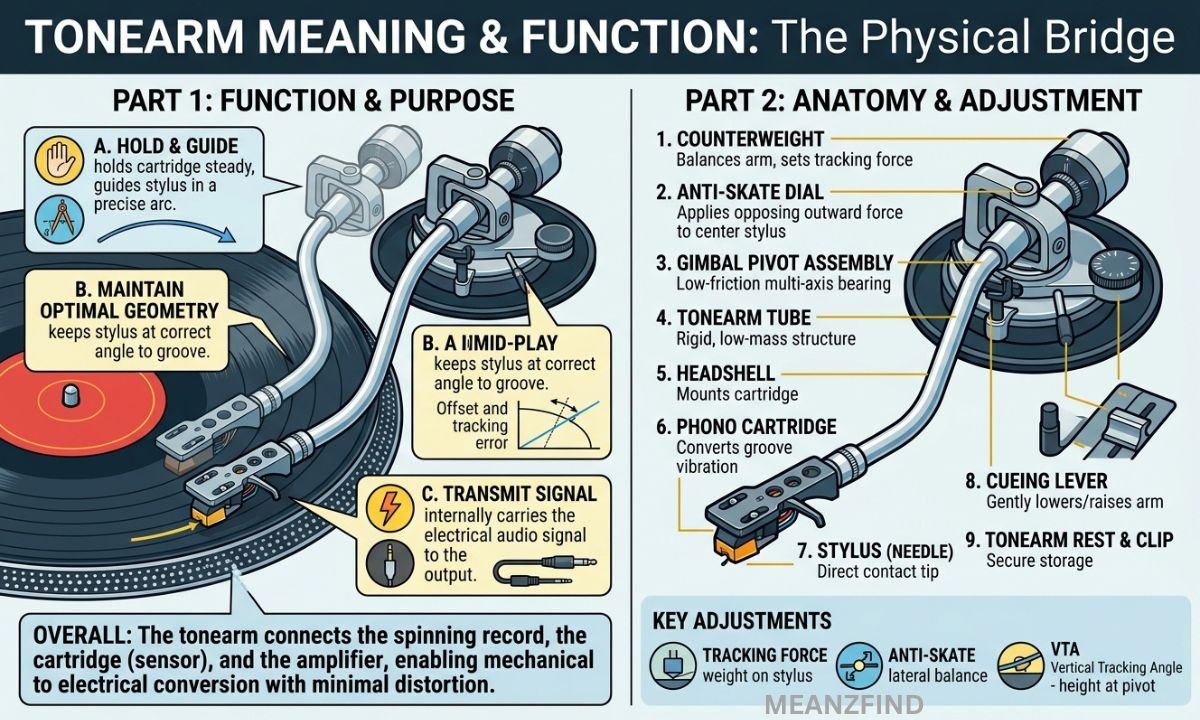
If you own a turntable, you have seen a tonearm. It is the long, thin arm that holds the needle. This arm moves across the record as it plays. Many people know what it looks like, but few know how it works.
A tonearm is more than just a piece of metal. It has several small parts working together. Each part plays a role in sound quality. Understanding these parts helps you use your turntable better.
The main purpose of a tonearm is simple. It guides the needle smoothly across the record. This creates clear and accurate sound. Without a good tonearm, your music can sound distorted or uneven.
What is Tonearm Meaning
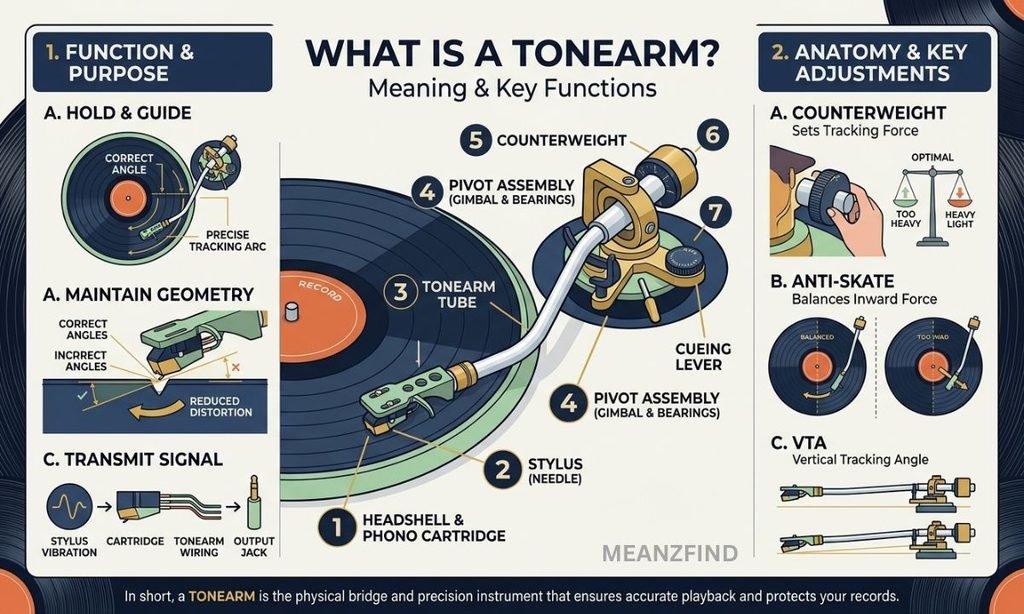
A tonearm is the long, thin arm on a turntable that holds the needle. It moves the needle across the record while the record spins. This movement lets the needle read the tiny grooves on the record and turn them into music.
The word “tonearm” comes from two simple words. “Tone” means sound. “Arm” means the part that moves and holds something. So a tonearm is simply the arm that carries the sound-reading needle.
In easy words, think of the tonearm as a small robotic finger. It gently touches the record. It follows the groove from the outer edge to the center. As it moves, it sends tiny vibrations to the cartridge, which turns them into sound.
Every turntable, old or new, needs a tonearm to work. Without it, the needle would have no way to touch the record safely and smoothly.
Why the Tonearm Meaning Matters More Than You Think
Many people think the tonearm is just a stick that holds the needle. That is not true. The tonearm controls how well your music sounds.
A good tonearm keeps the needle steady. It stops the needle from jumping or skipping. It also protects your records from scratches and damage.
Here is why understanding tonearm meaning is important:
- It helps you buy the right turntable.
- It helps you fix small sound problems yourself.
- It helps your records last longer.
- It helps you get clearer, richer sound.
If you ignore the tonearm, you may face skipping, distorted sound, or damaged records. Learning about it now can save you money and stress later.
How a Tonearm Works | Step by Step
The tonearm may look simple, but it does a smart job. Let’s break it down into easy steps.
- You place the record on the turntable. The platter starts spinning at a steady speed.
- You lift the tonearm. Most turntables have a lever or button for this.
- You move the tonearm over the record. You place it gently at the start of the groove.
- The needle drops into the groove. This is called “tracking.”
- The tonearm follows the groove. It moves slowly toward the center as the record plays.
- The needle picks up vibrations. These vibrations are tiny bumps in the groove.
- The cartridge turns vibrations into an electrical signal. This signal becomes sound through your speakers.
The whole process depends on smooth, steady movement. If the tonearm shakes or moves too fast, the sound gets distorted. If it moves too slow or gets stuck, the needle may skip.
Why Smooth Movement Matters
A tonearm must move freely, almost like it is floating. Too much friction can hurt the sound. Too little control can cause the needle to jump around.
The Main Parts of a Turntable Tonearm
A tonearm is made of many small parts. Each part has its own job. Let’s look at them one by one.
| Part | What It Does |
| Headshell | Holds the cartridge and needle in place |
| Cartridge | Turns groove vibrations into electric signals |
| Stylus (needle) | Touches the record and reads the groove |
| Counterweight | Balances the arm and sets tracking force |
| Anti-skate mechanism | Stops the needle from pulling too hard to one side |
| Arm tube | The long part that connects the headshell to the base |
| Pivot or bearing | Lets the arm move smoothly in all directions |
| Cueing lever | Lifts and lowers the arm gently |
| Arm rest | Holds the tonearm safely when not in use |
Headshell
The headshell sits at the front of the tonearm. It holds the cartridge firmly. Some headshells are removable, so you can swap cartridges easily.
Cartridge and Stylus
The cartridge and stylus work together. The stylus touches the groove. The cartridge changes that touch into an electric signal your speakers can use.
Counterweight
The counterweight sits at the back of the tonearm. It balances the arm so the needle does not press too hard or too soft on the record.
Anti-Skate Control
This small dial or weight stops the tonearm from pulling toward the center too fast. Without it, one side of your stereo sound may sound louder than the other.
Tonearm Tracking Force | The Goldilocks Zone
Tracking force means how much weight the needle puts on the record. It must be “just right,” not too heavy and not too light. This is why many people call it the Goldilocks zone.
If the tracking force is too light, the needle may skip and bounce. If it is too heavy, it can wear out your records faster and create dull sound.
How to Check Tracking Force
Most turntables list the correct tracking force in the manual. You can also use a small tool called a stylus force gauge. It tells you the exact weight in grams.
General tracking force range: Most cartridges need between 1.5 to 3 grams of force. Always check your specific cartridge for the exact number.
Signs Your Tracking Force Is Wrong
- Needle skips across the record
- Sound feels flat or muddy
- Record wears out quickly
- Needle jumps out of the groove
Getting tracking force right is one of the easiest ways to improve your sound quality instantly.
Tonearm Balance Adjustment | Start Here
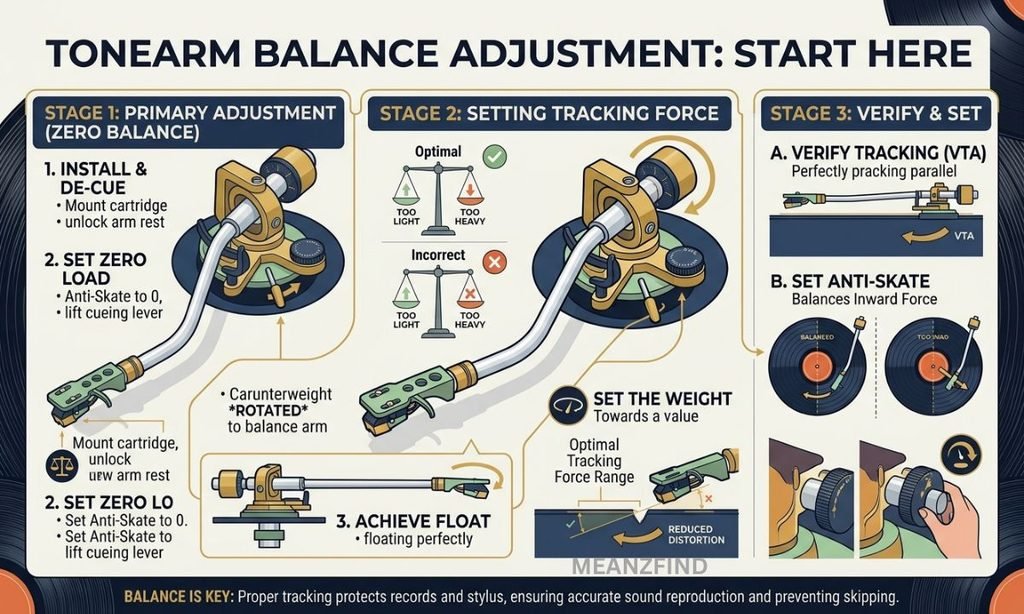
Balancing the tonearm is one of the first things you should learn. It sounds tricky, but it is actually simple once you try it.
Steps to Balance a Tonearm
- Remove the stylus guard for safety.
- Turn the anti-skate dial to zero.
- Slowly turn the counterweight until the tonearm floats level in the air.
- Once it floats evenly, this is called “zero balance.”
- Set the counterweight dial to zero without moving the weight itself.
- Turn the counterweight to match your cartridge’s recommended tracking force.
- Set the anti-skate to match the tracking force number.
This process may take a few tries. Go slow and be patient. A balanced tonearm protects both your needle and your records.
Tonearm Cartridge and Stylus | The Dynamic Duo
The cartridge and stylus are true partners. One cannot work well without the other.
The stylus is the tiny needle tip. It touches the groove directly. The cartridge is the small box that holds the stylus and converts movement into sound signals.
Types of Cartridges
| Cartridge Type | Best For | Sound Quality |
| Moving Magnet (MM) | Beginners | Warm and balanced |
| Moving Coil (MC) | Experienced listeners | Detailed and precise |
| Ceramic | Old or budget turntables | Basic and simple |
Moving Magnet cartridges are the most common. They are easy to use and affordable. Moving Coil cartridges cost more but give richer detail.
Signs You Need a New Stylus
- Sound feels scratchy or fuzzy
- Music sounds quieter than before
- Visible wear on the needle tip
- Records seem to skip more often
Most styluses last around 800 to 1,000 hours of play. After that, sound quality starts to drop.
Why Tonearm Alignment Importance Can’t Be Ignored
Alignment means how the cartridge sits compared to the record groove. Even a tiny angle mistake can cause big sound problems.
If the alignment is off, you may notice:
- Fuzzy or unclear vocals
- Uneven sound between left and right speakers
- Faster record wear
- Distortion, especially near the center of the record
How to Check Alignment
Many turntables come with a small paper or plastic tool called an alignment protractor. You place it on the platter and check if the cartridge lines up with printed marks.
Tip: Even small alignment errors can hurt sound quality. It is worth checking this once a year, especially if you often change cartridges.
Different Tonearm Types | Which One Do You Own?
Not all tonearms are the same shape or design. Each type has strengths and weaknesses.
| Tonearm Type | Shape | Common Use |
| Straight tonearm | Fully straight | Simple, budget turntables |
| S-shaped tonearm | Curved like the letter S | Classic and vintage turntables |
| J-shaped tonearm | Curved like the letter J | Mid-range turntables |
| Tangential (linear) tonearm | Moves in a straight line | High-end turntables |
Straight Tonearms
These are simple and budget-friendly. They work well but may have slightly more tracking error near the record’s edges.
S-Shaped and J-Shaped Tonearms
These curved designs help reduce tracking error. They are common in both vintage and modern turntables.
Tangential Tonearms
These move in a straight line across the record, just like the original recording machine did. This design reduces distortion but costs more money.
The Phonograph Tonearm Function | A Brief Reality Check
The word “phonograph” is an old name for record players. Early phonographs used tonearms too, but the technology was much simpler.
In old phonographs, the tonearm often connected directly to a large horn. There was no electricity involved. The vibrations from the needle traveled through the arm and into the horn, which made the sound louder.
Modern tonearms work differently. They use electric signals instead of sound horns. But the basic idea remains the same: the tonearm still guides the needle across the groove.
Old vs Modern Tonearm Function
| Feature | Old Phonograph Tonearm | Modern Tonearm |
| Power source | None (mechanical only) | Electric cartridge |
| Sound output | Horn amplification | Speakers |
| Materials | Wood or metal | Metal, carbon fiber, or wood |
| Precision | Basic | Highly adjustable |
Understanding this history helps you see how far turntable technology has grown, while the core purpose of the tonearm has stayed the same.
Tonearm Setup Guide | A Step-by-Step Walkthrough
Setting up a tonearm correctly makes a big difference in sound quality. Follow these steps carefully.
- Place your turntable on a flat, steady surface. Movement or tilting can affect sound.
- Attach the cartridge to the headshell. Make sure the wires connect to the correct pins.
- Balance the tonearm using the steps mentioned earlier.
- Set the correct tracking force based on your cartridge’s manual.
- Adjust the anti-skate control to match the tracking force.
- Check cartridge alignment using a protractor tool.
- Test with a record. Listen for clear, balanced sound on both speakers.
- Make small adjustments if you notice distortion or skipping.
Take your time with each step. A properly set-up tonearm can transform your listening experience.
Common Tonearm Mistakes Beginners Make
Many new vinyl lovers make small mistakes without realizing it. Here are the most common ones.
- Skipping the balancing step. This causes uneven pressure on records.
- Ignoring anti-skate settings. This creates unbalanced stereo sound.
- Touching the stylus with fingers. This can damage or dirty the needle.
- Using too much tracking force. This wears out records quickly.
- Not cleaning the stylus regularly. Dust buildup affects sound clarity.
- Placing the turntable on an unstable surface. Vibrations can cause skipping.
- Forcing the tonearm. Never push or pull it roughly.
Avoiding these simple mistakes can protect your equipment and improve your sound instantly.
Tonearm Materials and Resonance Control
Tonearms are made from different materials. Each material affects sound in its own way.
| Material | Sound Character | Common Use |
| Aluminum | Balanced and neutral | Most common turntables |
| Carbon fiber | Light and detailed | High-end turntables |
| Wood | Warm and natural | Vintage-style turntables |
| Titanium | Strong and precise | Premium turntables |
What is Resonance?
Resonance means unwanted vibration or shaking. If a tonearm vibrates too much, it adds noise to your music. Good materials and designs reduce this problem.
Manufacturers test different materials to control resonance. This is why premium tonearms often cost more money. They use materials that stay stiff and stable during playback.
How Tonearm Length Affects Sound
Tonearm length plays a bigger role than most people think. Longer tonearms often perform slightly better than shorter ones.
| Tonearm Length | Common Sizes | Effect on Sound |
| Short | 9 inches | More tracking error |
| Medium | 10 to 11 inches | Balanced performance |
| Long | 12 inches | Lower tracking error, smoother sound |
Why Length Matters
A longer tonearm moves in a wider arc. This wider arc creates a smoother path across the record. It reduces the angle error between the needle and the groove.
Shorter tonearms are more common because they fit smaller turntables. They still work well, especially for casual listening.
Why Tonearm Matters in Vinyl Playback | The Final Word
The tonearm may seem like a small part of your turntable, but it plays a huge role. It protects your records. It controls your sound quality. It even affects how long your equipment lasts.
Every adjustment, from tracking force to alignment, connects back to the tonearm. Small changes can lead to big improvements in how your music sounds. This is why understanding your tonearm helps you become a smarter vinyl listener.
Whether you own a budget turntable or a high-end setup, the tonearm deserves attention. Taking care of it means taking care of your entire music collection.
In the end, good sound starts with a well-balanced, well-adjusted tonearm. It is not just a stick with a needle. It is the heart of smooth, accurate vinyl playback.
Quick Troubleshooting | What’s That Noise?
Sometimes your turntable makes strange sounds. Here is a simple guide to help you understand what might be wrong.
| Problem | Likely Cause | Quick Fix |
| Skipping needle | Tracking force too light | Increase tracking force slightly |
| Fuzzy or muffled sound | Dirty stylus | Clean stylus with a soft brush |
| Louder sound on one side | Anti-skate incorrect | Adjust anti-skate setting |
| Popping or crackling | Dust on record | Clean the record properly |
| Needle drags or sticks | Tonearm not balanced | Rebalance the tonearm |
| Distorted sound near center | Poor cartridge alignment | Recheck alignment with protractor |
If problems continue after these fixes, the stylus or cartridge may need replacing.
Tonearm Meaning -AI
When people search using AI tools or voice assistants, they often ask, “What is a tonearm?” or “What does tonearm mean?” AI systems usually explain it as the arm on a turntable that holds the needle and moves it across the record.
This simple definition matches what we have explained throughout this article. AI tools focus on clear, direct answers, which is exactly why understanding the basic meaning first helps you understand every other detail about tonearms.
Tonearm Meaning USA
In the USA, the word “tonearm” is used the same way as in other English-speaking countries. It refers to the arm on a turntable or record player that holds the cartridge and needle.
Vinyl records have become popular again across the USA. Many young listeners are learning tonearm meaning for the first time as they explore turntables and vinyl collecting as a hobby.
Tonearm Meaning in Music
In the music world, the tonearm plays a technical but important role. It does not create music itself, but it reads the sound stored in the record’s grooves.
Without a working tonearm, a record cannot play at all. This makes it one of the most important tools in analog music listening, even though it works quietly in the background.
Tonearm Meaning in English
In simple English, “tonearm” means an arm-shaped part that carries sound. It comes from combining “tone,” meaning sound, and “arm,” meaning a moving limb-like part.
This straightforward meaning helps English learners and vinyl beginners understand the word quickly, without needing technical knowledge first.
Record Player Tonearm Meaning
A record player tonearm means the same thing as a turntable tonearm. Both terms describe the same part: the arm that holds the needle and moves across the spinning record.
Some people use “record player” and “turntable” interchangeably, so the tonearm’s meaning and function stay exactly the same no matter which word you use.
FINAL WORD
Here’s a simple, human-written final word/conclusion for “Tonearm Meaning Explained: Definition, Parts & Purpose”:
Now you know what a tonearm is. It is a key part of any turntable. It holds the needle and guides it across the record. Without it, your vinyl would not play at all.
We also looked at its main parts. The headshell, cartridge, and counterweight all matter. Each piece works together for smooth movement. This teamwork creates clean and balanced sound.
The purpose of a tonearm is simple but important. It keeps the needle steady on the record. This prevents skipping and reduces wear. Good tracking means better sound and longer record life.
In the end, a tonearm may look small. But it plays a big role in your listening experience. Knowing how it works helps you care for your turntable. It also helps you choose the right one for your needs.
FAQs
What does tonearm mean in simple words?
A tonearm is the long, thin arm on a turntable that holds the needle. It moves across the record so the needle can read the grooves and play music.
How do I know if my tonearm is balanced correctly?
A balanced tonearm floats level in the air when you let go of it gently. If it tips up or down on its own, it still needs adjusting.
What is the ideal tracking force for most cartridges?
Most cartridges work best between 1.5 and 3 grams of tracking force. Always check your cartridge’s manual for the exact number.
Can a bad tonearm damage my vinyl records?
Yes, a poorly balanced or misaligned tonearm can scratch grooves and wear records out faster. It can also cause skipping and distorted sound.
Are all tonearms replaceable?
No, some tonearms are fixed to the turntable and cannot be swapped. Higher-end turntables often allow tonearm replacement or upgrades.
What are the different types of tonearms available?
The main types are straight, S-shaped, J-shaped, and tangential (linear) tonearms. Each type differs in shape and how accurately it tracks the groove.
What does tone mean in simple terms?
Tone simply means sound or the quality of a sound. It can also describe the mood or feeling behind a sound or voice.
What does “tone” mean in slang?
In slang, “tone” can describe someone’s attitude or the vibe they’re giving off. For example, “watch your tone” means pay attention to how something is being said.