
Science is full of big and small words. Some of these words start with the letter W. They help us understand our world better. Learning them can be fun and easy.
In this article, we will look at science terms that start with W. Each word comes with a simple meaning. We will also give easy examples to help you understand. This makes learning new words fast and simple.
Whether you are a student or just curious, this list is for you. You do not need to be a scientist to learn these words. Just read along and enjoy the process. Soon you will know many new science terms.
What Are Science Words That Start With W?
Science has thousands of special words. These words help us name things we see, touch, and study every day. Many important science words start with the letter W.
Some of these words talk about physics, like wave and work. Some talk about nature, like weather and wetlands. Others talk about living things, like wildlife and white blood cells.
This guide gives you simple meanings and easy examples for each word. You will also find lists made for different school grades. By the end, you will know exactly what these words mean and how to use them.
Why Learning Science Vocabulary Matters
Science words are not just for tests. They help us talk about the world in a clear way. When you know the right word, you can explain your ideas better.
Here are a few reasons these words are useful:
- They help you understand your science textbook faster.
- They make it easier to follow news about weather, health, and nature.
- They build a strong base for harder science topics later.
- They help you do well in school tests and projects.
Now let’s look at the full list of physical science words that start with W.
Physical Science Words That Start With W
Physical science studies matter, energy, and forces. It includes physics, chemistry, and earth science. Many of the most common W words come from this field.
Below is a full list of physical science words starting with W. Each one has a simple meaning and an easy example.
1. Wave
A wave is energy that moves from one place to another. It does not carry matter with it, only energy. Waves can move through water, air, or even empty space.
Simple Example: When you drop a stone in a pond, you see rings of water moving outward. That moving ring is a wave.
There are different types of waves:
- Sound waves – carry sound through air
- Light waves – carry light from the sun
- Water waves – move across oceans and lakes
- Seismic waves – move through the ground during an earthquake
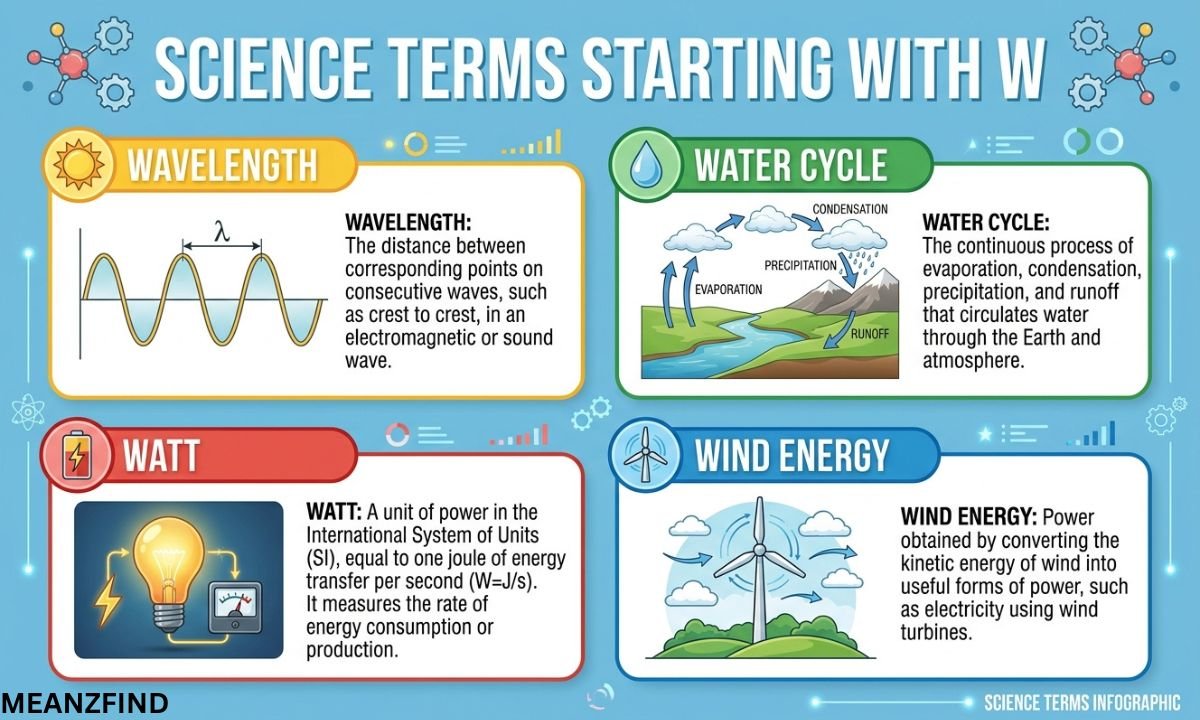
2. Wavelength
Wavelength is the distance between two matching points on a wave. It is usually measured from one peak (top) to the next peak. Short wavelengths carry more energy than long wavelengths.
Simple Example: Think of a rope tied to a wall. If you shake it up and down, the space between two high points is the wavelength.
Wavelength is important in light and sound:
- Short wavelengths make blue and violet light.
- Long wavelengths make red light.
- Radio waves have very long wavelengths.
3. Weather
Weather is the condition of the air at a certain place and time. It includes things like temperature, rain, wind, and clouds. Weather can change from hour to hour.
Simple Example: If it is sunny in the morning and rainy by afternoon, that is a change in weather.
Weather is different from climate. Weather changes daily, but climate is the usual weather pattern in an area over many years.
4. Water Cycle
The water cycle is the path water takes as it moves around the Earth. It moves between the ocean, the sky, and the land. This cycle repeats again and again, forever.
Simple Example: Water from the sea turns into vapor, forms clouds, falls as rain, and flows back to the sea.
The main steps of the water cycle are:
- Evaporation – water turns into vapor from heat
- Condensation – vapor cools and forms clouds
- Precipitation – water falls as rain, snow, or hail
- Collection – water gathers in rivers, lakes, and oceans
5. Work (Physics)
In physics, work means using force to move an object a certain distance. If nothing moves, no work is done, even if you feel tired.
Simple Example: Pushing a box across the floor is work. Pushing a wall that does not move is not work in the science meaning.
Work is measured using this simple idea:
- Work = Force × Distance
- More force or more distance means more work is done.
6. Watt
A watt is a unit that measures power. Power tells us how fast energy is used or made. It is named after the scientist James Watt.
Simple Example: A 60-watt light bulb uses more energy per second than a 10-watt light bulb.
Watts are used to describe:
- Light bulbs
- Phone chargers
- Kitchen appliances
- Electric motors
7. Wind
Wind is moving air. It happens because the sun heats different parts of the Earth unevenly. Warm air rises, and cooler air moves in to take its place.
Simple Example: On a windy day, you feel air pushing against your face because it is moving fast.
Wind can be gentle like a breeze or strong like a storm. Wind is also used to make clean electricity through wind turbines.
Life Science and Environmental Words That Start With W
Not all science words are about physics. Some describe living things and the places they live. These words are common in biology and environmental science classes.
8. Wildlife
Wildlife means animals that live in the wild, not as pets or farm animals. This includes birds, insects, fish, and mammals living in their natural homes.
Simple Example: Deer, tigers, and eagles are all examples of wildlife.
Protecting wildlife is important because:
- It keeps nature balanced.
- Many animals help plants grow by spreading seeds.
- Wildlife supports food chains everywhere.
9. Wetlands
Wetlands are areas of land covered with water for most or all of the year. They include swamps, marshes, and bogs. Wetlands are home to many plants and animals.
Simple Example: A swamp full of tall grass and frogs is a type of wetland.
Wetlands are helpful because they:
- Clean water naturally
- Give homes to fish and birds
- Reduce flooding by storing extra water
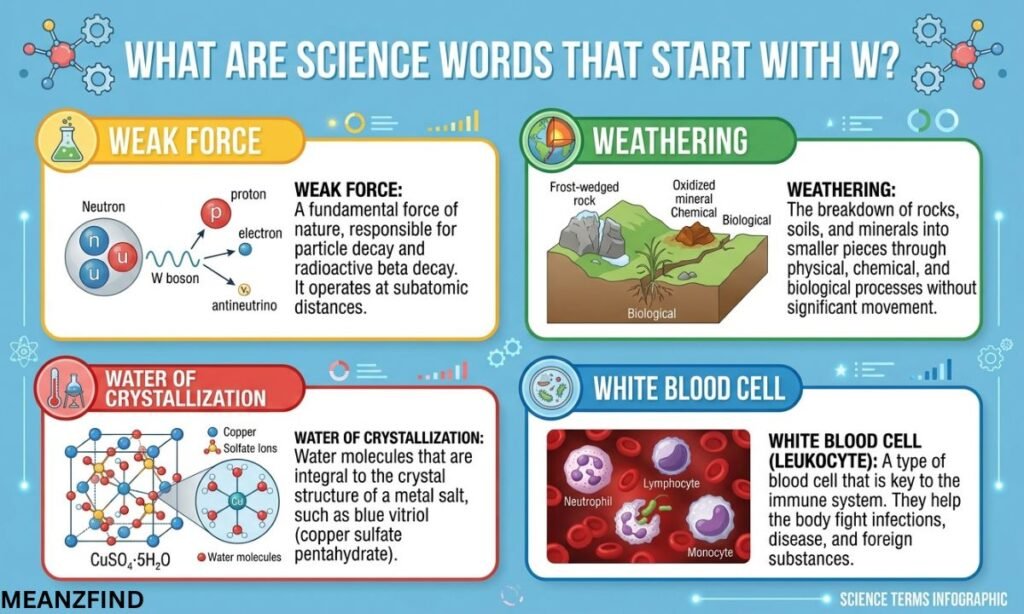
10. White Blood Cells
White blood cells are special cells in your blood that fight germs. They protect your body from sickness and infection. They are also called leukocytes.
Simple Example: When you get a cut and it gets a little red or swollen, white blood cells are working to fight germs there.
There are different types of white blood cells, and each one has its own job in keeping the body safe and healthy.
Full List Table: Science Words That Start With W
Here is a quick table you can use for fast revision.
| Word | Simple Meaning | Subject Area |
| Wave | Energy moving from one place to another | Physics |
| Wavelength | Distance between two wave peaks | Physics |
| Weather | Daily condition of the air | Earth Science |
| Water Cycle | Path water takes around the Earth | Earth Science |
| Work | Using force to move an object | Physics |
| Watt | Unit for measuring power | Physics |
| Wind | Moving air | Earth Science |
| Wildlife | Animals living in nature | Biology |
| Wetlands | Land covered with water | Environmental Science |
| White Blood Cells | Cells that fight germs in the body | Biology |
More Useful Science Words Starting With W
Along with the main words above, here are extra W words often used in science classes.
- Weathering – the slow breaking down of rocks by wind, water, or ice
- Water Vapor – water in its gas form
- Weight – the force of gravity pulling on an object
- Wing – a body part used by birds and insects to fly
- Womb – another word for the uterus, where babies grow before birth
- Worm – a small, soft-bodied animal that helps break down soil
These words are shorter but still important. They often appear in quizzes and worksheets alongside the main terms.
Science Words That Start With W by Grade Level
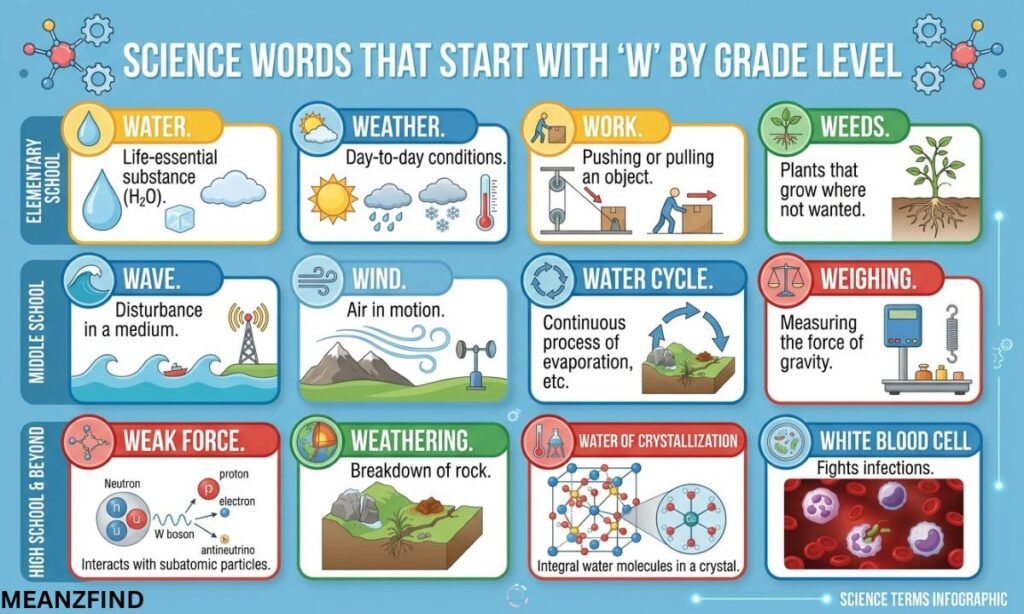
Different grades study different levels of science. Below is a simple guide to help students find words that match their class level.
Science Words That Start With W – 5th Grade
Fifth grade science focuses on basic, easy-to-see ideas. Students learn about weather, water, and simple forces.
- Weather
- Water Cycle
- Wind
- Wildlife
- Weight
At this level, examples should connect to things students already know, like rain, wind, and animals.
Science Words That Start With W – 6th Grade
Sixth grade adds a bit more detail. Students begin learning simple physics ideas and Earth systems.
- Wave
- Watt
- Weathering
- Wetlands
- Water Vapor
Students in 6th grade should start understanding how these words connect to bigger science ideas, not just definitions.
Science Words That Start With W – 7th Grade
Seventh grade often introduces biology topics along with physical science. This is where body-related words appear.
- Wavelength
- White Blood Cells
- Work (Physics)
- Wind Energy
- Womb
Here, students begin using formulas and simple science explanations, not just word meanings.
Science Words That Start With W – 8th Grade
Eighth grade science becomes more detailed. Students study energy, forces, and human biology at a deeper level.
- Wavelength (light and sound)
- Work and Power
- Watt (as a power unit)
- White Blood Cells (immune system)
- Wave Frequency
At this stage, students should be able to explain each word using their own sentences and real examples.
Quick Comparison: Wave vs Wavelength vs Watt
Students often mix up these three words because they sound related. Here is a simple table to clear the confusion.
| Term | What It Measures | Example Use |
| Wave | Movement of energy | Water wave, sound wave |
| Wavelength | Distance between wave points | Measuring light color |
| Watt | Power or energy use | Light bulbs, chargers |
How to Remember These Words Easily
Long lists can feel hard to remember. These simple tips can help students learn faster.
- Group similar words together – put physics words in one group and biology words in another.
- Use real-life examples – connect each word to something you already know.
- Draw simple pictures – a wave, a wind symbol, or a water cycle diagram helps memory.
- Practice with flashcards – write the word on one side and the meaning on the other.
- Use the words in sentences – saying a word in a full sentence helps you remember it longer.
Fun Facts About W Science Words
Learning is more fun with small, interesting facts. Here are a few to enjoy:
- The watt is named after James Watt, who studied steam engines.
- Light and sound both travel as waves, but light travels much faster.
- Wetlands cover only a small part of the Earth but support a huge number of species.
- White blood cells can move on their own, almost like tiny living helpers inside your body.
- Wind has been used for hundreds of years to power windmills and ships.
FINAL WORDS
Learning science words that start with W is fun and simple. Each word teaches us something new about the world. Now you know many of these terms. You can use them in school or daily life.
Words like water, weather, and wavelength are easy to remember. They connect to things we see every day. This makes science feel less hard. It becomes something we can enjoy.
You do not need to memorize everything at once. Take your time and learn a few words each day. Soon these terms will feel natural to you. Practice makes it easier to remember them.
Science is all around us, even in small things. These W words show us how nature works. They help us ask better questions about the world. Curiosity is the first step to learning more.
We hope this list helped you learn something new. Keep exploring more science words in the future. Reading and practice will build your vocabulary. Thank you for taking the time to learn with us.
FAQs
What are 10 science words?
Ten common science words are atom, cell, energy, gravity, force, matter, molecule, gene, ecosystem, and photosynthesis. Each one is used often in school science lessons.
What are 5 science words?
Five simple science words are energy, matter, cell, force, and gravity. These words appear in almost every science subject.
What are scientific words a to z?
Scientific words a to z means a full list of science terms arranged by alphabet, from “atom” to “zygote.” Such lists help students learn vocabulary in an organized way.
What is science A to Z?
Science A to Z is a way of covering every science topic and term by alphabet order. It helps learners explore science step by step, letter by letter.
What are 15 fields of science?
Fifteen fields of science include biology, chemistry, physics, astronomy, geology, ecology, botany, zoology, genetics, meteorology, oceanography, anatomy, microbiology, immunology, and physiology. Each field studies a different part of nature or life.
Can you give me 50 scientific words with meanings?
A list of 50 scientific words with meanings would include terms like atom (smallest unit of matter), gravity (force pulling objects down), and cell (basic unit of life). Such long lists are usually shared as a full chart or table for easy reading.
What are the ABCs of science?
The ABCs of science means learning basic science ideas in a simple, step-by-step order, like the alphabet. It is often used to teach young students easy science concepts first.
What are some cool science words?
Cool science words include bioluminescence, supernova, photosynthesis, gravity, and metamorphosis. These words sound interesting and describe amazing natural events.
What are 20 science facts?
Twenty science facts would be a list of short, true statements about nature, space, or the human body, such as “the human body has 206 bones.” These facts make science fun and easy to remember.
What are the 50 types of scientists?
Fifty types of scientists include biologists, chemists, physicists, astronomers, geologists, botanists, zoologists, and meteorologists, among many others. Each scientist studies a specific area of science.
What are 20 branches of science?
Twenty branches of science include biology, chemistry, physics, ecology, genetics, astronomy, geology, botany, zoology, and microbiology. These branches divide science into smaller, easier-to-study parts.
What is natural science?
Natural science is the study of nature and the physical world using observation and experiments. It includes biology, chemistry, physics, and earth science.
What is science in 3 words?
Science in three words can be described as “study of nature.” It focuses on understanding how the world works.
What is ABC in chemistry?
ABC in chemistry is not a standard term, but it can informally refer to basic beginner concepts like atoms, bonds, and compounds. It is sometimes used loosely to mean “the basics of chemistry.”
What are the 7 types of science?
The seven types of science often include physical science, life science, earth science, social science, formal science, applied science, and natural science. Each type covers different subjects and methods of study.