
Have you ever heard someone say “Wallahi” and wondered what it really means? This word is used a lot in daily conversations, especially among Muslims and Arabic speakers. It carries a deep meaning that goes beyond just casual talk. Understanding it can help you use the word correctly and respectfully.
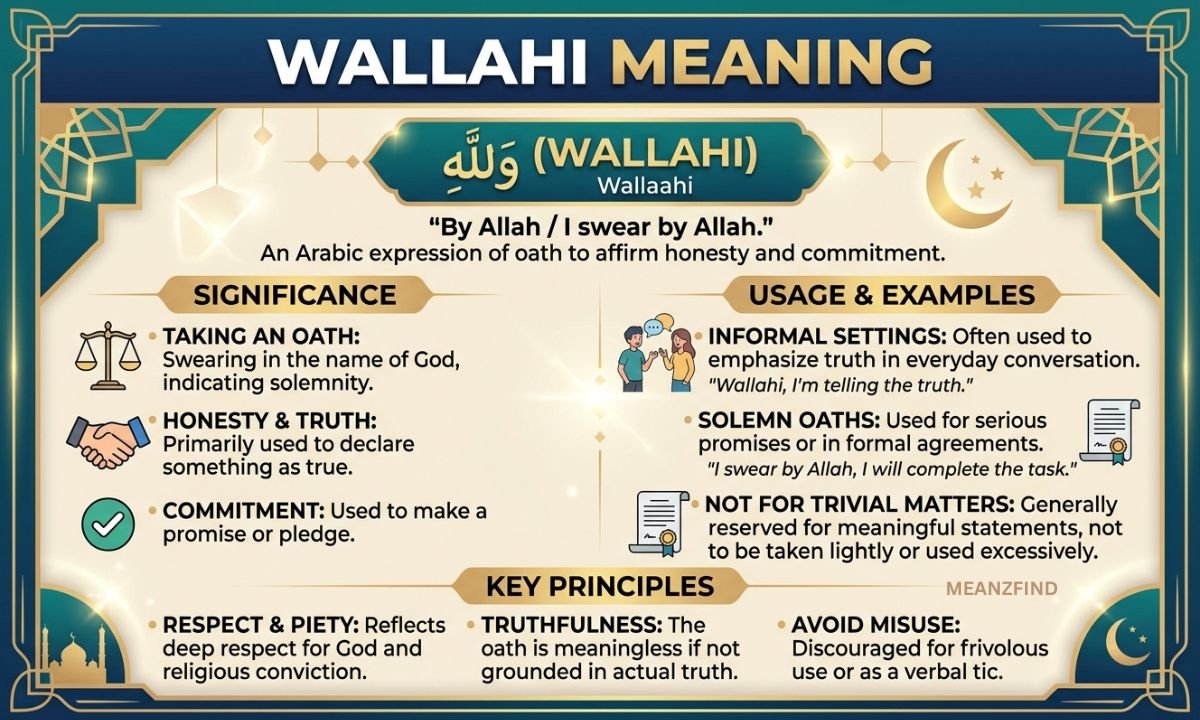
“Wallahi” comes from the Arabic language and it means “I swear by Allah.” It is used when someone wants to show that they are telling the truth. People use this word to add strength and honesty to what they are saying. It is not just a random phrase, but a serious promise in many cultures.
This word holds strong cultural and religious value, especially in Islam. Swearing by Allah’s name is taken seriously, so people avoid using it carelessly. It reflects honesty, trust, and sincerity in communication. Knowing its true meaning helps you understand its importance in everyday life.
What Does Say Wallahi Meaning
Wallahi – Quick Meaning
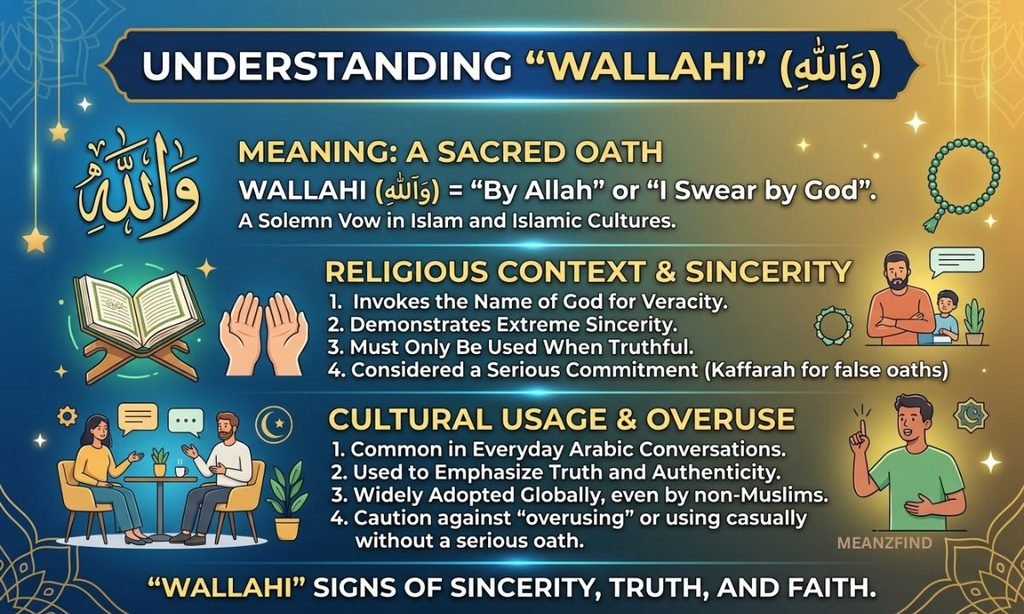
“Wallahi” is an Arabic word that means “I swear by Allah.” People say it when they want to prove they are telling the truth. It is a strong way of saying “I promise” or “I am not lying.”
This word is short, but it carries a big weight. When someone says “Wallahi,” they are calling on God as their witness. That is why it is not treated as a light or empty phrase in Arabic-speaking and Muslim communities.
Today, the word has also become popular on social media. Many young people use it in chats, comments, and videos, even outside its religious setting. This mix of old meaning and new use is what makes “Wallahi” so interesting to study.
Origin & Background

Linguistic roots
The word “Wallahi” comes from Arabic. It is made of two parts joined together. The first part, “Wa,” means “by,” and the second part, “Allahi,” refers to “Allah,” which means God.
So when you put the parts together, “Wallahi” literally means “by Allah.” It is used before a statement to show that the speaker is being fully honest. This kind of word is called an “oath” word in language studies.
Arabic has many oath words like this, but “Wallahi” is one of the most common. It is used daily by millions of Arabic speakers, not just in formal talk but in normal chats too.
Religious background
In Islam, swearing by Allah’s name is a serious act. It is not something people are supposed to do carelessly. The Quran teaches that oaths should be kept, and false oaths using Allah’s name are seen as a sin.
Because of this, saying “Wallahi” is meant to be used only when a person is telling the truth. It works like a personal promise backed by faith. Many Muslims feel a sense of responsibility when they say this word.
Religious scholars often remind people to be careful with oaths. Using “Wallahi” too often, or using it for small and unimportant things, is discouraged in strict religious teaching.
Cultural evolution
Over time, “Wallahi” moved beyond just religious talk. It became a normal part of daily conversation in many Arab countries. People started using it not just for big promises, but also for small everyday statements.
Then, with the rise of the internet, the word crossed borders. Non-Arabic speakers began hearing it in songs, memes, and videos. Soon, “Wallahi” became a trendy word used by people from different backgrounds, even those who do not fully understand its religious depth.
This shift shows how language changes when it travels through culture and technology. A word that once belonged to religious speech now lives comfortably inside internet slang too.
Real-Life Conversations (Mandatory Examples)

Seeing “Wallahi” in real chats helps explain its meaning better than any definition. Below are simple examples from common platforms.
WhatsApp Chat
Ali: Bro, did you really finish the project? Sam: Wallahi, I finished it last night. Check your email.
Ayesha: You saw my message right? Zara: Wallahi I just saw it now, sorry for the late reply!
Instagram DM
User1: Is this dress from the new collection? User2: Wallahi yes, I just got it today 😍
User1: Did you really meet him at the event? User2: Wallahi we talked for like an hour!
TikTok Comments
Comment 1: “Wallahi this video made my whole day 😂” Comment 2: “Wallahi I thought the same thing when I saw this trend” Comment 3: “Bro said wallahi and I believed him instantly 💀”
These examples show that “Wallahi” is used to add honesty, excitement, or emphasis. It works almost like saying “I swear” or “seriously” in English.
Emotional & Psychological Meaning
Why people connect with it
People connect with “Wallahi” because it feels personal and strong. Saying “I promise” can sound normal, but “Wallahi” feels heavier and more sincere to many speakers. It makes the listener feel like the speaker truly means what they say.
This emotional weight comes from its religious root. Even people who use it casually still feel that extra push of seriousness behind the word. That is part of why it stands out from other common phrases.
Psychological intent
When someone uses “Wallahi,” they often want to remove doubt from the listener’s mind. It is a way to say, “You can trust me now.” This need to be believed is a normal human feeling, especially in emotional or important conversations.
Sometimes, people also use it out of habit rather than deep thought. In these cases, it becomes more of a speech filler, similar to saying “literally” or “honestly” in English.
Usage in Different Contexts
Social Media
On social media, “Wallahi” is used to express excitement, shock, humor, or strong agreement. It fits well in captions, comments, and short video reactions. Many users treat it as a fun expression rather than a serious oath.
Friends & Relationships
Among friends, “Wallahi” is used to strengthen trust. It can be used when confirming plans, defending a story, or showing loyalty. In relationships, it may also be used to express deep feelings, like love or commitment.
Work or Professional Settings
In workplaces, especially in Arab countries, “Wallahi” may still appear, but usually in a lighter tone. It is common when confirming a task is done or defending one’s honesty about a work matter. However, it is used less formally than in personal chats.
Casual vs Serious Tone
| Tone Type | Example Situation | Meaning Level |
| Casual | “Wallahi this pizza is amazing” | Light emphasis |
| Serious | “Wallahi I did not take your money” | Strong oath, deep honesty |
| Playful | “Wallahi you’re so funny 😂” | Friendly expression |
| Emotional | “Wallahi I miss you so much” | Personal, heartfelt |
Common Misunderstandings
1. “It’s just slang”
Many people think “Wallahi” is only internet slang with no deeper meaning. This is not fully true. While it is used casually today, its root meaning is a religious oath, and that history still matters to many speakers.
2. “Anyone can say it freely”
Some assume the word has no rules and can be said in any situation. In reality, using it for jokes or lies is seen as disrespectful by many people who understand its religious weight.
3. “It always means the same thing”
The meaning of “Wallahi” can shift depending on tone, context, and intention. A casual “Wallahi” in a meme is very different from a serious “Wallahi” used to defend one’s honesty in a difficult moment.
When NOT to use it
- Do not use it to support a lie.
- Avoid using it as a joke about serious topics like death, harm, or religion itself.
- Do not use it repeatedly just to sound cool without understanding its meaning.
- Avoid using it to pressure someone into believing something untrue.
Comparison Table
| Word/Phrase | Meaning | Level of Seriousness | Common Use |
| Wallahi | I swear by Allah | High (religious oath) | Promises, honesty, emphasis |
| I swear | I promise strongly | Medium | Everyday talk |
| Honestly | I am being truthful | Low to Medium | Casual conversation |
| For real | This is true | Low | Slang, casual talk |
| I promise | I will keep my word | Medium | Commitments |
Variations / Types of Wallahi (Common Uses)
- Wallahi billahi – A stronger version, repeating the oath for extra emphasis.
- Wallahi al azeem – Means “I swear by the Great Allah,” used for very serious matters.
- Wallahi bro – A casual, friendly version common in youth slang.
- Wallahi habibi – Adds affection, often used between close friends or loved ones.
- Simple Wallahi – The most common everyday form, used for quick emphasis.
How to Respond When Someone Uses It
Casual replies
- “Okay, I believe you.”
- “Alright, no worries then.”
- “Cool, thanks for telling me.”
Funny replies
- “Wallahi or double wallahi? 😂”
- “That’s a big oath for a small thing!”
- “Okay okay, I trust you, relax!”
Mature / confident replies
- “I trust your word, no need to swear.”
- “You don’t have to say that, I believe you already.”
- “Thank you for being honest with me.”
Private or respectful replies
- “I understand, thank you for sharing that with me.”
- “That means a lot, I appreciate your honesty.”
- “Okay, let’s move forward then.”
Regional & Cultural Usage
Western Culture
In Western countries, “Wallahi” is mostly known through social media trends, music, and youth slang. Many non-Muslim users use it playfully without knowing its full religious background. It often blends into meme culture and casual online chats.
Asian Culture
In some Asian Muslim communities, “Wallahi” is used with more religious respect, similar to Middle Eastern usage. It is common in daily speech but still carries the weight of a promise tied to faith.
Middle Eastern Culture
In the Middle East, “Wallahi” is deeply rooted in both religious and everyday language. It is used naturally in normal conversations, but people are generally aware of its serious meaning and try to avoid misusing it for lies.
Global Internet Usage
Thanks to global internet trends, “Wallahi” has spread far beyond its original users. It now appears in comments, captions, and video trends across many countries, often mixed with humor and pop culture references.
Bomboclat Wallahi Meaning
“Bomboclat Wallahi” is an internet meme mix that combines two unrelated slang trends. “Bomboclat” is a Jamaican Patois expression often used humorously online, while “Wallahi” adds the swearing effect. Together, they form a funny, exaggerated phrase mostly used for comedy in memes and reaction videos.
This combination does not have a deep meaning. It is simply an internet trend where users mix different cultural slang words to create humorous or dramatic reactions. It should be treated as pure meme culture rather than a serious phrase.
Say Wallahi Bro Say Wallahi Meaning
“Say Wallahi Bro” is a popular trend where one person challenges another to swear “Wallahi” to prove they are telling the truth. It became a common phrase in memes, TikTok videos, and casual arguments among friends.
This trend usually happens in a playful or joking context. It reflects how deeply the word “Wallahi” is tied to trust, even in casual pop culture. When someone hesitates to say it, it is often taken as a sign that they might be lying, which adds a funny or dramatic effect to online content.
FINAL WORDS
In the end, “Wallahi” is more than just a common word. It is a promise that carries weight and meaning. When someone says it, they are calling on Allah as a witness to their truth. This makes it a phrase that should never be used lightly.
Understanding its meaning helps us respect the culture behind it. It is not just for Muslims, but anyone who wants to understand Arabic expressions better. Knowing when and how to use it shows good manners and awareness. It also helps avoid misusing a word tied to faith and honesty.
Language often carries emotions, beliefs, and traditions within it. “Wallahi” is a perfect example of this deep connection. It shows how words can hold religious value and everyday use at the same time. This is what makes learning such words interesting and meaningful.
So, next time you hear or use “Wallahi,” remember its true weight. It’s a word of honesty, trust, and sincerity. Using it with care shows respect for the culture it comes from. This small effort can make communication more meaningful and genuine.
FAQs
What does wallahi slang mean?
As slang, “wallahi” is used casually to mean “I swear” or “seriously,” often just for emphasis. It has drifted from its strict religious use into everyday internet and youth speech.
Can non-Muslims say wallahi?
Yes, non-Muslims can say it, since it’s simply an Arabic phrase meaning “by Allah.” However, many people feel it carries more weight when used by someone who shares the religious belief behind it.
Why do Muslims say wallah?
Muslims say “wallah” to swear by Allah’s name, showing they are being fully truthful. It adds religious weight to a statement, since lying under this oath is considered serious in Islam.
Is saying wallahi ok?
Yes, saying “wallahi” is fine when used honestly and with respect for its meaning. It becomes a problem only when used to support a lie or said too casually without any real intent.
Is it haram to say wallahi?
Saying “wallahi” itself is not haram; it is a normal Islamic expression of oath-taking. It becomes haram (forbidden) when used to swear falsely or to back up something untrue.
How do I respond to Wallahi?
A simple reply like “okay, I believe you” or “I trust your word” works well. You can also respond warmly with “thank you for being honest” in more personal conversations.
What is the 7:7-7 rule in Islam?
There isn’t an established “7:7-7 rule” recognized in mainstream Islamic teaching or texts. This may refer to a modern internet trend or misquoted concept rather than an actual religious rule.
Does Allah accept LGBT?
This is a matter of ongoing religious and personal interpretation, and views differ among scholars, communities, and individuals. Mainstream traditional Islamic teaching holds same-sex relationships as impermissible, while some progressive voices interpret texts differently — it’s a topic best explored through trusted religious scholars for a full answer.
Can Christians use Wallahi?
Yes, Christians can use the word since it’s an Arabic term, not exclusive to Islam. Arabic-speaking Christians, in fact, sometimes use “wallahi” naturally in daily conversation too.
Is it yallah or wallah?
“Yallah” means “let’s go” or “come on,” while “wallah” (or “wallahi”) means “I swear by Allah.” They sound similar but have completely different meanings.
Can anybody say wallahi?
Yes, anybody can say “wallahi” regardless of religion or background, since it’s just a phrase. That said, it’s respectful to understand its serious meaning before using it often.
How do Muslims say “I swear”?
Muslims commonly say “wallahi” to mean “I swear,” specifically swearing by Allah’s name. Longer versions like “wallahi al-azeem” (I swear by the Great Allah) are used for extra emphasis.