
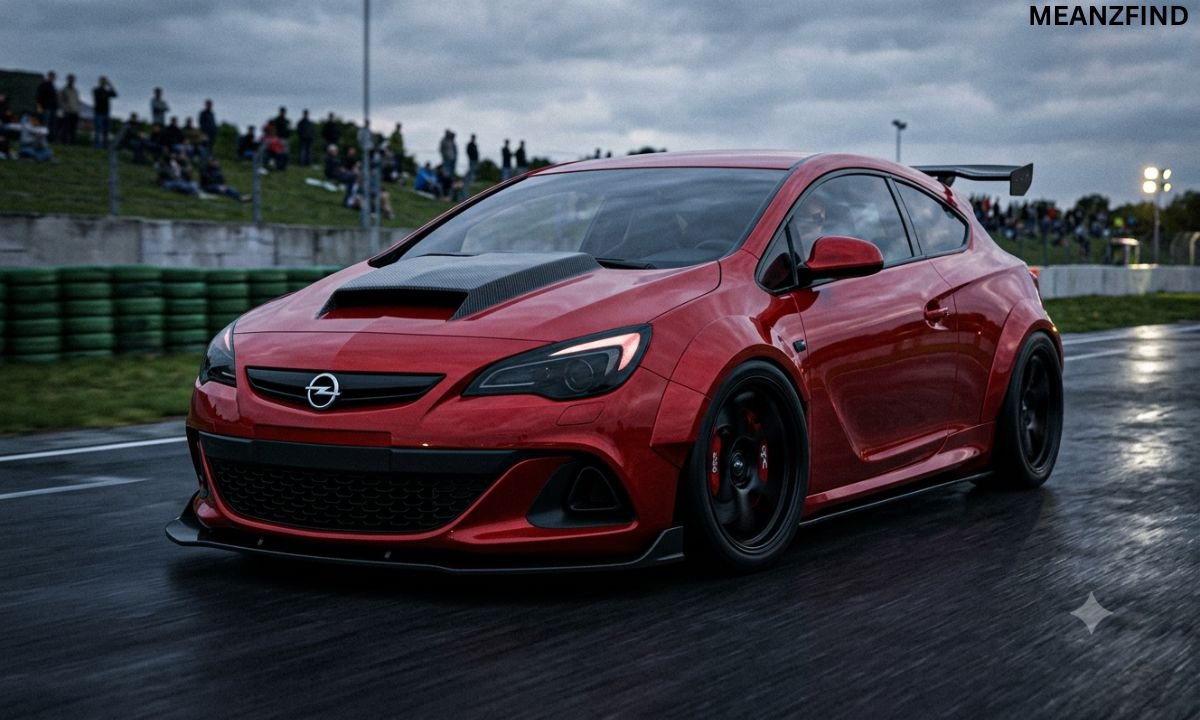
Have you ever seen an Opel car and wondered what the name actually means? Many people think it stands for something special, like an abbreviation. But the truth is much simpler than that. The name has a personal story behind it, not a hidden code.
Opel is not an acronym at all. It comes from the name of a real person, Adam Opel, who started the company back in 1862. He began by making sewing machines, and later his sons turned the business into a car company. The name simply stayed the same as the family surname.
Today, Opel is a well-known car brand across Europe. Its name reminds people of its long history and German roots. Understanding this simple origin helps clear up the common confusion around the word. It’s not complicated once you know the real story.
OPEL Meaning in the Automotive World
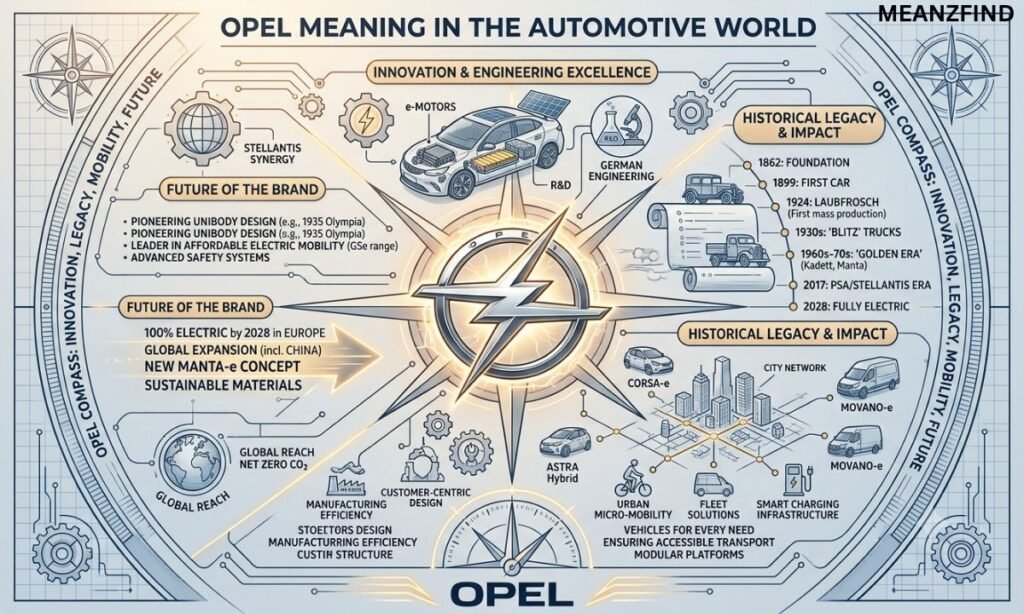
Quick Facts About OPEL
Before we go deep into the story, here are the fast facts about OPEL. This table gives you a snapshot you can scan in seconds.
| Fact | Details |
| Full form | OPEL is not an acronym; it is a family surname |
| Founder | Adam Opel |
| Founded in | 1862 |
| Country | Germany |
| First product | Sewing machines |
| Later product | Bicycles |
| Car production started | 1899 |
| Logo symbol | A lightning bolt inside a circle (blitz) |
| Owned by | Stellantis (since 2021) |
| Pronunciation | OH-pel (English), [ˈoːpl̩] (German) |
Now let’s break each part of this down in easy words.
OPEL Meaning Knitting
Some people search “OPEL meaning knitting” because they saw the word OPEL sitting next to knitting words like knit, purl, and mend. This mostly happens because of word puzzle games, not because OPEL is really a knitting word.
Here is the truth: there is no knitting stitch called OPEL. The real knitting terms are knit and purl. Purl is a basic stitch made by pulling a loop of yarn back through another stitch. OPEL sounds a little like these words, which is why confused readers link them together.
There is one small, fun fact worth knowing. Some independent knitting designers have used the word “Opel” as the name of a knitted pattern, like a cowl or a scarf design. But this is just a creative name someone picked. It is not an official knitting term that every knitter uses.
So if you were worried you missed a stitch called “opel” in a pattern, don’t worry. You didn’t miss anything. It simply does not exist as a standard knitting word.
OPEL Meaning Connections
“OPEL meaning connections” is one of the most searched phrases, and it comes from the NYT Connections game. Connections is a popular daily word puzzle where players sort sixteen words into four hidden groups of four.
In one puzzle, the word OPEL appeared next to words like Knit, Purl, Heal, Mend, and Recover. Many players got confused because OPEL looked like it belonged with the knitting or healing words. In reality, OPEL was placed there on purpose to trick players.
The real group in that puzzle was about healing a broken bone, using the words Heal, Knit, Mend, and Recover. OPEL did not belong in that group at all. It was simply a distractor, a word added to make the puzzle harder.
This is exactly how Connections works. The game likes to place tricky or unrelated words near a theme so players second-guess themselves. OPEL, being close in sound to “purl,” made a perfect trap word for the puzzle makers.
OPEL Meaning Nyt
“OPEL meaning nyt” is basically the same search as above, just shortened. NYT stands for The New York Times, the newspaper that owns and runs popular games like Wordle, Connections, and Spelling Bee.
When OPEL shows up in an NYT puzzle, it is almost always used as a car brand name. Puzzle writers enjoy using real brand names, place names, and surnames because they are short, well known, and easy to build categories around.
So if you searched “OPEL meaning NYT” hoping for a secret code, here is your answer. OPEL simply refers to the German car company in these puzzles. There is no deeper hidden meaning behind it.
OPEL Meaning Hospital
This one surprises a lot of people, but OPEL has a real and serious meaning in hospitals, especially in the United Kingdom. In this context, OPEL stands for Operational Pressures Escalation Levels.
Hospitals use the OPEL system to show how busy or stressed they are at any given time. It works like a warning scale, similar to a traffic light system, but with four levels instead of three.
Here is a simple breakdown of the OPEL hospital levels:
| OPEL Level | What It Means |
| OPEL 1 | Hospital is coping well; normal pressure |
| OPEL 2 | Hospital is showing early signs of pressure |
| OPEL 3 | Major pressure; patient flow is being affected |
| OPEL 4 | Highest alert; hospital cannot give full care safely |
When a hospital announces “OPEL 4,” it means the hospital is extremely full and under serious strain. Ambulances may be delayed, and emergency rooms may struggle to see every patient quickly. This system helps hospital staff, ambulance services, and health leaders talk to each other using the same clear language.
This OPEL framework has nothing to do with the German car brand. It is a completely separate meaning that just happens to use the same letters.
What Does OPEL Mean in German
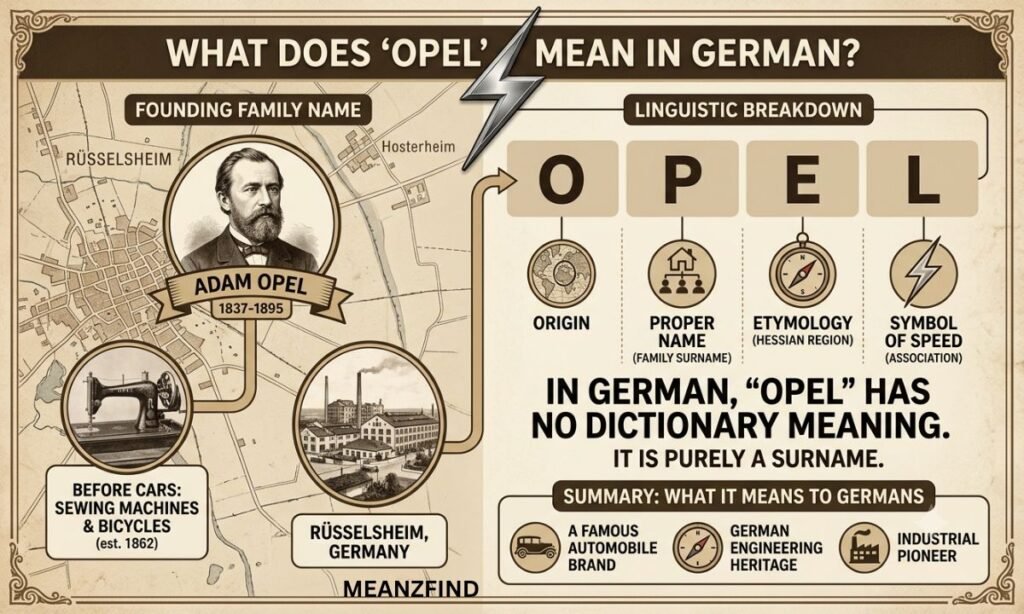
In the German language, OPEL is not a regular dictionary word. You will not find it listed with a definition like you would find for words such as “haus” (house) or “auto” (car).
OPEL is simply treated as a proper noun, meaning it is a name, not a describing word. It comes from an old German surname. Some language experts believe the surname may be linked to old German first names like Adalbert or Albrecht, which slowly changed over many generations into the shorter form “Opel.”
So in German, when someone says “Opel,” they are almost always talking about either:
- A person with that surname, or
- The car company founded by that family
There is no separate hidden German meaning like “strong” or “fast” behind the word. It is purely a family name that became a famous brand.
OPEL Car Brand Meaning
Now let’s talk about the meaning most people are actually searching for: OPEL, the car brand.
OPEL is one of the oldest car companies in the world. It began as a small workshop that made sewing machines in Rüsselsheim, Germany. The founder, Adam Opel, worked hard to build simple, reliable sewing machines that regular families could use at home.
After Adam Opel passed away, his five sons took charge of the company. They expanded the business into bicycles, which were becoming very popular in Europe at the time. Bicycles taught the company how to work with metal frames, wheels, and moving parts, skills that would later help them build cars.
In 1899, Opel made its very first car. From there, the brand grew quickly, and by the 1920s, Opel became the largest car manufacturer in Germany. The name OPEL, taken directly from the founder’s surname, stayed the same through every stage of this growth.
Is OPEL a German Company?
Yes, OPEL is a German company through and through. It was founded in Germany, built its early factories in Germany, and is still deeply connected to German engineering today.
However, ownership of the company has changed hands over the years. Here is a simple timeline of ownership:
| Time Period | Owner |
| 1862–1929 | Opel family |
| 1929–2017 | General Motors (USA) |
| 2017–2021 | PSA Group (France) |
| 2021–present | Stellantis (multinational company) |
Even though international companies have owned Opel at different points, the brand’s design, headquarters, and engineering roots remain firmly in Germany. Cars built under the Opel name are still associated with strong German manufacturing standards.
OPEL Word Origin & Linguistic Meaning
Let’s look closely at where the word OPEL actually comes from, from a language point of view.
OPEL is what language experts call a “patronymic surname.” This simply means it is a family name that likely grew out of an older personal first name. Many old German names were shortened over hundreds of years as people spoke them quickly in everyday conversation.
Here is roughly how the change may have happened over time:
- An old German first name, possibly Albrecht or Adalbert
- The name was shortened through casual daily speech
- It slowly turned into a common surname
- The Opel family carried this surname
- Adam Opel used his surname to name his company
This pattern is actually very common. Many big brands around the world are simply named after their founders, and OPEL fits perfectly into that pattern.
OPEL Meaning in German (Explained Again for Clarity)
Since many readers search this phrase separately, let’s clear it up one more time in the simplest way possible.
In German, “Opel” does not translate into an object, action, or feeling. It is not like the word “schnell,” which means fast, or “gut,” which means good. Instead, Opel behaves exactly like an English surname such as Smith or Johnson.
Just like “Smith” originally meant someone who worked with metal, “Opel” likely came from an old first name. But today, native German speakers do not think about that old meaning. They simply think of it as a name, or as the car brand.
OPEL Name Meaning in Different Contexts
The word OPEL is a great example of how one word can carry completely different meanings depending on where you see it. Let’s compare them side by side.
| Context | Meaning of OPEL |
| Automotive industry | A German car brand |
| Hospitals (UK) | Operational Pressures Escalation Levels |
| NYT Connections puzzle | A decoy word, usually meaning the car brand |
| Knitting | No official meaning; sometimes used as a pattern name |
| German language | A surname, not a describing word |
| Everyday English slang | No slang meaning exists |
This table shows why context matters so much. If someone searches “OPEL meaning” without saying where they saw the word, it’s almost impossible to guess which meaning they need. That’s exactly why this guide covers every angle.
OPEL Logo Meaning & Symbolism
The Opel logo is one of the most recognizable car logos in the world. It is simple, bold, and easy to remember, which is exactly what a good logo should be.
What Does the OPEL Logo Mean?
The Opel logo features a lightning bolt sitting inside a circle. In German, this lightning bolt is called a “blitz,” which literally means lightning or flash.
The lightning bolt is meant to represent:
- Speed
- Power
- Energy
- Forward movement
The circle around the lightning bolt represents unity, strength, and a sense of being complete. Together, the logo tells a short visual story: a powerful, fast-moving brand that stands strong as one company.
Symbol Meaning
Symbols in car logos are rarely picked by accident. Car companies want their symbol to say something about their identity before a customer even reads the brand name. In Opel’s case, the lightning bolt instantly signals energy and motion, which fits perfectly with a car company.
OPEL Symbol Meaning in Branding
From a branding point of view, the Opel symbol works very well because it is:
- Simple enough to recognize from far away
- Easy to shrink onto small items like keys or badges
- Bold enough to stand out on a vehicle’s front grille
- Timeless, since lightning has represented speed for centuries
Over the years, Opel has updated the logo’s style slightly, making it flatter and more modern. But the core idea, a lightning bolt in a circle, has stayed the same since it was first introduced.
What Does OPEL Stand For?
Here is a short, clear answer many readers are searching for: OPEL does not stand for anything.
It is not an abbreviation, and it is not built from the first letters of other words. Unlike acronyms such as NASA or SCUBA, OPEL is simply a surname. The letters O-P-E-L do not each represent a separate word.
This single fact clears up most of the confusion people have when they first hear the name.
Opel Meaning in the Automotive Industry
Inside the car industry, OPEL is respected as one of Europe’s pioneering manufacturers. It played a major role in bringing affordable cars to everyday German families, similar to how Ford did in the United States.
Opel was also one of the first European companies to use assembly line production. This method, where cars are built step by step on a moving line, made manufacturing faster and cheaper. It allowed more people to actually afford a car of their own.
Today, Opel is known for producing practical, comfortable, and reasonably priced vehicles, including hatchbacks, SUVs, and electric models, as the brand shifts toward cleaner energy.
OPEL History and Brand Story
The Opel story is a story of a family business that grew into a global name. It shows how one man’s small workshop eventually became part of car history.
Timeline of OPEL
| Year | Milestone |
| 1862 | Adam Opel starts making sewing machines |
| 1886 | Company begins producing bicycles |
| 1895 | Adam Opel passes away; sons take over |
| 1899 | First Opel automobile is produced |
| 1924 | Assembly line production begins in Germany |
| 1929 | General Motors takes a major stake in Opel |
| 1935 | Opel becomes the top car seller in Germany |
| 2017 | PSA Group purchases Opel from GM |
| 2021 | Stellantis is formed, becoming Opel’s new parent company |
This timeline shows just how long Opel has survived, through two world wars, several ownership changes, and huge shifts in car technology. Very few car brands can claim a history this long and this steady.
OPEL vs Other Car Brands
People often compare Opel with other well-known car brands to understand where it fits in the market. Here’s an easy comparison.
| Brand | Country | Known For |
| Opel | Germany | Practical, affordable family cars |
| Volkswagen | Germany | Reliable, mass-market vehicles |
| Ford | USA | Early mass production, trucks |
| Fiat | Italy | Compact, city-friendly cars |
| Peugeot | France | Stylish design, efficient engines |
Opel sits comfortably alongside these brands as a trusted, no-nonsense choice for everyday driving. It is not usually marketed as a luxury brand, but rather as a smart, dependable option for regular families.
OPEL Meaning in Knitting & Textiles
Let’s return briefly to the textile side, since many readers land on this article specifically hoping for a knitting definition.
OPEL Stitch Meaning
There is no widely recognized “OPEL stitch” in official knitting terminology. Standard stitch names include knit stitch, purl stitch, garter stitch, and stockinette stitch. OPEL is not part of this standard list taught in knitting books or classes.
If you ever see “Opel” attached to a knitting pattern, it is most likely being used as a creative project name chosen by a designer, similar to how someone might name a scarf pattern “Autumn Breeze” or “Winter Wave.” It is a title, not an instruction.
OPEL Meaning in Slang or English Usage
Some readers wonder if OPEL has picked up any slang meaning in everyday English conversation, the way some brand names do over time.
Right now, OPEL does not have any common slang meaning in English. It has not become a verb, like how people sometimes say “google it.” It has not become a general description either. It remains firmly tied to its two biggest identities: the car brand and, in specific medical circles, the hospital pressure system.
OPEL Pronunciation & Meaning
Getting the pronunciation right can help avoid confusion in conversation.
- In English, OPEL is usually said as OH-pel, with the stress on the first part of the word.
- In German, it is pronounced closer to OH-pl, with a very soft, almost silent second syllable.
Both pronunciations point to the same brand, so don’t worry too much about getting it perfectly German. Most English speakers will understand you either way.
Why People Search “OPEL Meaning” Online
It’s worth understanding why this single word creates so much curiosity. Here are the main reasons people type “OPEL meaning” into a search bar:
- They saw an Opel car and wondered about the name’s origin
- They played NYT Connections and got confused by the word
- They read a UK news story mentioning “OPEL 4” at a hospital
- They saw the word in a knitting pattern title and got curious
- They are simply curious about German surnames and branding history
This wide range of reasons is exactly why OPEL is such an interesting word to research. A single set of four letters connects a 160-year-old car company, a modern word puzzle, and a hospital alert system, all at once.
FINAL WORDS
So, the mystery of “OPEL” turns out to be quite simple. It’s not a hidden code or a fancy abbreviation. It’s just a family name that became a car brand. Adam Opel’s legacy lives on through it today.
Many big brand names actually work this way. They start with a person’s name and grow into something much bigger over time. Opel is a great example of this simple pattern. The name stayed loyal to its roots even after 150+ years.
Knowing this makes the brand feel more real and personal. It’s not just a logo on a car. It’s tied to a real man who once made sewing machines. That small detail adds a nice human touch to the story.
Next time someone asks what “OPEL” stands for, you’ll know the answer. You can tell them it’s simply a surname, not an acronym. It’s a small piece of trivia, but a fun one to share. And now, you won’t have to wonder about it again.
FAQs
What does Opel mean?
Opel doesn’t mean anything as a regular word. It’s a German surname that became the name of a car company.
What is the meaning of the word Opel?
Opel is a proper noun, not a word with a dictionary definition. It comes from an old German family name, possibly linked to names like Albrecht.
What is an Opel?
An Opel is a car made by the German car company of the same name. The brand also makes SUVs and electric vehicles today.
Is it Opal or Opel?
Opal and Opel are two different words. Opal is a gemstone, while Opel is the German car brand’s name.
Is Opel a word in Scrabble?
No, Opel is a proper noun, so it’s not allowed in standard Scrabble. Proper nouns like brand names and surnames can’t be used in the game.
What is the English version of Opel?
There isn’t a separate English version of the word Opel. It’s used the same way in English as it is in German, just pronounced slightly differently.
What does the Opel logo mean?
The Opel logo shows a lightning bolt inside a circle, called a “blitz” in German. It stands for speed, energy, and strength.
Who owns Opel?
Opel is currently owned by Stellantis, a large multinational car company. Before that, it was owned by PSA Group and, earlier, General Motors.
How do you spell Opel?
Opel is spelled O-P-E-L, with no extra letters or accent marks. It’s always capitalized since it’s a proper noun.