
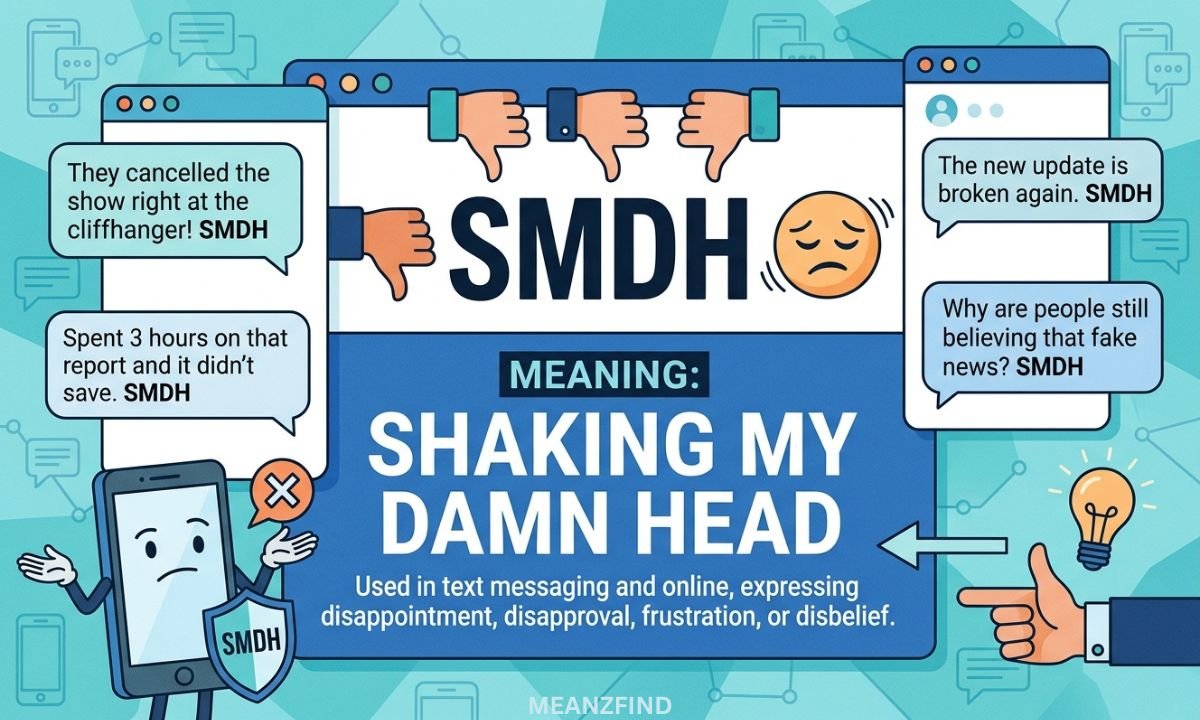
You have probably seen “SMDH” in a comment or a text and wondered what it means. It looks like a random set of letters. But it is a very common slang term online. People use it all the time when they feel upset or let down.
SMDH stands for “shaking my damn head.” Some people also say “shaking my dang head” to keep it softer. It shows disbelief, annoyance, or disappointment. It is like shaking your head in real life when someone does something silly.
You will see SMDH in texts, group chats, and on social media. People write it under news posts, memes, and tweets. It is short, quick, and easy to type. In this guide, you will learn what it means, how to use it, and how to reply to it.
What Is SMDH Meaning?
SMDH stands for “shaking my damn head.” People type it when they feel annoyed, let down, or shocked by something. It works like a real head shake, but it happens on a screen.
Some people write “shaking my darn head” instead. That version sounds softer. Both versions mean the same thing.
You will see SMDH in texts, group chats, comments, and captions. It is short and quick to type. That is why so many people use it.
Think of SMDH as a tiny reaction. It says, “I can’t believe this,” without a long message. One word can carry a lot of feeling.
SMDH Meaning in Text – Quick Definition
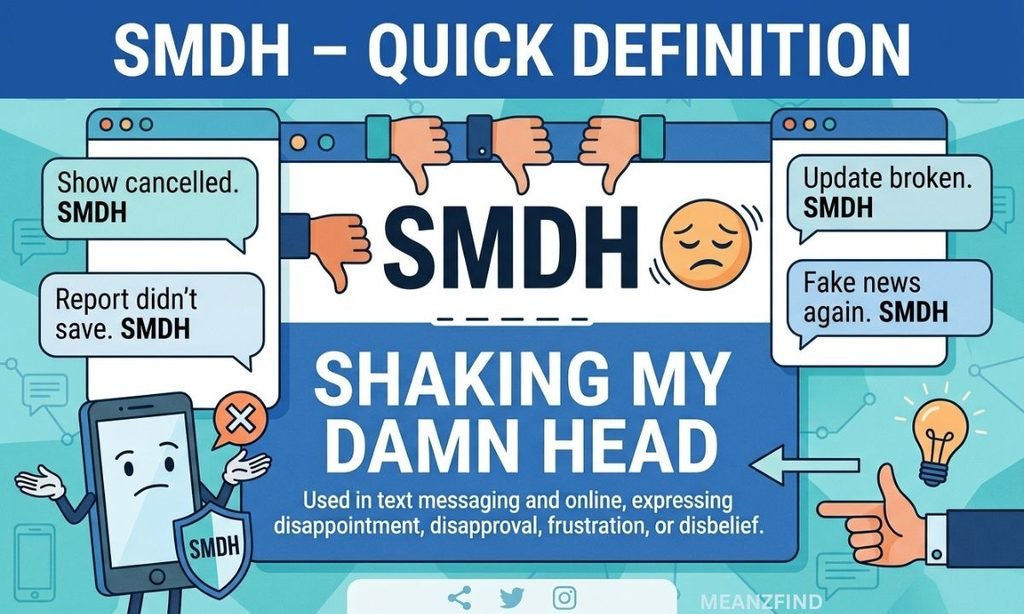
When someone sends SMDH in a text, they are showing disbelief, disappointment, or mild anger. They are not always angry. Sometimes they are just tired of a bad situation.
Here is the short answer you can remember:
- SMDH = shaking my damn head
- Feeling: disappointed, annoyed, or amazed in a bad way
- Where it is used: texts, chats, comments, and posts
- Tone: casual, not formal
Simple Meaning
In simple words, SMDH means, “This is so bad or so silly that all I can do is shake my head.” The person sees something wrong and has no more words.
Picture a teacher watching a student walk into a closed door for the third time. She does not say anything. She just shakes her head. SMDH is that moment in letters.
Example Messages
Here are some easy examples of how people use SMDH:
- “He forgot his own birthday party. SMDH.”
- “Third time this week the bus was late. SMDH.”
- “They sold out of tickets in two minutes. SMDH.”
- “My brother ate my lunch again. SMDH.”
- “People still don’t clean up after their dogs. SMDH.”
Notice that SMDH usually comes at the end of a sentence. It acts like a full stop with feeling. Sometimes people also put it alone as a reply.
Origin and Background
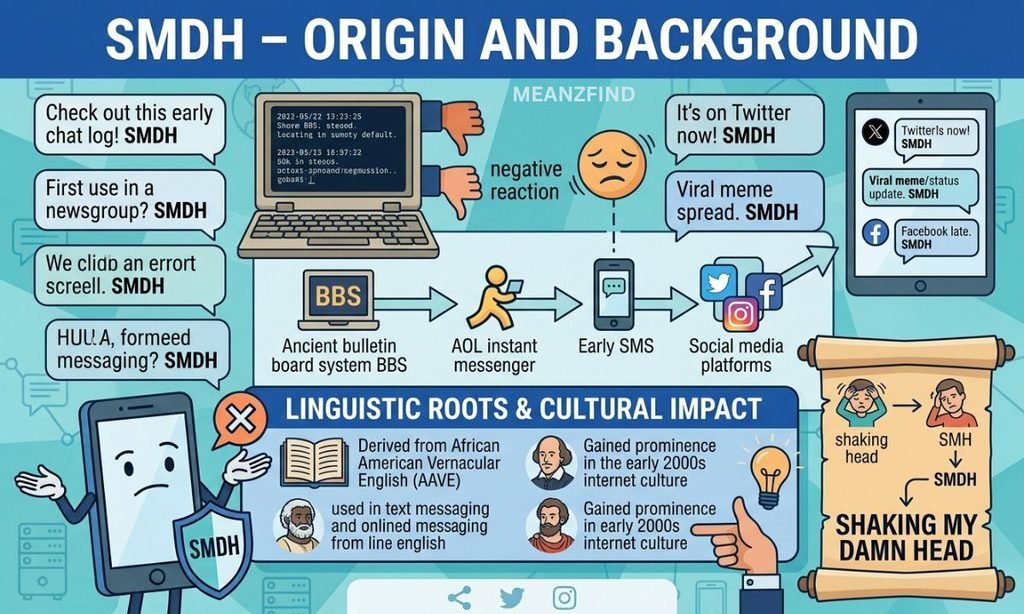
No one knows who typed SMDH first. Like most slang, it grew slowly because many people started using it. It is a longer form of SMH, which means “shaking my head.”
SMH became popular because it was fast to type. People needed short words for chat rooms, message boards, and early phones. Typing a full sentence took too long.
Then people wanted to show a stronger feeling. They added the letter “D” for “damn,” and SMDH was born. That one extra letter made the message sound more annoyed.
Early Internet Influence
In the early days of the internet, people chatted on forums and instant messengers. Short forms such as LOL, BRB, and OMG were everywhere. Writing less meant talking faster.
Early text messages also had a small limit on how many letters you could send. Every letter counted. So people shortened phrases, and SMH became one of those short forms.
Later, social media sites like Twitter made short writing even more popular. Posts had a limit, and people loved quick reactions. SMDH grew in this world of fast comments and short posts.
SMDH Meaning in Text Today
Today, SMDH meaning in text is clear to most young people online. It is not a new or strange word anymore. You can see it in group chats, comment sections, and video captions.
It has also changed a little over time. Many people now use it in a joking way, not only in an angry way. Sometimes it is just a funny reaction to a silly moment.
Real-Life Conversations (How People Actually Use It)
The best way to understand slang is to see it in real chats. Below are four easy examples. Each one shows a different place where people use SMDH.
WhatsApp Chat Example
Ayesha: Did you see Hamza’s message in the class group?
Sana: No. What happened?
Ayesha: He sent the homework answers to the wrong group. Our teacher’s group.
Sana: Oh no. SMDH.
Ayesha: I know. He is going to hear about this tomorrow.
Sana: At least he is honest by accident. 😂
Here, Sana uses SMDH to show she cannot believe the mistake. She is not angry at Hamza. She is just shocked and a little amused.
Instagram DM Conversation
Zara: Look at this reel. A man tried to park his car in a space that was way too small.
Maria: Haha, did he succeed?
Zara: He hit the pole and then blamed the pole.
Maria: SMDH. Some people never learn.
Zara: The comments are even funnier.
On Instagram, SMDH often comes with videos or reels. People use it to react to funny, silly, or sad clips. It keeps the chat light and quick.
TikTok Comment Section
Comment sections on TikTok move fast. People write short reactions because there are thousands of comments. Here is how it may look:
- “He really said that on live TV. SMDH.”
- “Not another price increase. SMDH.”
- “Still waiting for the part two. SMDH.”
- “People will believe anything. SMDH.”
In comment sections, SMDH shows that a person has an opinion but does not want to write a long essay. It is a polite way to say, “I disagree” or “That is sad.”
Text Message Example
Bilal: Bro, my phone fell in the water again.
Usman: Again? That is the second phone this year.
Bilal: I know. I was filming a fish.
Usman: SMDH. You and water are not friends.
Bilal: I need a new phone and a new hobby.
In a one-to-one text, SMDH can also be friendly teasing. Usman is not mad. He is shaking his head the way a friend would.
Emotional and Psychological Meaning
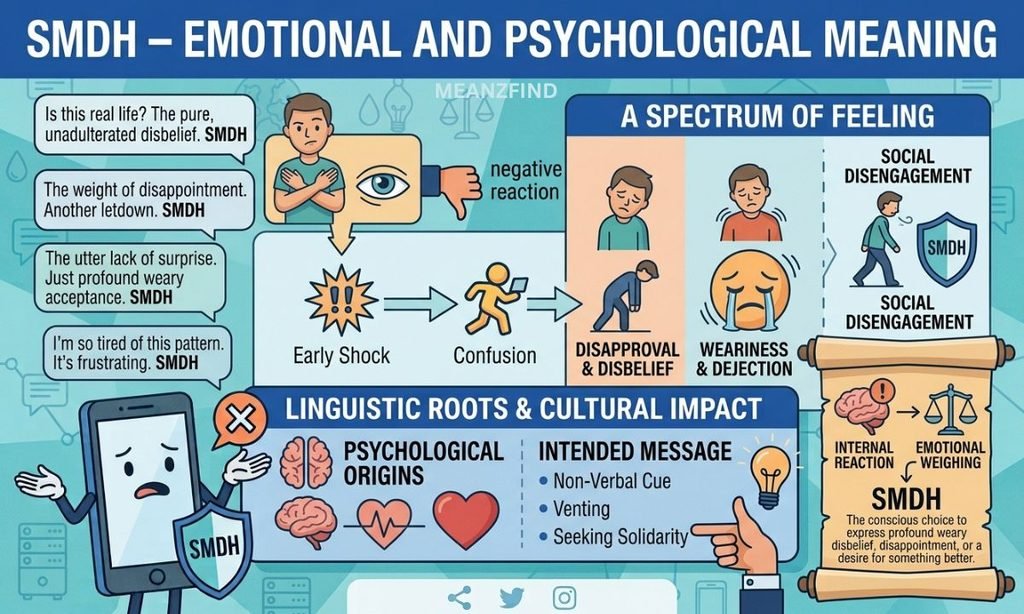
SMDH is more than three or four letters. It carries a feeling. Understanding that feeling helps you use the word the right way.
Why People Use It
People use SMDH for a few simple reasons:
- To show disappointment. Something went wrong, and they feel let down.
- To show disbelief. They cannot believe what they just saw or heard.
- To avoid a fight. It is a softer way to say, “I do not agree.”
- To save time. It is quicker than writing a full sentence.
- To joke. Sometimes it makes a silly moment even funnier.
Often a person feels tired or frustrated and does not want to explain why. SMDH says it all in one short word. It lets them share the feeling without a long talk.
Social Psychology Behind It
Humans love to belong to a group. Using the same slang as your friends makes you feel connected. When you write SMDH and they understand it, you feel part of the same circle.
Another reason is emotional release. When something annoys us, we feel better after we say something about it. SMDH is a small way to let the feeling out. It is safer than yelling or writing an angry message.
There is also the idea of shared opinion. When many people comment SMDH under the same post, they all say, “We feel the same.” That makes people feel less alone with their opinion.
Finally, a head shake is a body signal that almost every culture understands. Because of that, SMDH feels natural. Even if a person has never seen the word before, they can guess the meaning from the “shaking my head” part.
Usage in Different Contexts
SMDH is not used the same way everywhere. The place and the person you talk to matter. Let’s look at four common situations.
1. Social Media
Social media is the home of SMDH. It fits well in comments, captions, replies, and stories. People use it when they see something silly, sad, or unfair.
Here are some common social media uses:
- Reacting to a bad news headline
- Commenting on a funny mistake in a video
- Replying to a post that people disagree with
- Adding a caption to a photo of a messy situation
On social media, people usually write SMDH in capital letters. Sometimes they use small letters, like “smdh.” Both ways are fine.
2. Friends and Relationships
Among friends, SMDH is common and friendly. It often shows teasing. For example, a friend may send SMDH when you forget your keys again.
In a close relationship, it can also show mild frustration. A person may write, “You left the lights on again. SMDH.” It is a light way to complain without starting a big fight.
Be careful, though. If your friend is upset or sad, SMDH can sound cold. In that case, it is better to write a kind sentence, like, “That sounds hard. I’m sorry.”
3. Work or Professional Settings
Most of the time, SMDH is not a good choice for work. It is slang, and the word “damn” can sound rude to some people. A boss, a client, or a teacher may not like it.
If you must show disappointment at work, use clear and polite words. For example:
- Instead of “SMDH,” write, “That is disappointing.”
- Instead of “SMDH,” write, “I did not expect that result.”
- Instead of “SMDH,” write, “Let’s fix this together.”
There is one small exception. In a relaxed group chat with close coworkers, a quick SMDH may be fine. Still, think before you send it.
4. Casual vs Serious Tone
SMDH works best in a casual, light tone. It fits silly mistakes, small problems, and daily annoyances. Think late buses, spilled juice, and wrong orders.
It does not fit serious or painful topics. Imagine someone tells you about an illness or a loss. Replying with SMDH would sound unkind. In those moments, use warm and caring words.
A simple rule can help. If the topic is funny, silly, or small, SMDH is fine. If the topic is sad, painful, or serious, write a kind message instead.
Common Misunderstandings
Because SMDH is short, people sometimes get its meaning wrong. Here are the most common mistakes.
1. Thinking It Is an Insult
Some people think SMDH is a rude word aimed at them. That is usually not true. In most cases, the person is reacting to a situation, not attacking you.
For example, if someone writes, “The bus came late again. SMDH,” they are upset at the bus. They are not upset at you. Reading the full message helps you see what the feeling is about.
Of course, SMDH can sometimes be aimed at a person. If a friend writes, “You forgot again? SMDH,” it is a gentle complaint. It is still not a real insult, but it does show they are disappointed.
2. Confusing It With Similar Abbreviations
SMDH looks like other short forms. Because of that, people mix them up. SMH, SMFH, and SMDH all have a head shake in them, but the strength is different.
- SMH is the mildest one.
- SMDH is a bit stronger.
- SMFH is the strongest and the rudest.
Also, SMDH is not related to words like SMS or SMM. Those are about messages and marketing. Always look at the full message so you do not guess wrong.
3. Using It in Formal Situations
Many new users send SMDH in places where it does not belong. A school email, a job message, or a letter to an older person is not the place for it. It can make you sound careless.
Slang is like casual clothes. You wear it with friends, not to a formal meeting. Keep SMDH for relaxed chats.
4. Assuming It Always Means Anger
Many people think SMDH always means anger. That is not true. It can also mean sadness, shock, tiredness, or even a joke.
For example, “He tripped over his own shoelace again. SMDH.” This is more funny than angry. The person may be smiling while typing it.
The tone of the full message tells you the true feeling. Check the emojis, the words around it, and the topic. Those clues help you read the mood.
Comparison Table
This table shows how SMDH compares with similar words. Use it to pick the right one for your message.
| Term | Full Form | Strength | Best Used For | Safe for Work? |
| SMH | Shaking my head | Mild | Light disbelief or small disappointment | Usually okay in casual chats |
| SMDH | Shaking my damn head | Medium | Clear annoyance or strong disbelief | No, avoid it |
| SMFH | Shaking my f-ing head | Strong | Very angry or very upset moments | No, never |
| Facepalm | Hand on the face | Mild to medium | Silly mistakes | Yes, in friendly chats |
| Bruh | Casual “brother” word | Mild | Funny disbelief | No, too casual |
| Unbelievable | Plain word | Medium | Shock or frustration | Yes |
| Really? | Plain question | Mild | Doubt or surprise | Yes |
A quick tip: if you are not sure, pick the milder word. It is much easier to sound too soft than too harsh.
Variations and Related Expressions
SMDH has many cousins. Each one shows a slightly different mood. Knowing them helps you understand people better and pick the right word.
1. SMH
SMH means “shaking my head.” It is the original and mildest form. People use it for small things, like a silly mistake or a bad joke.
Example: “He wore two different shoes to school. SMH.”
2. SMMH
SMMH is a rare form. It is not standard slang, and it has no single fixed meaning. Most of the time, people use it as a playful stretch of SMH, or it is a typing slip.
If you see it, read the full message. The mood will usually be clear. It will most likely show light disbelief, just like SMH.
3. Facepalm
Facepalm means putting your hand on your face because of something silly. People write the word, or they use the 🤦 emoji. It shows that someone did something so foolish that you want to hide your face.
Example: “He locked his keys inside the car. Facepalm 🤦.”
4. Seriously?
“Seriously?” is a question people use when they are shocked or annoyed. It shows that they cannot believe what happened. It is safe and polite, so you can use it in many places.
Example: “Seriously? They cancelled the match again?”
5. I Can’t Even
“I can’t even” means, “I am so shocked that I cannot find the words.” The sentence is purposely left unfinished. It can show disbelief, frustration, or even excitement.
Example: “He wore his pajamas to the wedding. I can’t even.”
6. Bruh
“Bruh” is a casual slang word. It started from “bro,” but now it shows disbelief or disappointment. It is very informal and works best with friends.
Example: “You forgot the tickets? Bruh.”
7. Wow
“Wow” can be happy, but it can also be sarcastic. When someone says “wow” in a flat tone, it shows disappointment. In writing, the mood often depends on punctuation and emojis.
Example: “You ate the last slice and didn’t tell me? Wow.”
8. Unbelievable
“Unbelievable” is a plain, clear word. It means something is so bad or so shocking that it is hard to believe. It is more polite than SMDH, so it fits more places.
Example: “They raised the price again. Unbelievable.”
9. Here We Go Again
This phrase shows tiredness. It means a bad thing is happening one more time. The person feels worn out by the same problem.
Example: “The Wi-Fi stopped working. Here we go again.”
10. Really?
“Really?” is a short, soft question that shows doubt. It is very flexible and works in casual and formal chats. It is a good choice when you want to show surprise without sounding rude.
Example: “You want me to redo the whole project? Really?”
How to Respond When Someone Uses SMDH
Sometimes you are on the other side. A friend sends you SMDH, and you are not sure what to say. The best reply depends on the mood and the person.
First, read the message again. Ask yourself, “What is this person upset about?” Then pick a reply that matches the feeling.
Casual Replies
Casual replies are easy and friendly. Use them with friends and family. Here are some ideas:
- “I know, right?”
- “Same here.”
- “That is so annoying.”
- “Wait, what happened?”
- “I feel you.”
- “Ugh, I’m sorry.”
These replies show you listen. They also keep the chat going in a natural way.
Funny Replies
If the mood is light, a little humor can help. It can turn a bad moment into a good laugh. Use these with people who like jokes.
- “Shake it harder, maybe the problem will fall out. 😂”
- “Your head must be tired by now.”
- “Careful, you will get dizzy.”
- “That head shake needs a sports medal.”
- “Okay, now do a spin.”
Be careful, though. Only joke if the other person is clearly not too upset. If they seem hurt, skip the humor.
Mature or Confident Replies
Sometimes you want to sound calm and clear. These replies work well if the SMDH was aimed at something you did, or if the topic is a bit serious.
- “I understand why you feel that way.”
- “Fair point. Let me fix it.”
- “I hear you. Let’s talk about it.”
- “You are right. I’ll do better next time.”
- “Thanks for being honest.”
These replies show respect. They also stop small problems from growing bigger.
Respectful Private Replies
If the SMDH is aimed at you in a group chat, you may not want to answer in public. A private message can feel safer for both people. It also keeps the group chat calm.
Try something like this:
- “Hey, can we talk about it privately?”
- “I saw your message. Let me explain in a DM.”
- “I think I missed something. Can you tell me more?”
- “I’m sorry if I upset you. Let’s sort it out.”
Private replies show care. They also give the other person room to speak without an audience.
Regional and Cultural Usage
Slang moves across the world, but each place gives it a small twist. SMDH is mostly used by young people who chat in English online. Still, how they use it can change a little from place to place.
Western Culture
In countries like the United States, Canada, and the United Kingdom, SMH and SMDH are very common. Young people use them in texts, tweets, and comment sections. News posts and sports talk often have lots of them.
In Western chat culture, people often use SMDH as a quick reaction to a headline or a funny mistake. It is considered casual. Most people know it is not for formal emails.
Asian Culture
In many Asian countries, young people learn English slang from social media, games, and videos. SMDH shows up in English-language chats, especially on Instagram, TikTok, and Discord. Many users mix it with their own language.
For example, a teenager in South Asia may write a sentence in Urdu or Hindi and end it with SMDH. This mix of languages is very common. It makes chats feel fun and personal.
Respect for elders is also important in many Asian families. Because of that, many people avoid slang with older relatives or teachers. SMDH is kept for friends and classmates.
Middle Eastern Culture
In the Middle East, young people also use English slang online. They mix it with Arabic or other local languages. SMDH can show up in social media comments and in group chats.
Politeness and respect matter a lot in daily talk. Because “damn” can sound rude, some people choose the milder SMH or a local phrase instead. Many young users know that the harsh word may not suit every person.
Global Internet Culture
On the global internet, SMDH is part of a shared online language. Gamers, fans, and creators from different countries use the same short forms. A person in one country can read a comment from another country and understand the feeling right away.
Still, the same word can feel different to different people. What sounds friendly in one place may sound rude in another. The best habit is to know your audience before you hit send.
Tips For SMDH Meaning
Here are some simple tips to help you understand and use SMDH the smart way.
- Read the full message. The words around SMDH tell you the real mood.
- Check the emojis. A 😂 means it is a joke. A 😔 means the person is sad.
- Think about your audience. Use SMDH with friends, not with teachers or bosses.
- Do not use it in serious moments. When someone shares bad news, choose kind words.
- Pick the milder choice if unsure. SMH is softer and safer than SMDH.
- Do not overuse it. If every message ends in SMDH, it loses its power.
- Match the strength to the situation. Use it for small annoyances, not for big problems.
- Do not use it to hurt people. A head shake can feel like a put-down if it is aimed at a person.
- Ask when you are unsure. If you do not understand someone’s message, ask them politely.
- Keep learning. Slang changes fast, so stay open to new words.
If you remember only one tip, remember this one: tone matters more than letters. The same three words can be funny or hurtful, depending on how you use them.
FINAL WORDS
SMDH is a short way to say “shaking my damn head.” People use it when something feels silly, sad, or hard to believe. It is a quick way to show you are not happy about something. Just three letters can say a lot.
You can use SMDH in texts, chats, and social media posts. It works well when you want to react fast. Use it with friends and people you know well. Keep it light and clear, so your message is easy to understand.
Be careful about where you use it. The word “damn” can sound rude to some people. Avoid SMDH in school emails, work messages, or formal chats. In those places, write the full sentence instead.
Now you know what SMDH means and how to use it. Next time you see it, you will get the message right away. You can even reply with it when you feel the same way. Slang changes fast, but SMDH is easy to remember and still popular today.
FAQs
What does SMDH mean in text slang?
SMDH means “shaking my damn head.” People use it to show disbelief, annoyance, or disappointment.
What does SMH mean in Gen Z slang?
SMH means “shaking my head.” Gen Z uses it as a quick reaction to something silly, sad, or hard to believe, and often just as a joke.
When a girl says “smh”?
She is usually reacting to something silly or disappointing, not always to you. Check her tone, the words around it, and any emojis to see if she is joking or annoyed.
What does SDMH mean?
SDMH is not a standard slang term. Most of the time it is a typo for SMDH, which means “shaking my damn head.”
What is SMB texting from a girl?
SMB has no single fixed meaning in texting, and it can be a rude phrase or a casual abbreviation depending on the chat. Read the tone and context, or simply ask her what she means.
What does SDM mean in texting?
SDM is not common slang and has no standard meaning. It is often a typo or a short form of something like “send DM,” so ask the person if it is unclear.
What is SMFH texting?
SMFH means “shaking my f-ing head.” It is a stronger and ruder version of SMH and SMDH, used for big anger or shock, so avoid it in formal chats.