
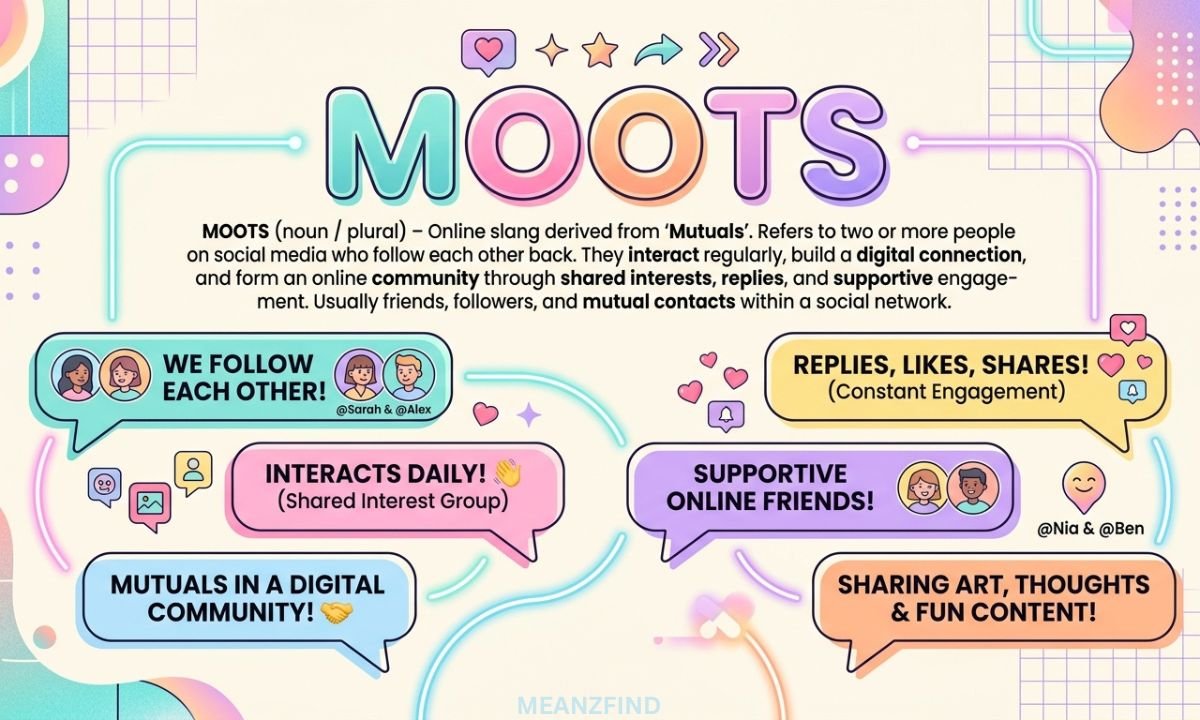
You have probably seen the word “moots” in a comment or a caption and wondered what it means. It pops up on TikTok, X, and Instagram all the time. People use it in posts, bios, and chats. The meaning is simple once you know it.
Moots is short for “mutuals.” A moot is someone you follow who also follows you back. It is a friendly term for online friends. You may not know them in real life, but you talk to them often and enjoy their posts.
In this guide, you will learn what moots means in text and on social media. You will also see where it came from and how people use it. There are easy examples too. By the end, you will know how to use it like a pro.
Moots Meaning in Text – Quick Meaning
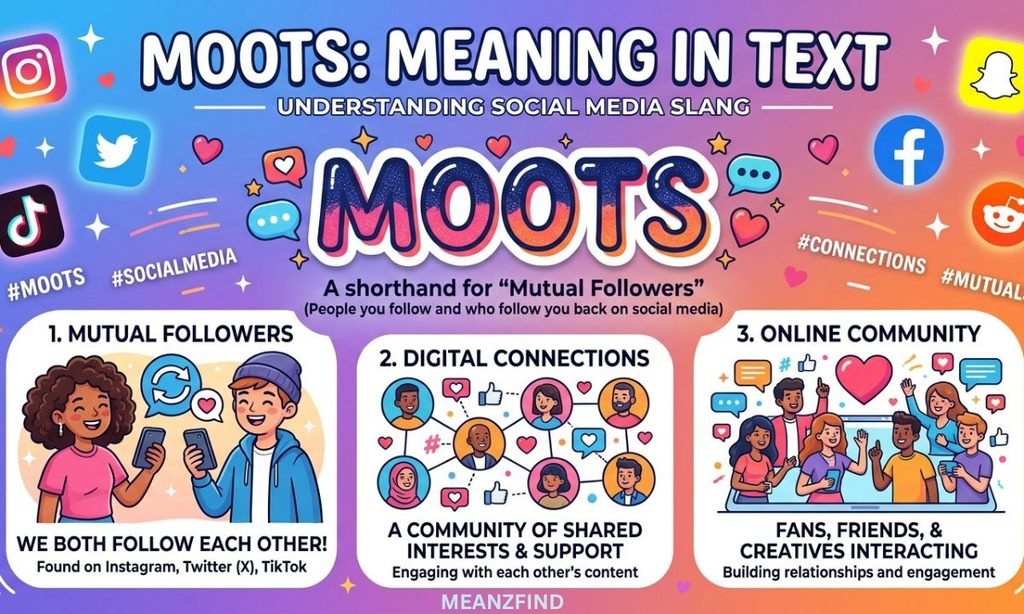
Moots means “mutuals.” A moot is a person you follow online who also follows you back. The word is short, casual, and very common on Instagram, TikTok, and X (Twitter).
When someone says “my moots,” they mean the online friends who follow them and whom they follow too. It is a warm word. It tells you there is a two-way link between two accounts.
Simple Definition
Moots is a slang word for mutual followers. You follow them. They follow you. That is all it takes to be moots.
Think of it like a handshake. One person reaching out is not enough. Both people need to reach out, and then you are moots.
Key Points
Here are the main things to remember about this word:
- Moots = mutuals. It is a short form of the word “mutuals.”
- It is a two-way link. Both people follow each other.
- It is online slang. You will mostly see it in texts, comments, captions, and bios.
- It is casual. People use it with friends, not in school essays or work emails.
- It does not mean close friends. Moots can be strangers who chat often, or real-life buddies.
- One person is a “moot.” Many people are “moots.”
Example Sentences
Here are some easy examples so you can see the word in action:
- “Shoutout to my moots for being so kind this week.”
- “I just hit 500 followers, thanks to all my moots!”
- “Do I have any moots who love anime?”
- “She is not a moot yet. I follow her, but she has not followed me back.”
- “Moots, please vote on my new profile picture.”
- “I love my moots. They always make me laugh.”
- “Any moots want to join my group chat?”
Moots Meaning in Text
In a text message or chat, moots works the same way. It points to people who follow each other online. You might see it in a DM, a group chat, or a comment under a post.
For example, a friend may text you, “I posted a new reel, tell the moots to watch it.” Here, “the moots” means all the shared followers you both know. It is a quick way to say “our online circle.”
Most people type it in lowercase. You will often see it with emojis like 💕, 😂, or 🫶. The tone is nearly always friendly and light.
The word also saves time. Typing “moots” is faster than typing “people who follow me and whom I follow back.” That is a big reason it caught on so fast in texting.
IG Moots Meaning in Text
On Instagram, moots are people who follow you, and you follow them. You can see this right on the app. When you open someone’s profile, Instagram often shows a “Follows you” label if they follow you back.
IG moots matter a lot to many users. They are often the first people to like your photos, watch your stories, and reply to your reels. Many creators say their moots are the heart of their small online space.
Here is how IG users talk about moots:
- In captions: “Happy Friday to my favorite moots.”
- In stories: “Moots, send me a song to listen to.”
- In bios: “Moots only. Please follow back.”
- In comments: “This is so true, moots will understand.”
Some people keep a private account just for their moots. Others use the “Close Friends” list for a smaller group. That list is not the same as moots, but the two ideas often overlap.
Origin & Background of the Word “Moots”
The word comes from “mutuals,” which is a short way to say “mutual followers.” People began shortening it to “moots” because it is quicker and sounds cute. Nobody can point to the exact day it started. Language online grows in many places at once.
Many users first noticed the term on Twitter, now called X. Fan communities there used it often. Fans of music groups, shows, and games liked to talk about who followed whom. A short word made those chats easier.
The word “mutuals” has a simple logic. Mutual means shared or two-way. Two accounts that follow each other share a link, so they are mutuals. Over time, the casual spelling “moots” took over in everyday talk.
Evolution of the Word
At first, “mutuals” was a plain word used in fan spaces. People said things like “I only follow mutuals.” Then users began typing it fast and dropping letters. Short forms spread in texting, and “moots” was born.
After that, the word grew in a few steps:
- Mutuals became the common term for people who follow each other.
- Moots became the short, playful form.
- Moot became the word for one person.
- Extra phrases like “moot check” and “moot squad” came later as fun add-ons.
Today, moots is not just a word. It is a small piece of online culture. It shows how fast slang can move when many people use it every day.
Platform Influence
Different apps helped the word spread in different ways:
| Platform | How “Moots” Is Used |
| X (Twitter) | Fans and creators call their followers who follow back “moots.” Posts like “moots, say hi” are common. |
| Used in captions, stories, and DMs to speak to close online friends. | |
| TikTok | Used in comments and videos. Creators say “hi to my moots” or ask for support. |
| Snapchat | Less common, but some users use it for friends who add each other. |
| Tumblr and Reddit | Used in fan spaces, though other words also appear. |
TikTok gave the word a big boost with young users. Short videos and fast comments made the slang spread quickly. Instagram helped it reach even more people through stories and DMs.
Real-Life Conversations Using “Moots”
Seeing a word in real chats is the best way to learn it. Here are three simple examples that sound like what people say every day.
1. Instagram DM Conversation
Sara: Hey! Did you see Maya’s new post?
Zain: Yes! She tagged all her moots.
Sara: I think we are moots now, right? You followed me back.
Zain: Yes, we are! Welcome to the moots club 😂
In this chat, Sara and Zain use “moots” to mean people who follow each other. The tone is playful and friendly.
2. TikTok Comment Section
Comment 1: Moots, where are you? I need support on my new video!
Comment 2: Right here! Just liked and shared it 💕
Comment 3: Love how my moots always show up.
Here, the creator is calling on followers who follow back. The replies show the warm side of moots. People are cheering each other on.
3. WhatsApp Chat
Ali: Did you join the new group?
Bilal: Which one?
Ali: The one for our moots from Instagram. We all chat there now.
Bilal: Oh nice, send me the link.
This shows how moots can move from one app to another. People who first met online as followers often start private chats on WhatsApp.
Emotional & Psychological Meaning Behind “Moots”
Moots is more than a label. It carries a feeling. When someone calls you a moot, it can mean “I see you, and I like having you here.” That small signal feels good to many people.
Online spaces can feel big and noisy. A small group of moots feels like a cozy corner. You know their names. You know their jokes. You feel safe posting around them.
Why People Like the Term
People love this word for a few clear reasons:
- It feels friendly. The word is soft and playful.
- It builds belonging. Being a moot means you are part of a group.
- It is easy to say. It is short and fun to type.
- It feels fair. Both people follow each other, so neither feels left out.
- It sounds less formal than “followers.” Followers can feel like a crowd. Moots feel like friends.
Many young users say it feels good to have people who show up for them. A like, a comment, or a kind message from a moot can make a day better.
Online Identity
Our online selves are a part of who we are. The people we follow, and who follow us, shape how we feel on an app. Moots help build that picture.
A strong set of moots can make a person feel more confident. They share ideas. They share jokes. They share support. This helps people feel seen, especially if they are shy in real life.
However, it is wise to remember one thing. Moots are online connections. They can be wonderful, but they do not replace real-life friends and family. A healthy mix of both is best.
Usage in Different Contexts
The word moots can sound a little different in each setting. Here is how people use it in the most common places.
1. Social Media
This is the main home of the word. Users talk to their moots in captions, stories, bios, and comments. They also use it to ask for help, to share news, or to say thanks.
Some common social media lines are:
- “Moots, what should I post next?”
- “Thank you to all my moots for 1,000 followers.”
- “Drop a 💜 if you are my moot.”
2. Friends & Online Relationships
Many friendships begin as moots. Two people follow each other, like each other’s posts, and slowly start to chat. Over time, they may share more about their lives.
In these cases, the word often describes a stage. First you are moots. Then you may become friends. Later, you might even meet in person. Not every moot becomes a close friend, and that is perfectly fine.
3. Professional or Creator Communities
Artists, writers, gamers, and small business owners often use the word too. Their moots may be other creators who support each other’s work. They share posts, give feedback, and cheer each other on.
In these spaces, moots can be a helpful network. They may share tips, share job news, or help each other grow. The tone is still casual, but the link can be very useful.
Casual vs Serious Tone
Moots is a casual word. It fits best in relaxed chats, captions, and comments. It sounds natural when you talk to friends.
It does not usually fit serious or formal talk. You would not write “I will ask my moots” in a school report or a job email. Saying “my online friends” or “my followers” works better there.
| Setting | Is “Moots” a Good Fit? | Better Choice for Serious Talk |
| Chat with friends | Yes | Not needed |
| Instagram caption | Yes | Not needed |
| TikTok comment | Yes | Not needed |
| Job email | No | “My professional contacts” |
| School essay | No | “My online friends” |
| Official post for a brand | Sometimes | “Our community” |
A good rule is simple. If you would use a smiley face, you can use moots. If you would wear a suit, skip it.
Common Misunderstandings
Some people mix up the meaning of this word. Here are the most common mistakes and how to fix them.
1. Thinking Moots Means Close Friends
Moots are not always close friends. A moot may be someone you have never met. You might only like each other’s posts and send an emoji now and then.
Close friends are people you know well and trust deeply. Some moots do become close friends, but the word itself only describes a follow link.
2. Assuming It Means Followers
Followers and moots are not the same thing. A follower is anyone who follows you. A moot is someone who follows you and whom you follow back.
If 1,000 people follow you, but you follow only 100 of them, you have up to 100 moots. The rest are followers only.
3. Using It in Formal Conversations
Moots is slang. It can sound odd in a formal setting. A teacher or boss might not know the word.
Save it for casual chats. When in doubt, pick a plain word like “friends” or “contacts.”
4. Confusing It With “Moot”
“Moot” is also an old English word. It means something that is open to debate, like “a moot point.” It can also mean something that no longer matters.
These meanings are not connected to the social media word. If you see “moot point” in a news story, it has nothing to do with followers. Context makes the meaning clear.
Comparison Table
This table shows how moots differ from similar words:
| Term | Meaning | Follows You? | You Follow Them? | Closeness |
| Moots | People who follow each other | Yes | Yes | Varies |
| Followers | Anyone who follows your account | Yes | Not always | Low to medium |
| Following | Accounts you follow | Not always | Yes | Low to medium |
| Close friends | People you trust and know well | Often | Often | High |
| Mutual friends | Friends shared by two people | Varies | Varies | Varies |
| Strangers | People with no link to you | No | No | None |
Key Insight
The most important idea is this: moots describes a link, not a level of friendship. The link is the follow. The friendship, if there is one, grows on top of it.
Variations of “Moots”
Online slang grows fast. People have made many fun phrases around the word moots. Here are the most common ones and what they mean.
1. Moot
“Moot” is the word for one person. If someone says “She is my moot,” it means she follows them and they follow her.
2. Mooties
“Mooties” is a cute and playful form of moots. It sounds extra friendly. People often use it for a close, warm group. For example: “Good morning, mooties!”
3. New Moots
“New moots” means people who just started following each other. A user may post, “Hi to my new moots! Tell me about yourself.”
4. Moot Check
A “moot check” is a fun way to see who follows whom. Someone posts “moot check” and asks people to reply. Everyone who replies may then follow each other and become moots.
5. Moot Support
“Moot support” means help from your mutual followers. It can be a like, a share, or a kind comment. A creator might write, “Moot support needed for my new video.”
6. Moot Circle
A “moot circle” is a small group of moots who talk often. They may share jokes, tag each other, and chat in group messages. It feels like a small online club.
7. Loyal Moots
“Loyal moots” are the ones who always show up. They like your posts, cheer for you, and stay kind. Creators often thank their loyal moots in big moments.
8. Active Moots
“Active moots” are moots who post and chat a lot. They are easy to reach, and they keep conversations going. Quiet moots, on the other hand, may follow you but rarely interact.
9. Moot Squad
A “moot squad” is a tight, fun group of moots. It is like a friend team online. Members may have inside jokes and shared plans.
10. Favorite Moot
A “favorite moot” is your best online buddy among your mutuals. It is the person you talk to the most. Saying “You are my favorite moot” is a sweet compliment.
How to Respond When Someone Uses “Moots”
Your reply depends on the mood. You may want to be playful, calm, or warm. Here are some good options.
Casual Replies
Use these when the chat is relaxed and friendly:
- “Haha yes, we are moots now!”
- “Glad to be one of your moots.”
- “Thanks! I love being your moot.”
- “Moots forever 💕”
- “Yes, count me in!”
Funny Replies
Use these when you want to make someone smile:
- “Moots? I thought we were best friends already 😂”
- “Welcome to the moot club. Snacks are free.”
- “I accept this moot title with honor.”
- “Okay, but who is the president of the moots?”
- “Moots unite! 🎉”
Mature / Confident Replies
Use these when you want to sound calm and kind:
- “Thank you, I enjoy our chats too.”
- “I am happy to be connected with you.”
- “I appreciate the support, and I am glad we follow each other.”
- “That means a lot. Let us keep in touch.”
Private or Respectful Replies
Use these when you want to stay polite but keep some distance:
- “Thanks for the kind words.”
- “Nice to meet you online.”
- “I appreciate that. I like to keep things simple.”
- “Thank you. I am happy to chat here.”
These replies are friendly, but they do not promise a deep friendship. You can always change your tone later if you feel more comfortable.
Regional & Cultural Usage
The word is global, yet it feels a little different in each place. Here is how people in various regions often use it.
Western Culture
In the US, UK, Canada, and Australia, moots is very common on X, TikTok, and Instagram. Young users use it in fandom spaces, gaming groups, and creator circles. It is usually playful and warm.
Many people in these regions also use it as a way to build a small safe space online. They may say, “Moots only,” to show they want a private, friendly group.
Asian Culture
In countries like South Korea, Japan, India, and Pakistan, fan culture has helped spread the word. Fans of music, dramas, and anime often talk about moots when they find others who share their love for the same star or show.
The tone is often very kind and supportive. Fans share art, translations, and news with their moots. In many places, the word is mixed with local languages, which makes it feel even more personal.
Middle Eastern Culture
In the Middle East, social media is huge, and young people use English slang with Arabic, Urdu, or Persian words. Moots appears in chats and captions as a friendly term for mutual followers.
People often use it in a respectful way. Many users prefer to keep their moots as a small, trusted circle. Privacy matters to many, so private accounts and close lists are popular alongside the term.
Global Internet Culture
Across the world, moots has become a shared piece of internet language. A teenager in one country and a student in another can both use it and understand each other. That is the power of shared slang.
| Region | Common Platforms | Typical Tone |
| Western countries | X, TikTok, Instagram | Playful and casual |
| Asia | X, Instagram, fan forums | Supportive and fan-driven |
| Middle East | Instagram, Snapchat, TikTok | Friendly and private |
| Global | All major apps | Warm and welcoming |
Tips For Choosing Moots Meaning in Text
It is helpful to know how to read the word correctly. Here are some simple tips.
- Check the platform. If you see “moots” on Instagram, TikTok, or X, it almost always means mutual followers.
- Read the full sentence. Words around “moots” often give a clear clue. Phrases like “my moots” or “shoutout to moots” point to followers.
- Look at the tone. A happy, casual tone usually means the slang meaning.
- Do not mix it with “moot point.” If the text talks about debates or old issues, it is the other meaning.
- Ask if you are unsure. A short question like “Do you mean mutual followers?” is polite and clear.
- Match the setting. Use moots with friends and online groups. Use “friends” or “followers” in formal places.
- Keep it kind. The word is warm, so use it in a warm way.
- Remember it is not “close friends.” Do not assume a moot knows you well or wants to share private things.
A quick way to remember: Moots = follow each other. Friends = trust each other. Sometimes they are the same people, and sometimes they are not.
FINAL WORDS
Moots is a simple word with a friendly meaning. It stands for “mutuals,” which are people who follow you and whom you follow back. Online, it means a real connection. It is more than just a follower count.
You can use moots in posts, captions, and chats. Say “shoutout to my moots” when you want to thank your friends. You can also use it when you want to ask them for help. It keeps the tone light and fun.
Keep in mind that moots are not always close friends. Some are people you only talk to online. Others may become real friends over time. Be kind and respectful to all of them, and the bond will grow.
Now you know what moots means in text and on social media. You can use it with confidence and spot it in any chat. Share this guide with a friend who is still confused. And if you have moots of your own, give them a shoutout today.
FAQs
What Does Moots Mean in Slang?
In slang, moots means “mutuals,” or people who follow each other online. It is a casual word used on Instagram, TikTok, and X.
What Is Moots in Gen Z?
For Gen Z, moots are online friends who follow them and whom they follow back. It is a fun, friendly word for their small circle on social media.
Is a Moot a Friend?
Not always. A moot is someone you follow and who follows you back, but they may not be a close friend. Some moots do become real friends over time.
What Are Female Moots?
Female moots are girls or women who follow you and whom you follow back. The word has no special meaning for gender. It works the same for everyone.
What Is Moots Short For?
Moots is short for “mutuals,” which comes from “mutual followers.” People shortened it because it is quicker and sounds cute.
What Does “Moots” Mean in K-pop Slang?
In K-pop slang, moots are fellow fans who follow each other, often on X. They share news, fan art, and love for the same group.
What Is a Moot Person?
A moot person is one account that follows you while you follow them back. “Moot” is the word for one person, and “moots” is for many.