
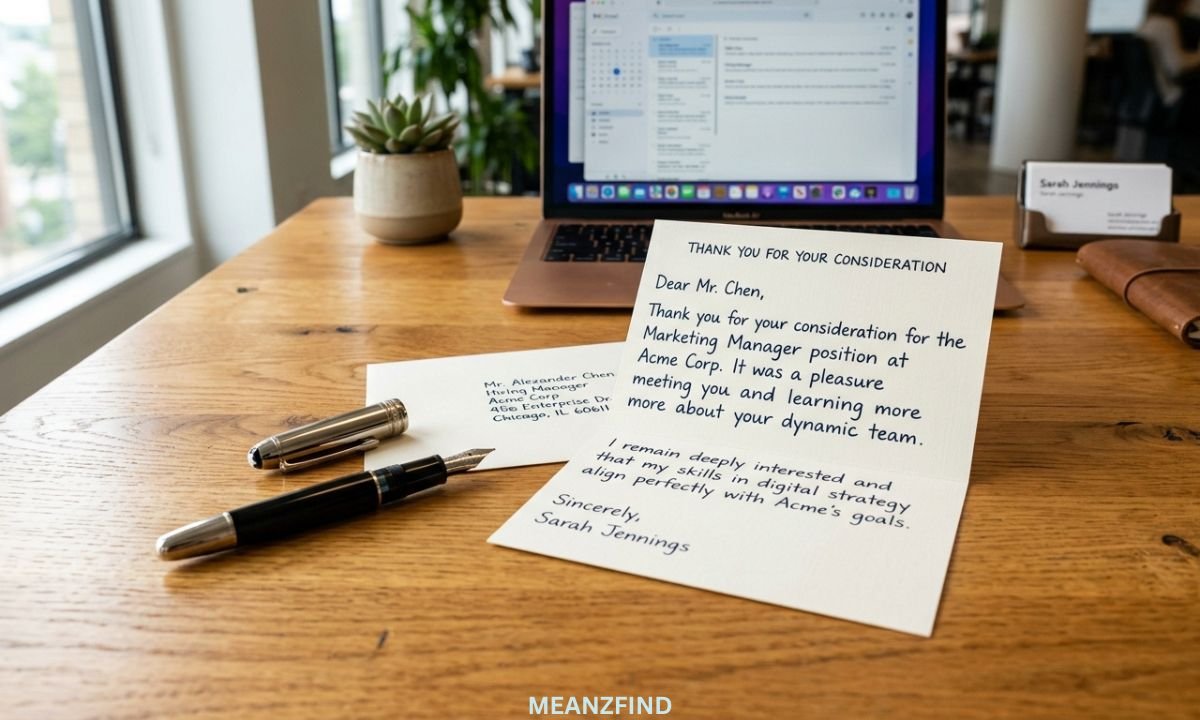
You have probably seen the line “Thank you for your consideration” at the end of an email. It looks simple, but many people are not sure what it really means. Is it a polite goodbye? Or is it asking for something? The answer is a little of both.
In simple words, it means “Thank you for taking the time to think about my request.” The writer is not saying thanks for something you already did. They are saying thanks in advance for the time and thought you will give. That is why it fits so well at the end of a message.
You will see this phrase most in job applications, cover letters, and formal emails. It shows respect and good manners. In this guide, you will learn what it means, when to use it, and how to reply to it. You will also find simple examples you can copy.
Thank You for Your Consideration Meaning
Thank You For Your Consideration Meaning
Discover what this polite phrase means, when to use it, and how to respond in professional and everyday situations.
Note: The phrase is generally polite and professional. Its exact implication depends on the full message and situation.
“Thank you for your consideration” means “Thank you for thinking about my request.” You say it when someone is about to make a decision about you, your work, or your idea. You are thanking them for the time and thought they will give it.
The word “consideration” means careful thinking. When a person considers something, they look at it closely before they decide. So when you write this phrase, you are saying, “I know you are busy. I am glad you will look at this.”
The phrase is polite and formal. It is often used at the end of a message, a letter, or a cover letter. It sounds respectful and calm. It does not sound pushy, and it does not sound too casual.
Here is a simple way to see it.
| Part of the phrase | Simple meaning |
| Thank you | I am grateful |
| for your | for what you will give |
| consideration | your time and careful thought |
One more point matters. This phrase usually looks forward. You say it before the person has decided. You are thanking them in advance for looking at your request. That is why it fits so well in job applications, proposals, and requests.
Quick Meaning in One Line
If you need the shortest answer, here it is. “Thank you for your consideration” means “I appreciate you taking the time to think about this.”
Is It Formal or Casual?
It is a formal phrase. You can use it with a boss, a hiring manager, a teacher, a client, or someone you do not know well. With close friends, it can sound too stiff. You would not usually say it to your best friend about a movie choice.
Where the Phrase Comes From
The word “consideration” comes from an old Latin word that means “to look at closely.” Over many years, people used it in letters and business writing. Today it is a standard polite closing in English.
Thank You for Your Consideration Meaning in Email
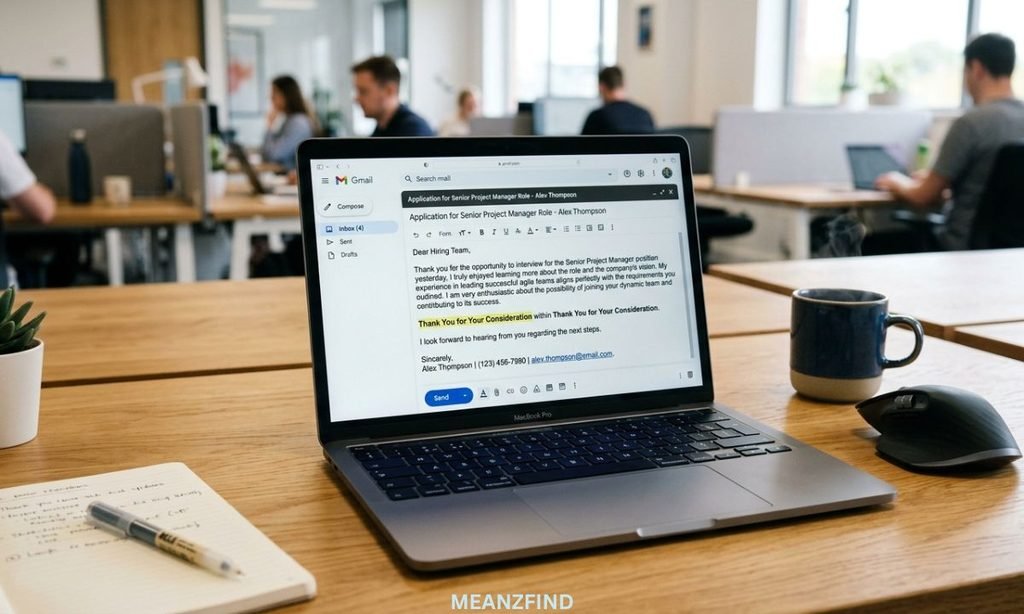
In email, this phrase is a closing line. It goes near the end of your message, just before your sign-off. It tells the reader that your message is finished and that you are thankful for their time.
You can use it in many kinds of emails. These include job applications, follow-up emails, business requests, school requests, and proposals. The phrase works well when you are asking someone to review, approve, or think about something.
Here is a simple email example.
Subject: Application for Marketing Assistant
Dear Ms. Khan,
I am writing to apply for the Marketing Assistant role. I have attached my resume and cover letter. I would be happy to talk about my skills in more detail.
Thank you for your consideration.
Kind regards,
Ali Raza
Notice how short and clear this is. The phrase sits on its own line. It closes the message without adding extra pressure.
What the Phrase Tells the Reader in an Email
When someone reads this line in an email, they usually understand three things.
- You are done with your request.
- You respect their time.
- You are waiting for their decision or reply.
That is a lot of meaning for four words. This is why so many people use it.
Where to Place It in an Email
The best place is the last line of your main message. Put your sign-off after it, such as “Sincerely” or “Best regards.” This keeps the email neat and easy to read.
Here is the usual order.
- Greeting
- Main message
- Thank you for your consideration
- Sign-off
- Your name
Email Examples for Different Situations
| Situation | Example sentence |
| Job application | “I have attached my resume. Thank you for your consideration.” |
| Business proposal | “Please review the attached proposal. Thank you for your consideration.” |
| Request to a teacher | “I would like to request an extension. Thank you for your consideration.” |
| Asking a manager for leave | “I am requesting leave from June 5 to June 8. Thank you for your consideration.” |
| Sending a quote to a client | “Please find our quote below. Thank you for your consideration.” |
How Do You Use “Thank You for Your Consideration”?
Using this phrase is easy. You only need to follow a few simple steps. These steps help you sound polite without sounding fake.
Step-by-Step Guide
- Write your main message first. Say what you need clearly.
- Keep it short. One or two sentences before the phrase is enough.
- Add the phrase near the end. Put it on its own line or as the last sentence.
- Use a full stop or a comma. “Thank you for your consideration.” is the most common style.
- Finish with a sign-off. Use “Sincerely,” “Best regards,” or “Kind regards.”
Simple Rules to Remember
- Use it once in a message. Do not repeat it.
- Use it when you are asking for something or applying for something.
- Use it with people who are making a decision.
- Keep the rest of the message polite and clear.
Different Ways to Write It
You can change the phrase a little to fit your message. Here are some common forms.
- Thank you for your consideration.
- Thank you for your time and consideration.
- Thank you for considering my application.
- Thanks for your consideration.
- Thank you in advance for your consideration.
The first two are the most common. “Thanks for your consideration” is a bit lighter. “Thank you in advance for your consideration” is a bit stronger, because it shows you expect them to think about it.
A Small Tip About “In Advance”
Be careful with the words “in advance.” Some readers feel that “thank you in advance” sounds like you expect a yes. If you want to sound soft and humble, leave those words out. Plain “Thank you for your consideration” is safer.
Examples in Short Sentences
- “I have attached my CV. Thank you for your consideration.”
- “I hope you can approve this request. Thank you for your consideration.”
- “Please review my work when you can. Thank you for your consideration.”
These are short and simple. Short lines like these are easy to read, and busy people like them.
When We Use Thank You for Your Consideration
Now let us look at the best moments to use this phrase. There are many, but a few come up again and again. Each one has its own feel.
After a Job Interview
This is one of the most common times to use the phrase. After an interview, you usually send a thank-you email. In that email, “thank you for your consideration” fits very well. It shows you are grateful and still interested in the job.
Here is an example.
Dear Mr. Ahmed,
Thank you for meeting with me today. I enjoyed learning more about the team and the role. I am very excited about this chance to join your company.
Thank you for your consideration. I look forward to hearing from you.
Sincerely,
Sara Malik
A few tips for this moment:
- Send the email within 24 hours.
- Mention one thing you liked from the interview.
- Keep it under 120 words.
- End with the phrase, then your name.
This small email can make you stand out. Many people forget to send one.
After Receiving or Declining a Job Offer
You can also use the phrase when you answer a job offer. The meaning changes a little here, but it still works well.
When you accept an offer, you are thanking them for choosing you.
Thank you for the offer. I am happy to accept the position. Thank you for your consideration and for this great chance.
When you decline an offer, you are thanking them for the time they spent on you. This keeps the door open for the future.
Thank you for offering me the Sales Executive role. After careful thought, I have decided to decline. I appreciate your time and consideration, and I wish you all the best.
Being polite when you say no is smart. The hiring manager may remember you well. They might contact you again for a better role later.
After Receiving Feedback or Guidance
Sometimes a teacher, a boss, or a mentor gives you advice. You can thank them with this phrase. In this case, “consideration” means the care and thought they put into helping you.
Thank you for your feedback on my report. I will use your advice in the next draft. I appreciate your consideration and your time.
This shows maturity. It tells the person that you listened and that you value their help. Most people enjoy being thanked for their guidance.
One small note. In this case, a phrase such as “Thank you for your feedback” may feel more natural. Use “consideration” when the person also spent extra thought or effort on you.
After a Meeting or Discussion
You can use the phrase after a meeting where you shared an idea or asked for something. It helps you end the follow-up email on a polite note.
Thank you for meeting with me today. I have shared the project plan below for your review. Thank you for your consideration.
This works well when you want a decision, a review, or a reply. It reminds the reader of your request without being rude.
Other Good Times to Use It
Here are a few more moments when the phrase fits.
- When you send a scholarship application.
- When you send a proposal to a client.
- When you submit a resume to a company.
- When you ask for a refund or exception.
- When you send a request letter to a school or office.
- When you send work samples to an editor or agency.
Quick Table: When to Use It
| Moment | Does it fit? | Why |
| After a job interview | Yes | Shows thanks and interest |
| Sending a resume | Yes | Closes a formal request |
| Declining a job offer | Yes | Keeps the relationship kind |
| After feedback | Sometimes | Better if they gave extra effort |
| After a meeting | Yes | Good for follow-up emails |
| Texting a friend | No | Too formal |
| Replying to a casual chat | No | Sounds stiff |
Pros or Cons of Using “Thank You for Your Consideration”
Like any phrase, this one has good points and weak points. Knowing both helps you decide when to use it. Let us look at each side.
Pros
1. It sounds polite and respectful.
The phrase shows good manners. Readers like to feel that their time is valued.
2. It is short and clear.
You do not need many words. Four or five words do the job.
3. It works in many places.
You can use it in emails, letters, cover letters, and forms. It fits school and work.
4. It ends a message neatly.
It gives your message a clean, finished feel. The reader knows you are done.
5. It is safe.
Nobody gets upset by this phrase. It rarely causes problems, which makes it a good choice when you are not sure what to write.
6. It keeps the tone calm.
It does not push the reader. It simply asks them to think about your message.
7. It is easy to learn.
Even new English learners can use it with confidence.
Cons
1. It can sound too common.
Many people use it. If you use it as a copy-and-paste line, it may feel empty.
2. It can feel stiff.
In a friendly or relaxed email, it may sound cold. A warmer line might work better.
3. It can sound like a template.
Hiring managers read many emails. If every email ends with the same line, it may not stand out.
4. It does not add new information.
It does not tell the reader anything about you. It only closes the message.
5. It may sound like you expect a yes.
Some readers feel that the phrase assumes a good answer. This is especially true with “in advance.”
6. It is a poor fit for casual talk.
With friends or close coworkers, it can sound odd.
7. It does not replace a clear next step.
If you want a reply by a certain date, the phrase alone will not say so.
Pros and Cons Table
| Pros | Cons |
| Polite and respectful | Can sound stiff |
| Short and easy | Can feel like a template |
| Works in many emails | Adds no new details |
| Ends a message neatly | May sound like you expect a yes |
| Safe and professional | Poor fit for casual chat |
How to Fix the Weak Points
You can avoid most of the cons with a few small changes.
- Add one personal line before it. For example, “I really enjoyed learning about your team.”
- Say what you want next. For example, “I am happy to share more samples if needed.”
- Change the wording sometimes. Use a synonym when it fits better.
- Match the tone of the person. If they write in a warm style, you can be warmer too.
Thanks for Your Consideration Meaning Synonyms
Sometimes you want to say the same thing in a fresh way. A good synonym can make your message feel more personal. Below are five simple options. Each one has its own feel and best use.
I’m Grateful for Your Attention
This phrase is warm and sincere. The word “grateful” is stronger than “thank you.” It shows deeper thanks. The word “attention” tells the reader you value the time they spent reading.
Meaning: I am thankful that you gave me your time and focus.
Best used: In emails to someone who read a long message, a report, or a detailed application.
Example:
I have attached my full portfolio. I’m grateful for your attention.
I Appreciate Your Thoughtfulness
This one focuses on the kindness and care of the person. “Thoughtfulness” means thinking about other people’s needs. It fits well when someone did something kind or careful for you.
Meaning: I see that you thought about me, and I am thankful.
Best used: After someone offered help, gave advice, or made a kind choice.
Example:
Thank you for adjusting the meeting time for me. I appreciate your thoughtfulness.
Many Thanks for Your Time and Effort
This phrase thanks the person for two things: their time and the work they put in. It is very good when someone worked hard for you, such as a reviewer, a teacher, or an interviewer.
Meaning: I know you spent time and worked hard, and I am thankful.
Best used: After an interview, a long meeting, or a review.
Example:
Many thanks for your time and effort during the interview process.
I Appreciate Your Consideration
This is the closest match to the original phrase. It has the same meaning but sounds a little more personal. “I appreciate” feels like it comes from you, directly.
Meaning: I am thankful that you will think about my request.
Best used: In job emails, requests, and applications when you want a slightly warmer tone.
Example:
I have submitted my application for the open position. I appreciate your consideration.
I Value Your Time and Effort
This phrase shows respect. The word “value” tells the person that their time matters to you. It is a strong and clear way to show thanks.
Meaning: Your time and work are important to me.
Best used: In emails to busy leaders, mentors, or clients.
Example:
I value your time and effort in reviewing my proposal.
Synonym Comparison Table
| Phrase | Tone | Best for |
| Thank you for your consideration | Formal, neutral | Job emails, requests |
| I’m grateful for your attention | Warm, sincere | Long reports, detailed applications |
| I appreciate your thoughtfulness | Kind, personal | Acts of kindness or care |
| Many thanks for your time and effort | Polite, strong | Interviews, reviews, long meetings |
| I appreciate your consideration | Formal, a bit warmer | Applications, requests |
| I value your time and effort | Respectful, strong | Leaders, mentors, clients |
More Simple Alternatives
Here are a few more short options you can use.
- Thank you for reviewing this.
- Thank you for considering my request.
- I appreciate your time.
- Thanks for taking a look.
- Thank you for your time and attention.
- I am thankful for the opportunity.
How to Choose the Right Synonym
Ask yourself three questions.
- Who am I writing to? A boss needs a more formal line than a coworker.
- What did they do for me? Match the thanks to the action. Time, effort, advice, or kindness each have a best phrase.
- How close are we? The closer you are, the warmer and simpler you can be.
Common Mistakes to Avoid
Even a simple phrase can be used wrongly. Here are the most common mistakes and how to fix them.
Mistake 1: Using It Too Many Times
Writing “Thank you for your consideration” in every paragraph sounds odd. Use it once, at the end.
Better: One clear thank-you line at the close.
Mistake 2: Using It in Casual Chats
If you text a friend, “Thank you for your consideration,” it may sound like a joke. Use “Thanks!” or “I appreciate it” instead.
Mistake 3: Spelling Errors
Be careful with the word “consideration.” Some people write “consideratoin” or “considderation.” Check your spelling before you press send.
Mistake 4: Using It Without Any Request
If you did not ask for anything, the phrase may feel out of place. It works best when you have made a request or sent an application.
Mistake 5: Sounding Pushy with “In Advance”
“Thank you in advance” can sound like a command. Skip it when you want a gentle tone.
Mistake 6: Forgetting the Next Step
If you need a reply by a certain day, say it. A simple line works well: “I would be glad to hear from you by Friday.”
Mistake 7: Copy and Paste Without Reading
Always read your message again. Make sure the name, the date, and the job title are right.
Mistake Fix Table
| Mistake | Quick fix |
| Using it many times | Use it once at the end |
| Using it in casual chat | Say “Thanks!” instead |
| Spelling errors | Check before sending |
| No request in the message | Add a clear ask |
| Pushy tone | Remove “in advance” |
| No next step | Add a simple deadline or offer |
Tone Guide: Formal, Neutral, and Friendly
The same idea can be said in different ways. The right choice depends on your reader. Here is a quick guide.
| Tone | Example | When to use |
| Very formal | “Thank you for your time and consideration.” | Job letters, legal or official mail |
| Neutral | “Thank you for your consideration.” | Most work emails |
| Friendly | “Thanks for taking a look at this.” | Coworkers you know well |
| Casual | “Thanks, I appreciate it!” | Friends and teammates |
You can move between these styles as needed. The goal is to sound like a real person. A natural voice always works better than a perfect but cold one.
Short Examples You Can Copy
Here are ready-to-use lines for different needs. Change the details to fit your situation.
For a job application
- “I have attached my resume and cover letter. Thank you for your consideration.”
For a follow-up after an interview
- “Thank you for the chance to interview. I appreciate your time and consideration.”
For a request at school
- “I would like to ask for a short extension. Thank you for your consideration.”
For a business proposal
- “Please review the proposal below. I value your time and effort.”
For a polite no
- “Thank you for the offer. I appreciate your consideration, but I must decline.”
For thanking a mentor
- “I appreciate your thoughtfulness and your guidance.”
Quick Do’s and Don’ts
Do:
- Use it near the end of a formal message.
- Keep your message short and clear.
- Match your tone to your reader.
- Add one personal line when you can.
Don’t:
- Repeat it many times.
- Use it with close friends in casual chat.
- Use it as your only closing without a next step.
- Forget to check names and spelling.
FINAL WORDS
“Thank you for your consideration” is a short and polite phrase. It tells the reader you value their time. It also shows you have good manners. That is why it works so well in formal emails.
In job applications, this line is a safe way to end your message. It tells the employer you are serious about the role. It also leaves a calm and respectful final note. Just keep the rest of your email clear and honest.
Do not overuse it, though. One time at the end is enough. If you use it in every line, it will sound forced. Match your tone to the person you are writing to.
Now you know what it means and where to use it. Use it with confidence in your next email or cover letter. A small phrase like this can leave a big and positive impression.
FAQs
Is it correct to say thank you for your consideration?
Yes, it is correct. It is a polite and formal phrase used in emails, cover letters, and job applications.
What can you say instead of thank you for your consideration?
You can say “I appreciate your time,” “Thank you for reviewing this,” or “I’m grateful for your attention.” Other good options are “Many thanks for your time and effort” and “I value your time and effort.”
What is another way to say “for your consideration”?
You can say “for your review,” “for your attention,” or “for your thoughts.” You can also say “please take a look” or “for you to think about.”
How do you say thank you professionally?
Use clear and polite lines like “Thank you for your time,” “I appreciate your help,” or “Thank you for your support.” Keep it short, and put it near the end of your email before your sign-off.
What does “thank you your consideration” mean?
It means “Thank you for thinking about my request.” The correct form is “thank you for your consideration,” and the missing word “for” is a small typing mistake.
What is the most humble way to say thank you?
Say “I am truly grateful for your time and guidance.” Another soft option is “I sincerely appreciate your help.”
Is it okay to say thank you for your kind consideration?
Yes, it is okay. The word “kind” adds warmth and makes the phrase sound more polite, but it can feel a little old-fashioned in modern emails.