
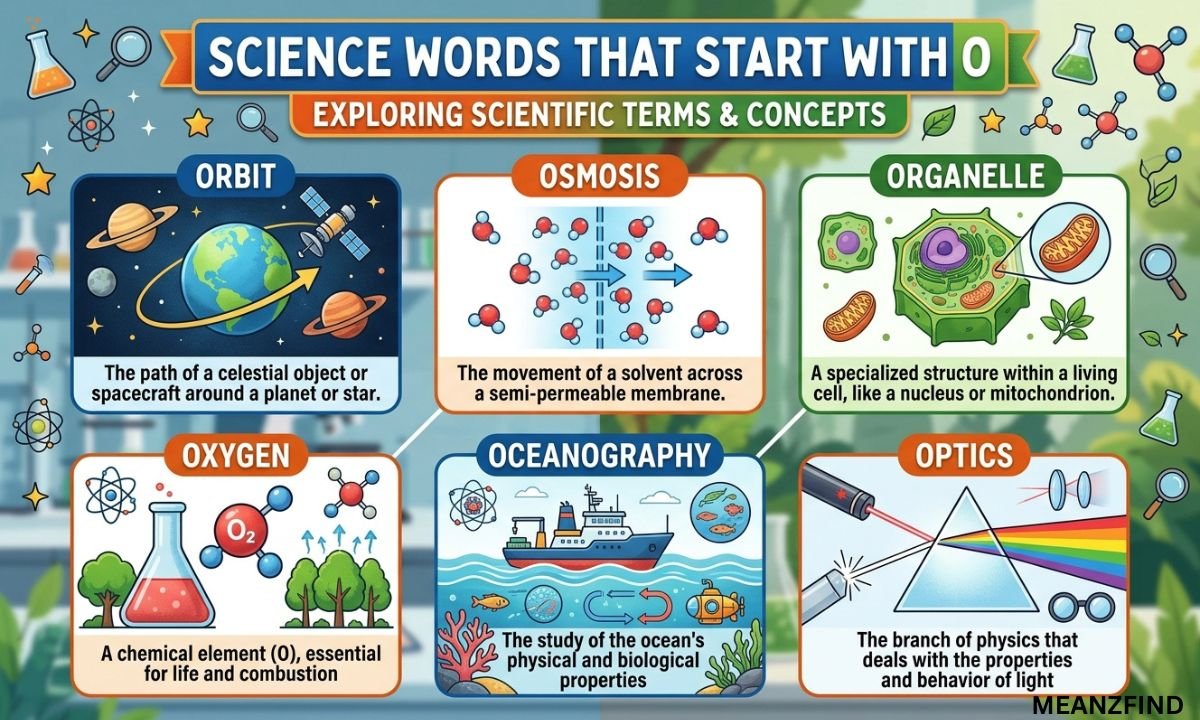
Science is full of big words. Some of them can feel hard to say or understand. But once you know what they mean, they become easy to use. This guide will help you learn science words that start with the letter O.
Words like “oxygen” and “orbit” are used every day in science class. You may have heard them on TV or in books too. Knowing these words helps you understand how the world works. It also makes learning science more fun.
This glossary is made in an A-Z style. That means each word is explained in a simple and clear way. You don’t need to be a scientist to understand it. Anyone can read and learn from this list.
Whether you are a student, a teacher, or just curious, this list is for you. Each word comes with an easy meaning. You can use it for homework, quizzes, or just to learn something new. Let’s explore science words that start with O together.
What Does Each Science Word Starting With O Mean?
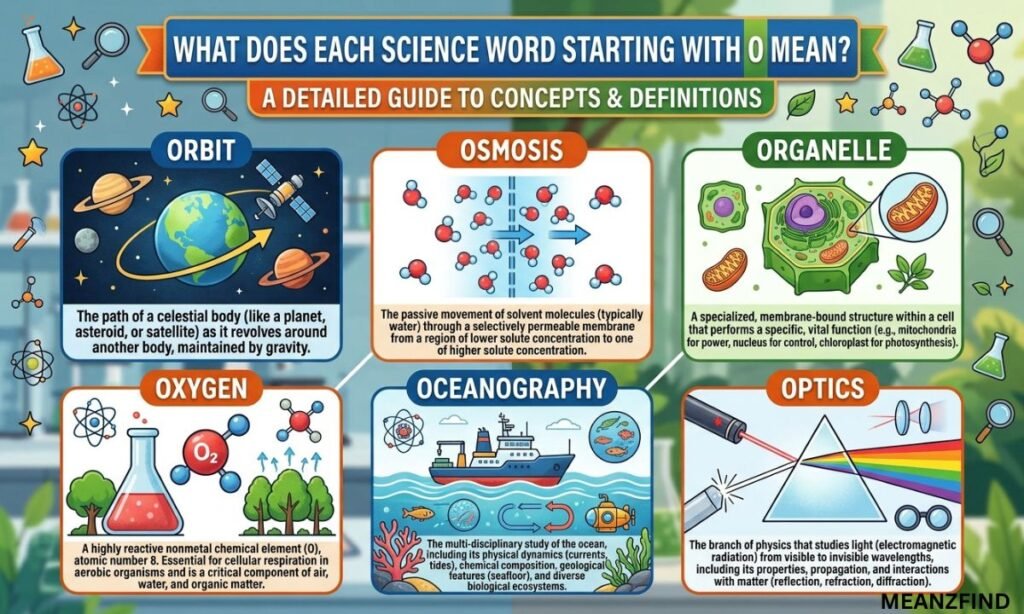
Science has many big words. Some are hard to say. Some are easy once you know them. This article explains simple meanings for science words that start with the letter O. Each word has an easy example too.
Let’s start learning these words one by one.
Oxygen
Oxygen is a gas. We cannot see it, smell it, or touch it. But we need it to live.
Humans and animals breathe in oxygen. Plants make oxygen too. This gas helps our body turn food into energy.
Simple Fact: Oxygen makes up about 21% of the air around us.
Easy Example: When you take a deep breath, your lungs take in oxygen from the air.
Osmosis
Osmosis is how water moves. It moves from a place with more water to a place with less water. This happens through a thin wall called a membrane.
Plants use osmosis to drink water from soil. Their roots pull water in through osmosis.
Easy Example: When you soak a dry raisin in water, it soaks up water and becomes soft. That is osmosis in action.
Orbit
An orbit is a path. It is the path one object takes around another object in space.
Earth moves around the Sun in an orbit. The Moon moves around the Earth in an orbit too.
Simple Fact: Earth takes about 365 days to complete one orbit around the Sun.
Easy Example: Think of a ball tied to a string, spinning around your hand. That circle path is like an orbit.
Organism
An organism is any living thing. This includes humans, animals, plants, and even tiny germs.
Every organism can grow, breathe, and make more of its kind. Some organisms are big, like elephants. Some are so small you need a microscope to see them.
Easy Example: A tree, a fish, a bird, and a person are all organisms.
Oxidation
Oxidation happens when something combines with oxygen. This change can happen slowly or quickly.
You can see oxidation in everyday life. Rust on iron is a common example.
Simple Fact: Fire burning is a fast type of oxidation.
Easy Example: When a metal bike is left in the rain, it turns orange and rusty. That rust forms because of oxidation.
Ozone
Ozone is a special type of oxygen gas. It has three oxygen atoms stuck together instead of two.
Ozone forms a layer high up in our sky. This layer protects us from strong sun rays.
Simple Fact: The ozone layer blocks harmful UV rays from the Sun.
Easy Example: Think of ozone like a giant sunscreen blanket around the Earth.
Oceanography
Oceanography is the study of oceans. Scientists who study oceans are called oceanographers.
They study ocean water, sea animals, waves, and the ocean floor. This helps us understand more about our planet.
Easy Example: A person studying how deep-sea fish live is doing oceanography.
Optics
Optics is the science of light. It studies how light moves, bends, and reflects.
Eyeglasses, cameras, and telescopes all use optics. This science helps us build tools that use light.
Easy Example: When light bends as it passes through a glass of water, that is optics at work.
Orbitals
Orbitals are tiny spaces around the center of an atom. Electrons move inside these spaces.
Every atom has orbitals. They help scientists understand where electrons are likely to be found.
Simple Fact: Orbitals have different shapes, like spheres and dumbbells.
Easy Example: Think of orbitals like invisible clouds where tiny electron particles float around the atom’s center.
Ovoviviparous
This is a big word, but it has an easy meaning. Ovoviviparous animals grow their babies inside eggs. But the eggs stay inside the mother’s body until they hatch.
This is different from animals that lay eggs outside their body.
Easy Example: Some sharks and snakes are ovoviviparous. Their eggs hatch inside the mother, and then live babies are born.
Organic Chemistry
Organic chemistry is the study of carbon. It looks at how carbon connects with other elements to make different substances.
Many things around us are made from organic chemistry, including plastics, medicines, and food.
Easy Example: Sugar and fat in your food are studied using organic chemistry.
Oxytocin
Oxytocin is a chemical made inside our body. It is often called the “feel-good” chemical or “love hormone.”
It helps people feel close and happy with others, like family and friends.
Easy Example: When a mother hugs her baby, oxytocin is released in her brain, making her feel love and comfort.
Oligotrophic
Oligotrophic describes a lake or body of water that has very few nutrients. This means it has less food for plants and tiny living things.
These lakes are usually very clear and clean. But because there’s less food, fewer plants and fish live there.
Easy Example: A deep, clear mountain lake with very little plant life is often oligotrophic.
Oscillation
Oscillation means moving back and forth in a steady pattern. This kind of movement repeats again and again.
Many things in science and daily life oscillate.
Easy Example: A swinging pendulum clock or a swing at the park moves back and forth. That is oscillation.
Quick Reference Table: Science Words That Start With O
| Word | Simple Meaning | Easy Example |
| Oxygen | A gas we need to breathe | Taking a deep breath |
| Osmosis | Water moving through a thin wall | A raisin soaking up water |
| Orbit | Path an object takes around another | Earth moving around the Sun |
| Organism | Any living thing | A tree, fish, or person |
| Oxidation | Combining with oxygen | Rust on a metal bike |
| Ozone | Special oxygen gas that blocks sun rays | Earth’s protective sky layer |
| Oceanography | Study of oceans | Studying deep-sea fish |
| Optics | Study of light | Light bending in water |
| Orbitals | Space where electrons move | Electron clouds around an atom |
| Ovoviviparous | Eggs hatch inside the mother | Some sharks and snakes |
| Organic Chemistry | Study of carbon-based substances | Sugar and fat in food |
| Oxytocin | “Feel-good” body chemical | Feeling love during a hug |
| Oligotrophic | Water with few nutrients | A clear mountain lake |
| Oscillation | Steady back-and-forth movement | A swinging pendulum |
Science Words That Start With O for 5th Grade
Fifth-grade science focuses on simple ideas. These are easy words a 5th grader can learn quickly.
- Oxygen – the gas we breathe
- Orbit – the path a planet or moon follows
- Organism – any living thing
- Ozone – a gas layer that protects Earth
- Oscillation – back-and-forth movement, like a swing
These words are great starting points because they connect to things students already see, like breathing air or swinging on a playground swing.
Science Words That Start With O for 6th Grade
Sixth-grade science introduces slightly more detail. Students start learning about chemical changes and body systems.
- Oxidation – when something combines with oxygen and changes, like rust
- Optics – how light travels and bends
- Organism – living things, now studied in more detail with cells
- Oxytocin – a body chemical linked to feelings
- Oscillation – studied with waves and sound
At this stage, students begin connecting words to real science experiments, like light bending through water or watching rust form over time.
Science Words That Start With O for 7th Grade
Seventh-grade science often covers cells, chemistry basics, and Earth science. These words fit well with that stage.
- Osmosis – how water moves through cell walls
- Oceanography – study of oceans and marine life
- Oxidation – chemical reactions with oxygen
- Oligotrophic – lakes with low nutrients
- Orbit – studied more deeply with gravity and space
Seventh graders often study cell biology, so words like osmosis become especially useful for understanding how plant and animal cells work.
Science Words That Start With O for 8th Grade
Eighth-grade science gets more advanced. Students explore atoms, chemistry, and human biology in greater depth.
- Orbitals – electron spaces around an atom’s center
- Organic Chemistry – study of carbon-based compounds
- Ovoviviparous – reproduction method in some animals
- Ozone – studied with atmosphere and environmental science
- Oxytocin – studied with the human body’s hormone system
These words prepare students for high school chemistry and biology classes, where atomic structure and hormones become bigger topics.
Physical Science Words That Start With O
Physical science covers matter, energy, light, and motion. Here are the O-words that belong to this branch of science.
| Word | Type of Physical Science |
| Oxygen | Chemistry |
| Oxidation | Chemistry |
| Ozone | Chemistry / Atmosphere |
| Optics | Physics (Light) |
| Orbitals | Physics / Chemistry (Atoms) |
| Oscillation | Physics (Motion and Waves) |
| Orbit | Physics (Space and Motion) |
Physical science words often connect to everyday objects. For example, light bending in optics, or metal rusting through oxidation, are things students can observe at home.
Why Learning Science Words Matters
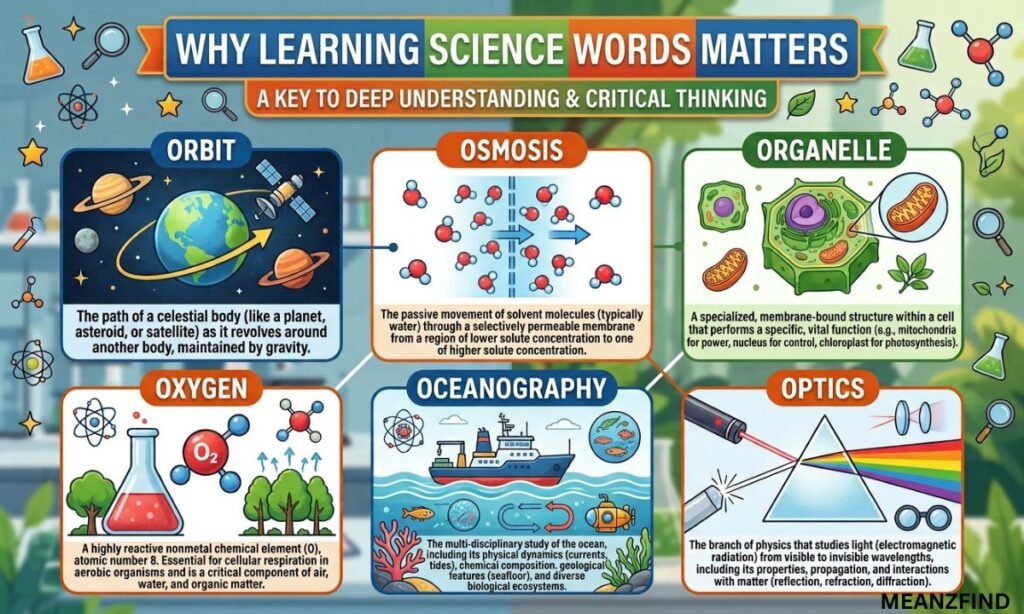
Learning science words helps students in many ways. It is not just about memorizing terms for a test.
- It builds a strong foundation for future science classes.
- It helps students understand news about space, health, and the environment.
- It makes reading science books and articles much easier.
- It boosts confidence during science exams and school projects.
Once you know a word like “oxidation” or “orbit,” you start noticing it everywhere. You might see rust on a fence and think about oxidation. You might look up at night and think about the Moon’s orbit.
Simple Tips to Remember Science Words That Start With O
Here are some easy tips to help remember these words:
- Connect words to real life. Think of oxygen every time you breathe.
- Use flashcards. Write the word on one side and the meaning on the other.
- Draw pictures. A simple drawing of Earth orbiting the Sun helps the word stick in memory.
- Say the word out loud. Saying a word helps your brain remember it better.
- Group similar words together. Put “oxygen,” “oxidation,” and “ozone” together since they relate to oxygen.
These small steps make learning science vocabulary feel less like a chore and more like a fun challenge.
Fun Facts About Some O Science Words
Science facts make learning more interesting. Here are a few extra facts about some O words.
- Oxygen was first identified as a separate gas in the 1770s.
- Ozone has a sharp smell, similar to the smell after lightning strikes.
- Osmosis happens in your own body every day, helping cells stay balanced.
- Oxytocin is sometimes released just from a warm smile or a kind hug.
- Oceanography covers less than half of the ocean floor that has been fully mapped by humans.
These fun facts help students see that science words are not just definitions. They are connected to real discoveries and real-world wonders.
FINAL WORDS
Learning new words is a great way to grow your mind. Science words can seem tricky at first. But with simple meanings, they become easy to understand. We hope this list made learning fun for you.
Words like “oxygen,” “orbit,” and “organism” are all around us. They help us understand nature, space, and living things. Now you know what these words mean. You can use them in school work or daily talk.
This glossary was made to help students and curious minds. It breaks down hard science terms into simple parts. You don’t need a big dictionary to learn new words. Just a little time and interest is enough.
We hope you enjoyed this A-Z list of science words. Keep exploring and asking questions. Science is everywhere, and now you know more of its words. Come back anytime to learn something new.
FAQs
Why Is It Important to Learn Science Words Starting With O?
Learning these words helps students understand key ideas in biology, chemistry, and space science. It also builds a strong vocabulary base for future exams and real-life reading.
Are Science Words Starting with O Used in Everyday Life?
Yes, words like oxygen, orbit, and oxidation appear in daily life all the time. We breathe oxygen, watch the Moon’s orbit at night, and see oxidation when metal rusts.
Science Words That Start With B: Important Terms Used in Science
This topic covers key science words starting with B, such as biology, bacteria, and buoyancy. These terms help students understand living things, tiny organisms, and basic physics ideas.
Science Words That Start With K: Key Terms, Meanings, and Their Importance in Science
This topic explains science words starting with K, like kinetic energy and karyotype. These words are useful for learning about motion, energy, and genetics.
Opposite of Benefit: Meaning, Examples, Synonyms, and Usage Guide
This topic explains words that mean the opposite of “benefit,” such as harm, loss, or disadvantage. It helps readers understand how to use these words correctly in sentences.
Top Science Words That Start With T: Meaning, Uses, and Importance in Modern Science
This topic covers words like temperature, tissue, and telescope. These terms are common in physics, biology, and space science.
Top Science Words That Start With S: Definitions, Examples, and Their Importance in Modern Science
This topic explains words like solar, species, and sound. These terms appear often in school science lessons and everyday conversation.
What is a science word that starts with o?
Oxygen is a common science word that starts with O. It is the gas that humans and animals need to breathe.
What does “o” mean in science?
In science, “O” is the chemical symbol for oxygen on the periodic table. It represents a single oxygen atom.
What are 5 science words?
Five common science words are oxygen, orbit, organism, energy, and gravity. Each one is used often in school science lessons.
What are 10 science words?
Ten common science words include oxygen, orbit, organism, oxidation, ozone, energy, gravity, atom, cell, and force. These words appear across biology, chemistry, and physics.
What are scientific words a to z?
Scientific words A to Z are terms used in science that start with each letter of the alphabet, like atom for A and zygote for Z. They help cover topics from biology to physics in an organized way.
What are 15 fields of science?
Fifteen fields of science include biology, chemistry, physics, astronomy, geology, oceanography, botany, zoology, ecology, genetics, meteorology, physiology, microbiology, anatomy, and environmental science. Each field studies a different part of the natural world.
What is an O in chemistry?
In chemistry, “O” is the symbol for oxygen, an element found on the periodic table. It has an atomic number of 8.
Can we breathe O or O2?
We breathe O2, which is two oxygen atoms joined together. A single oxygen atom (O) alone is not stable enough for us to breathe.
What does O mean in physics?
In physics, “O” is often used to represent the origin point on a graph or coordinate system. It marks the starting position from which measurements are taken.