
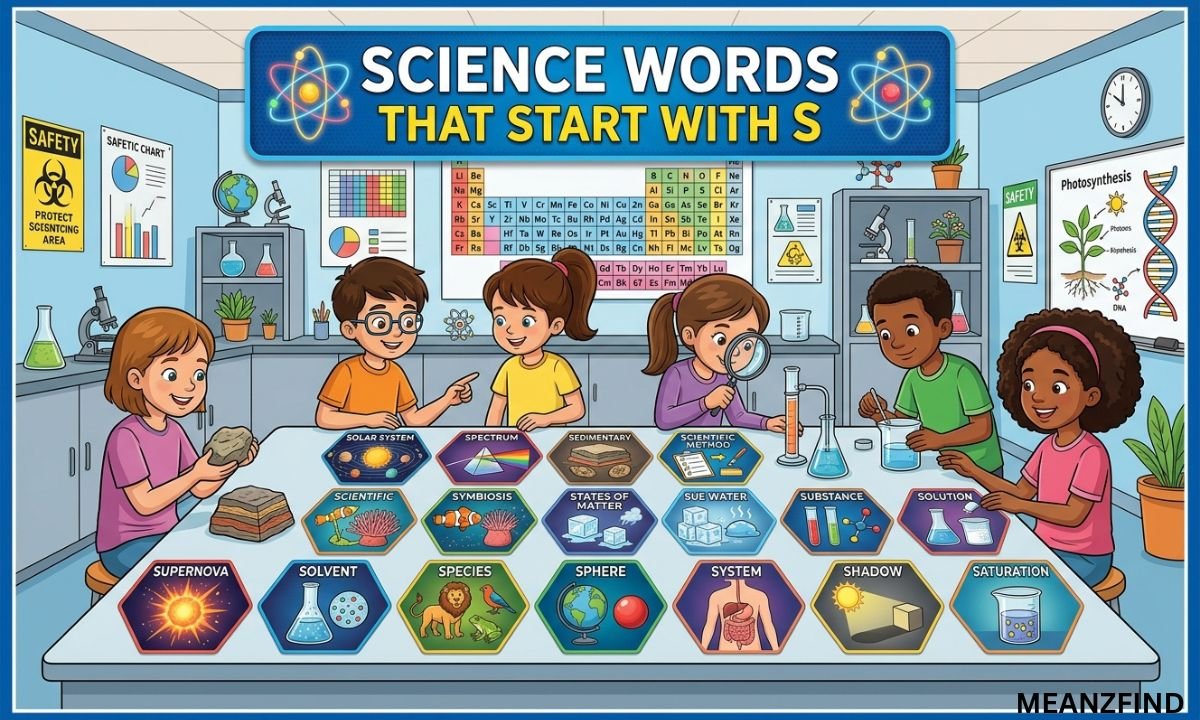
Science is full of interesting words. Many of these words help us understand the world around us. Some science words start with the letter S. These words are used in biology, chemistry, physics, and more.
Learning science words can be fun and easy. Students often see these words in books and tests. Knowing their meaning helps in better understanding of lessons. It also builds a strong vocabulary for future learning.
This list includes simple and important science words. Each word starts with the letter S. You will also find short and clear meanings. This makes learning quick and easy for everyone.
Whether you are a student or just curious, this list is helpful. It covers common terms used in classrooms and daily life. You can use it for school work, quizzes, or general knowledge. Let’s explore science words that start with S.
What Are Some Science Words That Start With S?
Science has its own special language. Many science words start with the letter S. These words appear in biology, chemistry, physics, earth science, and space science.
Students hear these words in class every day. Some are easy, like “solution.” Some are tricky, like “symbiosis.” This guide explains all of them in simple words.
You will find words for 6th grade, 7th grade, and 8th grade students. Younger readers can use the simple meanings too. By the end, you will know these words well enough to use them in a sentence.
Why Learning Science Words Starting With S Matters
Science words help you explain what you see in the world. When you know the right word, you can talk about ideas clearly. This helps in tests, projects, and science fair presentations.
Many S-words connect to each other. For example, “solution” and “solubility” both deal with mixing things. Learning them together makes it easier to remember what each one means.
Here are the main reasons these words matter for students:
- They build a strong science vocabulary for school.
- They help you understand textbooks and lab instructions.
- They prepare you for science quizzes and exams.
- They make science feel less confusing and more fun.
Complete List of Science Words That Start With S
Below is a full list of science words that start with S. Each word has a short, simple meaning that a 5th-grade student can understand.
| Word | Simple Meaning |
| Science | The study of how the world works through observation and testing |
| Species | A group of living things that can breed together |
| Solar Energy | Power that comes from the sun’s light and heat |
| Solution | A mixture made when one substance dissolves in another |
| Symbiosis | A close relationship between two different living things |
| Sediment | Small pieces of rock, sand, or soil that settle at the bottom of water |
| Synthesis | Making a new substance by combining smaller parts |
| System | A group of parts that work together as one whole |
| Stimulus | Something that causes a living thing to react |
| Sustainability | Using resources in a way that does not run them out |
| Spectrum | A range of colors or waves, like the colors in a rainbow |
| Solubility | How well a substance dissolves in a liquid |
| Satellite | An object that moves around a planet or star in space |
| Seismology | The study of earthquakes and how the earth shakes |
| Symmetry | When one half of something matches the other half exactly |
This table is a quick reference. Keep reading below for deeper explanations, examples, and grade-level word lists.
Science Words That Start With S — With Meaning and Examples
Science
Science is the study of the natural world. It uses observation, questions, and testing to learn new facts. Doctors, teachers, farmers, and engineers all use science every day.
Example: A scientist uses science to find out why plants grow toward light.
Species
A species is a group of living things that look alike and can have babies together. Dogs are one species. Cats are another species. Every plant and animal belongs to a species.
Example: The tiger is a species that lives in forests across Asia.
Solar Energy
Solar energy is power that comes from sunlight. People use special panels called solar panels to catch this energy. Solar energy is clean and does not pollute the air.
Example: Many homes now use solar energy to run lights and fans.
Solution
A solution forms when one substance dissolves completely into another. Salt water is a solution because the salt dissolves in the water. You cannot see the salt anymore, but it is still there.
Example: Sugar mixed into tea makes a sweet solution.
Symbiosis
Symbiosis is a close and long-term relationship between two different living things. Sometimes both living things benefit. Sometimes only one benefits, and the other is not harmed.
Example: Bees and flowers show symbiosis. Bees get food, and flowers get help spreading pollen.
Sediment
Sediment is made of tiny bits of rock, sand, mud, or dead plants. Rivers carry sediment and drop it at the bottom of lakes and oceans. Over time, layers of sediment can turn into rock.
Example: After a heavy rain, sediment collects at the bottom of the river.
Synthesis
Synthesis means putting smaller parts together to make something new. In chemistry, scientists combine simple substances to create new compounds. In biology, plants make food through a process called photosynthesis.
Example: Plants use sunlight for the synthesis of their own food.
System
A system is a set of parts that work together for one purpose. Your body has many systems, like the digestive system and the nervous system. Each part has a job, and they work as a team.
Example: The solar system includes the sun, planets, and moons moving together.
Stimulus
A stimulus is anything that causes a living thing to react or respond. Light, sound, heat, and touch can all be a stimulus. Our senses pick up a stimulus and send a message to the brain.
Example: A loud noise is a stimulus that makes you jump.
Sustainability
Sustainability means using natural resources carefully so they last for the future. It means not wasting water, trees, or energy. Sustainability helps protect the earth for the next generations.
Example: Recycling paper is one way to practice sustainability.
Spectrum
A spectrum is a range of something, often light or color. When sunlight passes through a prism, it splits into a spectrum of colors like red, orange, yellow, green, blue, and violet.
Example: A rainbow shows the full spectrum of visible light.
Solubility
Solubility tells us how much of a substance can dissolve in a liquid. Sugar has high solubility in warm water. Sand has very low solubility in water because it does not dissolve at all.
Example: Sugar has better solubility in hot water than in cold water.
Satellite
A satellite is an object that orbits, or moves around, a larger object in space. The moon is a natural satellite of Earth. Scientists also build man-made satellites for weather, TV signals, and GPS.
Example: Weather satellites help predict storms before they arrive.
Seismology
Seismology is the study of earthquakes and the movement of the earth’s crust. Scientists who study this are called seismologists. They use tools called seismographs to measure shaking in the ground.
Example: Seismology helps scientists warn people before a big earthquake strikes.
Symmetry
Symmetry happens when both sides of an object match each other perfectly. A butterfly’s wings show symmetry because one side looks just like the other. Many shapes in nature have symmetry.
Example: A snowflake shows beautiful symmetry under a microscope.
Physical Science Words That Start With S
Physical science covers matter, energy, motion, and forces. Here are important physical science words that start with S.
| Word | Simple Meaning |
| Solid | A state of matter with a fixed shape and volume |
| Speed | How fast an object moves over a certain distance |
| Sound | Energy we hear, made by vibrations |
| Solvent | A liquid that dissolves another substance |
| Solar System | The sun and everything that orbits around it |
| Static Electricity | A buildup of electric charge on an object’s surface |
| Spring | A coiled object that stores energy when stretched or squeezed |
Physical science words often describe things you can touch, see, or measure. Learning these helps in physics and chemistry classes.
Earth Science Words That Start With S
Earth science studies the planet, its rocks, weather, and oceans. These S-words are common in earth science lessons.
| Word | Simple Meaning |
| Soil | The top layer of earth where plants grow |
| Sedimentary Rock | Rock formed from layers of sediment pressed together |
| Storm | A strong weather event with wind, rain, or snow |
| Stratosphere | A layer of the earth’s atmosphere above the troposphere |
| Season | A time of year, like summer or winter, based on Earth’s tilt |
| Stalactite | A rock formation hanging from a cave ceiling |
| Sun | The star at the center of our solar system |
These words help students understand rocks, weather patterns, and how our planet works.
Science Words That Start With S: 6th Grade
Sixth-grade students learn basic science ideas. These words fit well with a 6th-grade science course.
- Species – A group of living things that can reproduce together
- Solution – A mix where one thing dissolves in another
- Solar Energy – Energy that comes from the sun
- System – Parts working together for one job
- Sediment – Small pieces of rock or soil that settle down
- Stimulus – Something that causes a reaction
- Spectrum – A range of light or color
These 6th-grade words focus on basic ideas about matter, living things, and energy.
Science Words That Start With S: 7th Grade
Seventh-grade science goes a bit deeper into life science and chemistry. Here are matching words.
- Symbiosis – A close relationship between two living things
- Synthesis – Combining parts to make something new
- Solubility – How well something dissolves in a liquid
- Sustainability – Using resources wisely for the future
- Seismology – The study of earthquakes
- Symmetry – When both sides of something match
Seventh graders often study ecosystems, chemical reactions, and earth changes, so these words fit those topics well.
Science Words That Start With S: 8th Grade
Eighth-grade science includes physics, space science, and more advanced biology. These words match that level.
- Satellite – An object that orbits a planet or star
- Spectrum – A full range of light, color, or waves
- Sedimentary Rock – Rock made from pressed layers of sediment
- Static Electricity – A charge that builds up on a surface
- Stratosphere – A layer high in Earth’s atmosphere
- System – A set of connected parts, like body systems or the solar system
By 8th grade, students connect these words to bigger ideas like space, chemistry, and forces.
How to Remember Science Words That Start With S
Long lists of new words can feel hard to remember. Try these simple tricks to make learning easier.
- Group similar words together. Put “solution” and “solubility” in one group since they both deal with dissolving.
- Draw a picture for each word. A drawing of a rainbow can help you remember “spectrum.”
- Use the word in a sentence. Saying the word out loud in a full sentence helps your brain hold onto it.
- Make flashcards. Write the word on one side and the meaning on the other side.
- Connect words to real life. Think of your pet when you learn “species,” or think of the sun when you learn “solar energy.”
- Test yourself weekly. Go back and quiz yourself on the list once a week.
These simple study habits work for any subject, not just science.
Fun Facts About Science Words Starting With S
- The word “science” comes from an old Latin word that means “to know.”
- A snowflake and a butterfly wing both show natural symmetry, even though they look nothing alike.
- Seismology helped scientists build early warning systems that can save lives during earthquakes.
- Solar energy from the sun takes about 8 minutes to reach the Earth.
- Some symbiosis relationships last for the entire life of both living things.
Fun facts like these make science words easier to remember because they connect to interesting stories.
Quick Reference Table: All Science Words That Start With S
| Word | Category | Simple Meaning |
| Science | General | Study of the natural world |
| Species | Biology | Group of living things that breed together |
| Solar Energy | Physical Science | Energy from the sun |
| Solution | Chemistry | A mixture where one thing dissolves in another |
| Symbiosis | Biology | Close relationship between two living things |
| Sediment | Earth Science | Tiny bits of rock or soil that settle |
| Synthesis | Chemistry | Combining parts to make something new |
| System | General | Parts working together as one |
| Stimulus | Biology | Something that causes a reaction |
| Sustainability | Environmental Science | Using resources wisely for the future |
| Spectrum | Physical Science | A range of light or color |
| Solubility | Chemistry | How well something dissolves |
| Satellite | Space Science | Object that orbits a planet or star |
| Seismology | Earth Science | Study of earthquakes |
| Symmetry | Physical Science | When both sides match perfectly |
FINAL WORDS
Science words that start with S cover many topics. From small cells to large stars, this list has it all. Students can use these words to build strong science knowledge. It makes learning new topics easier and more fun.
These words are useful for school lessons and daily life. You may find them in textbooks, quizzes, or science projects. Knowing their meanings helps you understand ideas faster. It also improves your confidence in science subjects.
This list is simple and easy to remember. Each word is explained in short and clear sentences. You don’t need to be an expert to understand them. Anyone can learn and use these words with ease.
We hope this list helped you learn something new. Keep exploring more science words from A to Z. Practice using them in sentences or study notes. Science becomes more exciting when you know the right words.
FAQs
What are the S words in science?
Science has many S words like species, solution, system, satellite, and symmetry. These words appear in biology, chemistry, physics, and earth science topics.
What are 50 science words?
Fifty science words include terms like atom, cell, energy, force, gravity, species, solution, system, satellite, and habitat. They cover living things, matter, energy, and space across all science branches.
What are 10 science words?
Ten common science words are atom, cell, energy, gravity, species, solution, system, habitat, force, and matter. These words show up often in school science lessons.
What are some words for science?
Words related to science include research, experiment, discovery, observation, and knowledge. Science is often described using terms like study, inquiry, and investigation.
What are 15 fields of science?
Fifteen fields include biology, chemistry, physics, geology, astronomy, botany, zoology, ecology, genetics, meteorology, oceanography, seismology, physiology, microbiology, and environmental science. Each field studies a different part of nature.
What are 10 examples of science?
Examples of science subjects are biology, chemistry, physics, astronomy, geology, ecology, botany, zoology, meteorology, and genetics. Each one explores a different area of the natural world.
What is science in 20 words?
Science is the study of the natural world through observation, experiments, and evidence. It helps us understand how things work and why.
What are key words in science?
Key science words include hypothesis, theory, experiment, data, energy, matter, and system. These terms form the basic language used across all science subjects.
What are some cool scientific words?
Cool science words include symbiosis, photosynthesis, gravity, ecosystem, and spectrum. These words sound interesting and describe amazing natural processes.
What is science in 50 words in English?
Science is the careful study of the natural world using observation, questioning, and testing. It helps people understand how living things, matter, and energy behave. Scientists form hypotheses, run experiments, and gather evidence to explain facts. Science covers many fields, including biology, chemistry, physics, and earth science, helping us solve real-world problems.
What is science essay 200 words?
A 200-word science essay explains what science is, why it matters, and how it helps solve problems in daily life. It usually covers the meaning of science, its major branches like biology and physics, and examples of scientific discoveries. Such an essay also explains how scientists use observation and experiments to find facts, and why science education is important for students to understand the world around them.
What is science in five words?
Science means studying nature through evidence. It explains how the world works.