
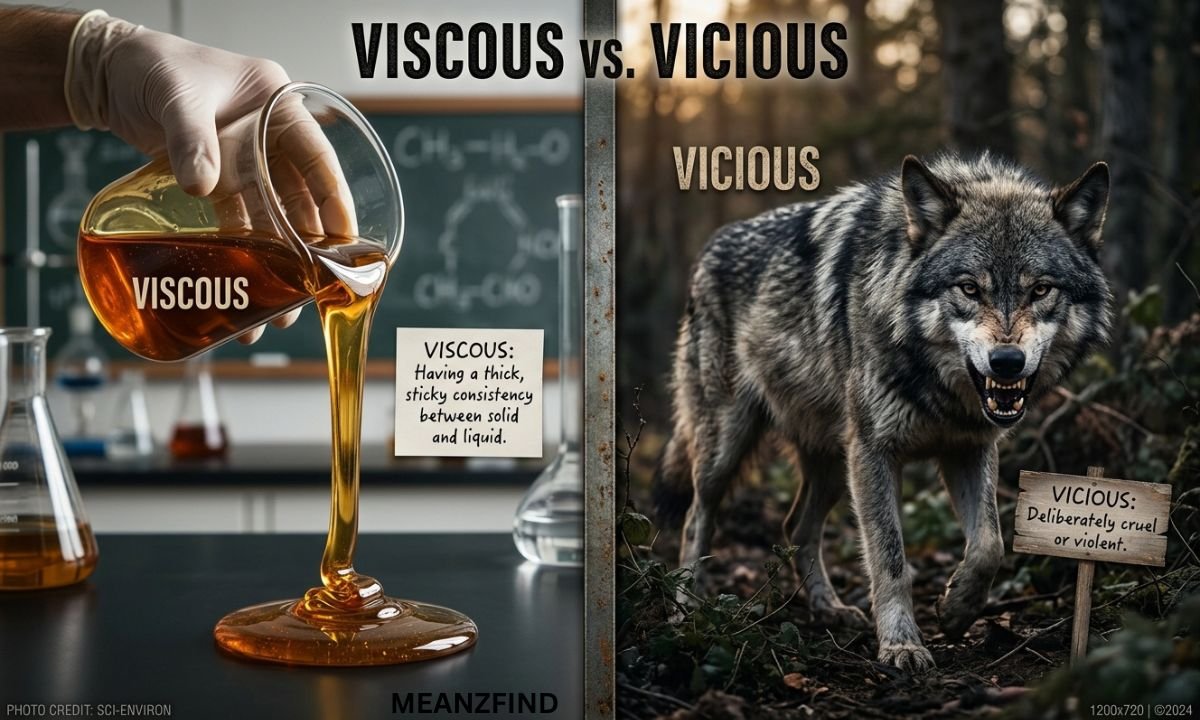
Have you ever typed “vicious” when you meant “viscous”? You’re not alone. These two words look almost the same. But they mean very different things.
“Vicious” describes something cruel or dangerous. It’s often used for animals, people, or actions. A vicious dog can bite. A vicious rumor can hurt someone’s feelings.
“Viscous,” on the other hand, is about thickness. It describes liquids that flow slowly. Honey is viscous. So is thick syrup. This guide will help you use both words the right way, every time.
What Does Vicious Mean?
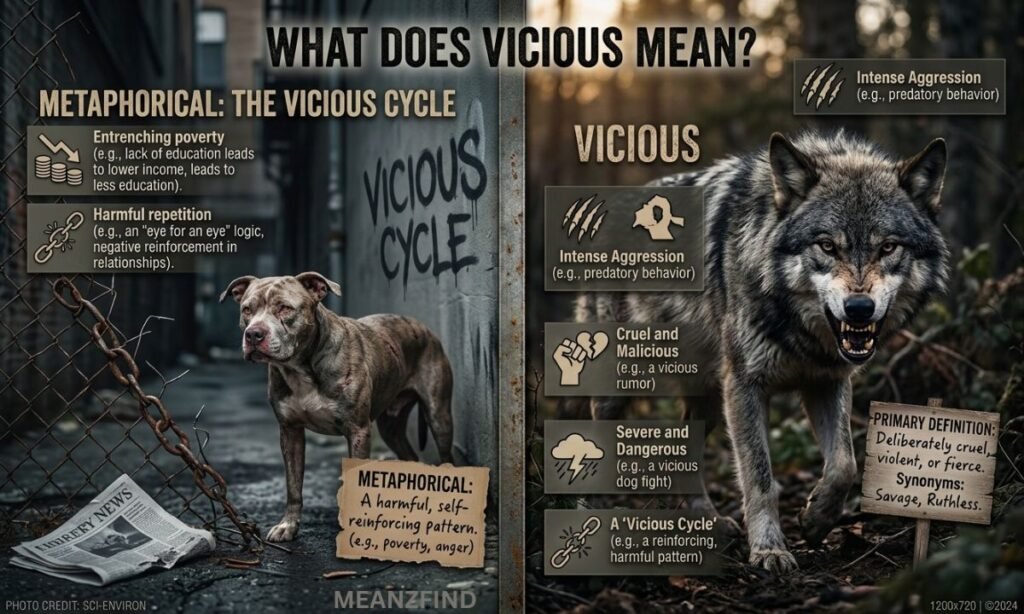
The word vicious means cruel, violent, or full of hate. It describes behavior that hurts others on purpose. You will hear this word used for people, animals, and even words.
A vicious dog might bite without warning. A vicious person might say mean things to hurt someone’s feelings. This word always carries a negative, harsh feeling.
Here are simple ways to remember what vicious means:
- It relates to vice, which means bad behavior or evil habits.
- It describes actions, attitudes, or creatures that are dangerous.
- It often shows up in phrases like “vicious attack,” “vicious cycle,” or “vicious rumor.”
Quick meaning: Vicious = cruel, fierce, or dangerous.
Where the Word Vicious Comes From
The word “vicious” comes from the Latin word “vitiosus,” which means “faulty” or “full of vice.” Over time, English speakers began using it to describe cruel or harmful behavior. This history explains why the word still feels so strongly negative today.
Vicious is not a word for mild annoyance. It is a strong word. When you call something vicious, you are saying it goes beyond normal unkindness. It shows deep cruelty, danger, or violence.
Different Shades of Meaning
Vicious can describe different levels of harm, depending on the sentence. Sometimes it means physically violent, and sometimes it means emotionally cruel.
- Physical danger: “The vicious shark attacked the swimmer.”
- Emotional cruelty: “Her vicious comments made him cry.”
- General harshness: “The critic wrote a vicious review of the movie.”
In each case, the core feeling stays the same. Something or someone is causing real harm, either physically or emotionally.
What Does Viscous Mean?
The word viscous is completely different. It describes how a liquid flows. A viscous liquid is thick and moves slowly, not thin and runny.
Think about honey. When you pour it, it moves slowly and sticks together. That is because honey is viscous. Water, on the other hand, is not viscous because it flows fast and easily.
Here are some liquids people often call viscous:
- Honey
- Motor oil
- Melted chocolate
- Thick syrup
- Wet cement
Quick meaning: Viscous = thick, sticky, and slow-flowing.
This word comes from science and everyday cooking. You will find it a lot in physics books, recipes, and product labels.
Where the Word Viscous Comes From
“Viscous” comes from the Latin word “viscosus,” which relates to “viscum,” meaning mistletoe. Long ago, people used sticky mistletoe juice to trap birds. Because that juice was thick and sticky, the word grew to describe anything with that same sticky, slow-flowing quality.
This history explains why viscous feels so connected to texture rather than emotion. It has never meant cruel or dangerous. From the very beginning, it described physical stickiness and thickness.
Understanding Viscosity in Simple Words

Viscosity is just a science word for “how thick a liquid is.” A liquid with high viscosity flows slowly, like honey. A liquid with low viscosity flows quickly, like water.
- High viscosity: Honey, tar, thick oil
- Medium viscosity: Shampoo, ketchup, liquid soap
- Low viscosity: Water, milk, rubbing alcohol
Temperature also changes viscosity. When you heat honey, it becomes thinner and flows faster. When you cool oil, it becomes thicker and flows slower. This is why viscous is such an important word in science and engineering.
Why Do People Confuse Vicious and Viscous?
Many people mix up these two words, and there are good reasons why. Let’s look at the main causes of this common mistake.
1. They Look Almost the Same
Both words have similar letters. They start with “vi” and end with “ous.” Only the middle part changes, “ci” versus “sc.” This tiny difference is easy to miss when reading fast.
2. They Sound Alike When Spoken Quickly
When people talk fast, “vicious” and “viscous” can sound close to each other. Both words have two syllables and a similar rhythm. This makes it easy to mishear or misspeak them.
3. Spell-Check Doesn’t Always Catch It
Both words are real, correctly spelled words. So spell-check tools will not flag them as wrong, even if you use the incorrect one. This lets the mistake slip through in essays, emails, and articles.
4. Both Words Feel “Intense”
Even though they mean different things, both words describe something strong. A vicious storm feels intense. A viscous liquid feels heavy and strong too. This shared “intensity” can confuse the brain.
5. Autocorrect Sometimes Swaps Them
Phones and computers sometimes autocorrect one word into the other, especially if you type quickly. Since both are valid English words, autocorrect tools do not always catch the switch. This can lead to strange, confusing sentences in texts and emails.
6. Both Words Are Less Common Than Simpler Alternatives
Many people don’t use vicious or viscous every day. Words like “mean,” “cruel,” “thick,” or “sticky” are more common in daily speech. Because vicious and viscous are used less often, people don’t build strong memory habits around them, which makes mix-ups more likely.
Vicious vs Viscous in Real-Life Contexts
Understanding these words in real situations makes them much easier to remember. Below is a simple comparison table you can refer back to anytime.
| Feature | Vicious | Viscous |
| Meaning | Cruel, violent, harmful | Thick, slow-flowing liquid |
| Word type | Adjective (behavior) | Adjective (texture) |
| Used for | People, animals, actions, words | Liquids, substances, materials |
| Example | A vicious guard dog | Viscous honey |
| Feeling it gives | Fear, danger, harshness | Heaviness, thickness, slowness |
| Common field | Everyday language, literature | Science, cooking, engineering |
Everyday Examples of Vicious
- The vicious storm destroyed several homes.
- She spread a vicious lie about her coworker.
- The boxer threw a vicious punch.
Everyday Examples of Viscous
- The viscous syrup stuck to the spoon.
- Engine oil becomes more viscous in cold weather.
- The paint was too viscous to spread smoothly.
How Context Clues Help You Choose the Right Word
If you’re ever unsure which word fits, look at the subject of your sentence. Ask yourself two simple questions.
- Is the subject alive or capable of acting cruelly? If yes, you probably need “vicious.”
- Is the subject a liquid, paste, or flowing substance? If yes, you probably need “viscous.”
This simple check works almost every time. A dog, a person, a rumor, or a storm needs “vicious.” A sauce, an oil, a shampoo, or a syrup needs “viscous.”
Vicious in Literature and Media
Writers love the word “vicious” because it adds emotion and tension. It helps readers feel danger, fear, or cruelty without long explanations.
In novels, villains are often described as vicious to show they cannot be trusted. A “vicious cycle” is also a popular phrase in books and movies. It means a bad situation that keeps repeating and getting worse.
Here are common ways “vicious” appears in stories and media:
- Vicious villain – a character who enjoys causing harm
- Vicious cycle – a repeating pattern that is hard to escape
- Vicious attack – a sudden, harmful act of violence
- Vicious tongue – someone who speaks cruelly or spreads gossip
News reports also use “vicious” to describe serious events, like a vicious storm, a vicious crime, or a vicious battle. The word instantly signals danger to the reader.
Why Writers Prefer Vicious Over Weaker Words
Authors often choose “vicious” instead of softer words like “mean” or “unkind” because it creates a stronger picture in the reader’s mind. It adds drama and tension to a scene without needing extra description.
For example, compare these two sentences:
- “The man was mean to his neighbor.”
- “The man was vicious to his neighbor.”
The second sentence feels sharper and more serious. This is why “vicious” appears so often in thrillers, crime novels, and news headlines. It grabs attention quickly.
Vicious in Movie and TV Reviews
Film critics often use “vicious” to describe intense scenes or harsh characters. A “vicious fight scene” tells the audience to expect real danger. A “vicious villain” warns viewers that the character has no mercy. This word helps set expectations before anyone even watches the movie.
Viscous in Scientific Papers and Cookbooks
“Viscous” belongs mostly to science, cooking, and engineering. It describes a property called viscosity, which measures how easily a liquid flows.
In physics and chemistry, viscosity is important. Scientists study how viscous a liquid is to understand how it behaves under heat, pressure, or movement. Thick liquids, like oil, have high viscosity. Thin liquids, like water, have low viscosity.
Where You’ll See “Viscous” in Science
- Engineering reports about oils and lubricants
- Weather and climate studies (for example, viscous lava)
- Medical research about blood viscosity
- Physics lessons about fluid movement
Where You’ll See “Viscous” in Cooking
Cookbooks also use this word often, especially for sauces, syrups, and batters.
- “Simmer the sauce until it becomes viscous.”
- “The batter should be viscous, not watery.”
- “Let the caramel cool slightly until it turns viscous.”
In both fields, viscous always points to thickness and slow movement, never to danger or cruelty.
Viscosity in Everyday Products
You don’t need to be a scientist to notice viscosity. Companies list it on product labels all the time, especially for things like motor oil, lotion, and paint.
- Motor oil bottles show numbers like “10W-30,” which relate to viscosity at different temperatures.
- Skincare products describe lotions as “light” or “viscous” depending on thickness.
- Paint cans often warn buyers if a product is highly viscous and needs thinning before use.
Why Chefs Care About Viscosity
In cooking, viscosity affects texture, taste, and presentation. A sauce that is too viscous can feel heavy and clumpy. A sauce that is too thin can taste watery and weak. Chefs often adjust viscosity by adding flour, cream, or cornstarch to thicken a dish, or by adding water or stock to thin it out.
Getting viscosity right is often the difference between a good dish and a great one. That’s why recipes frequently mention this word, even if the writer never explains what it means.
Can Vicious and Viscous Ever Be Interchangeable?
No, vicious and viscous can never replace each other. They belong to completely different categories of meaning.
- Vicious is about behavior, emotion, and danger.
- Viscous is about texture, thickness, and flow.
There is no situation where swapping them would make correct sense. A “vicious liquid” doesn’t make sense unless you’re using it as an unusual metaphor, and a “viscous person” would also sound wrong and confusing.
The only overlap is that both words describe something with strong intensity. But intensity in feeling (vicious) is not the same as intensity in texture (viscous). Keeping this difference clear will stop the confusion for good.
A Fun Way to Test Yourself
Try this quick mental test whenever you’re unsure. Picture the sentence without the word, and ask what’s missing.
- “The ___ dog attacked the mailman.” (You need a word about behavior, so use vicious.)
- “The ___ honey dripped slowly off the spoon.” (You need a word about texture, so use viscous.)
If the missing word describes an action or emotion, choose vicious. If it describes how something flows or feels physically, choose viscous. This little trick works in almost every sentence you’ll ever write.
Synonyms and Alternatives of Vicious
Learning synonyms helps you understand a word more deeply. Here are common alternatives for “vicious,” grouped by how strong they are.
| Level | Synonyms |
| Mild | Unkind, harsh, nasty |
| Medium | Cruel, aggressive, hostile |
| Strong | Savage, brutal, ferocious |
Example Sentences Using Synonyms
- The cruel boss shouted at his employees.
- The savage attack shocked the entire town.
- Her harsh words hurt his feelings deeply.
Using different synonyms in your writing keeps it interesting and avoids repeating “vicious” too many times.
Words That Are Almost, But Not Quite, Synonyms
Some words feel close to “vicious” but carry slightly different shades of meaning. Knowing these small differences can make your writing more precise.
- Fierce often describes intensity, not always cruelty. A fierce competitor is not necessarily cruel.
- Ruthless describes someone without mercy, often in business or war, but not always violent.
- Malicious focuses on intent to harm, especially through words or tricks, rather than physical violence.
Choosing the right synonym depends on exactly what kind of harm or cruelty you want to describe.
Synonyms and Alternatives of Viscous
Just like “vicious,” the word “viscous” has several helpful alternatives, especially useful in science and cooking writing.
| Level | Synonyms |
| Mild | Thick, syrupy |
| Medium | Sticky, gooey, dense |
| Strong | Gluey, gelatinous, treacly |
Example Sentences Using Synonyms
- The soup turned thick after boiling for an hour.
- The glue felt sticky and hard to spread evenly.
- The lava moved slowly because it was so dense.
These synonyms are especially useful for cooking blogs, science reports, and product descriptions.
Words That Are Almost, But Not Quite, Synonyms
Just like with “vicious,” some words feel similar to “viscous” but have small differences worth knowing.
- Thick is a general word for density, but it doesn’t always relate to flow speed. A thick book is not viscous.
- Runny is the opposite idea, describing liquids that flow fast and easily.
- Congealed describes a liquid that has become solid or semi-solid, which goes a step beyond viscous.
Understanding these small differences helps you pick the most accurate word for scientific or descriptive writing.
Common Mistakes to Avoid
Even careful writers slip up sometimes. Here are the most common mistakes people make with these two words, and how to fix them.
Mistake 1: Using “Vicious” for Liquids
❌ The oil was vicious and hard to pour. ✅ The oil was viscous and hard to pour.
Mistake 2: Using “Viscous” for Behavior
❌ The dog gave a viscous bark and scared everyone. ✅ The dog gave a vicious bark and scared everyone.
Mistake 3: Mixing Them in the Same Sentence
❌ The viscous criminal attacked without warning. ✅ The vicious criminal attacked without warning.
Simple Trick to Remember the Difference
- Vicious has a “C” like Cruel. Both start with a hard “C” sound in meaning.
- Viscous has “SC” like Sticky Consistency. Think “S” for slow and sticky.
This small memory trick can help you pick the right word instantly, even under pressure.
Mistake 4: Forgetting the Noun Forms
Some writers use the adjective correctly but stumble on the noun form. Remember, the noun for vicious is “viciousness,” and the noun for viscous is “viscosity.” Mixing these up is another common slip.
❌ The viscousness of the oil surprised the mechanic. ✅ The viscosity of the oil surprised the mechanic.
Mistake 5: Overusing One Word in Writing
Even when the correct word is chosen, using it too many times in one paragraph can feel repetitive. Mix in synonyms from the earlier sections to keep your writing fresh and engaging, especially in essays, blogs, and stories.
A Simple Practice Exercise
Try filling in the blanks below with either “vicious” or “viscous.” This kind of practice builds long-term memory faster than just reading definitions.
- The ___ shark circled the boat.
- The ___ tar stuck to his shoes.
- Her ___ words left a lasting scar.
- The ___ gravy was too thick to pour.
- The ___ storm knocked down three trees.
(Answers: vicious, viscous, vicious, viscous, vicious)
Vicious vs Viscous Examples
Here is a longer list of examples so you can see both words used naturally in sentences.
Vicious Examples
- The vicious wolf chased its prey through the forest.
- He gave a vicious response to a simple question.
- The team faced a vicious defense during the final match.
- Rumors about her were vicious and untrue.
- The vicious wind ripped the roof off the barn.
Viscous Examples
- The viscous shampoo took a while to pour out.
- Scientists measured how viscous the liquid was at different temperatures.
- The mechanic checked if the oil was too viscous for winter driving.
- Melted cheese becomes viscous as it cools slightly.
- The paint was thick and viscous, perfect for textured walls.
More Advanced Examples
Once you feel confident with basic sentences, try these slightly longer examples. They show how both words can appear in more detailed, natural writing.
- The vicious argument between the two neighbors lasted almost an hour before anyone stepped in to calm things down.
- Because the syrup was so viscous, it took nearly a full minute to pour from the bottle into the pan.
- Historians describe the ruler’s vicious reign as one of the darkest periods in the kingdom’s history.
- Engineers had to redesign the pump after discovering the fluid was far more viscous than expected.
- The critic’s vicious review left the young author feeling completely discouraged.
Vicious vs Viscous Grammar
Both words are adjectives, which means they describe nouns. However, they follow slightly different grammar patterns depending on how they’re used.
Grammar Rules for Vicious
- Vicious describes people, animals, actions, or emotions.
- It can go before a noun: “a vicious dog.”
- It can also follow a linking verb: “The attack was vicious.”
- Its adverb form is viciously: “He viciously insulted his rival.”
- Its noun form is viciousness: “The viciousness of the storm surprised everyone.”
Grammar Rules for Viscous
- Viscous describes liquids, substances, or materials.
- It can go before a noun: “a viscous liquid.”
- It can also follow a linking verb: “The syrup became viscous.”
- Its adverb form is rarely used, but viscously does exist in technical writing.
- Its noun form is viscosity: “The viscosity of honey is much higher than water.”
Quick Grammar Comparison Table
| Grammar Feature | Vicious | Viscous |
| Part of speech | Adjective | Adjective |
| Adverb form | Viciously | Viscously (rare) |
| Noun form | Viciousness | Viscosity |
| Common subject | Living things, actions | Liquids, substances |
| Sentence position | Before or after noun | Before or after noun |
Comparative and Superlative Forms
Both words can be made stronger by adding “more” and “most” instead of adding “-er” or “-est” endings. This is because both words have more than one syllable.
- Vicious → more vicious → most vicious
- Viscous → more viscous → most viscous
Example: “This oil is more viscous than that one, but the thickest oil we tested was the most viscous of all.”
How to Use Them in Questions
Both words work naturally in questions too, which is useful for writers creating quizzes, surveys, or dialogue.
- “Why was the dog so vicious toward strangers?”
- “How viscous does the sauce need to be before serving?”
Practicing questions like these helps you get comfortable using both words in different sentence structures, not just simple statements.
Wrapping Up: The Viscous Nature of Vicious Words
Words like vicious and viscous show just how tricky the English language can be. Two words that look almost the same can mean completely different things. One is about danger and cruelty. The other is about thickness and flow.
The good news is that once you understand the core difference, these words become easy to use correctly. Vicious belongs to the world of behavior and emotion. Viscous belongs to the world of liquids and texture. Keeping this simple separation in mind will stop the confusion for good.
Practice makes these words stick. Try using both words in your own sentences a few times this week. Soon, choosing between vicious and viscous will feel natural, quick, and completely mistake-free.
FINAL WORDS
Vicious and viscous may look alike, but they are not the same. One word talks about behavior. The other talks about texture. Once you know this, mixing them up gets much harder.
Remember, “vicious” means cruel or harmful. Think of a vicious attack or a vicious insult. It’s a word about actions and attitude, not liquids or objects.
“Viscous” means thick and slow-moving. Think of honey, oil, or syrup. It describes how a liquid flows, nothing more. Keep this picture in your mind, and the word will stick.
With a little practice, you’ll never confuse them again. Read both words in sentences often. Say them out loud if it helps. Soon, choosing the right one will feel natural and easy.
FAQs
Is it vicious or viscous?
It depends on what you’re describing. Use “vicious” for cruel or violent behavior, and “viscous” for thick, slow-flowing liquids.
Can something be both vicious and viscous?
Not directly, since one word describes behavior and the other describes texture. But in creative writing, a thick, sticky substance could be described poetically as having a “vicious” grip if it traps or harms something.
What does it mean to be very viscous?
Being very viscous means a liquid is extremely thick and flows very slowly. Tar and cold honey are good examples of highly viscous substances.
Is it vicious or vicious?
This looks like a typo for “vicious or viscous” — if you meant to ask about spelling, “vicious” is always spelled with a “c” before the “ious.” For the meaning comparison, see the first answer above.
What is the opposite of viscous?
The opposite of viscous is “runny” or “thin,” meaning a liquid flows quickly and easily. Water is a common example of a non-viscous, runny liquid.
Is water considered viscous?
Water has very low viscosity, so it is not usually called viscous. It flows quickly and easily compared to liquids like honey or oil.
What is another word for “viscous”?
Common alternatives include “thick,” “sticky,” “syrupy,” and “gooey.” In scientific writing, “dense” is sometimes used as well.
Is viscous runny or thick?
Viscous means thick, not runny. The higher a liquid’s viscosity, the slower and thicker it flows.
Is honey a viscous liquid?
Yes, honey is a classic example of a viscous liquid. It flows slowly and sticks together instead of pouring quickly like water.
What does it mean if someone is viscous?
This usage is technically incorrect, since “viscous” describes liquids, not people. If someone is being cruel or harsh, the correct word to use is “vicious.”
What is viscosity behaviour?
Viscosity behavior refers to how a liquid’s thickness changes under different conditions, like temperature or pressure. For example, oil becomes thinner when heated and thicker when cooled.