
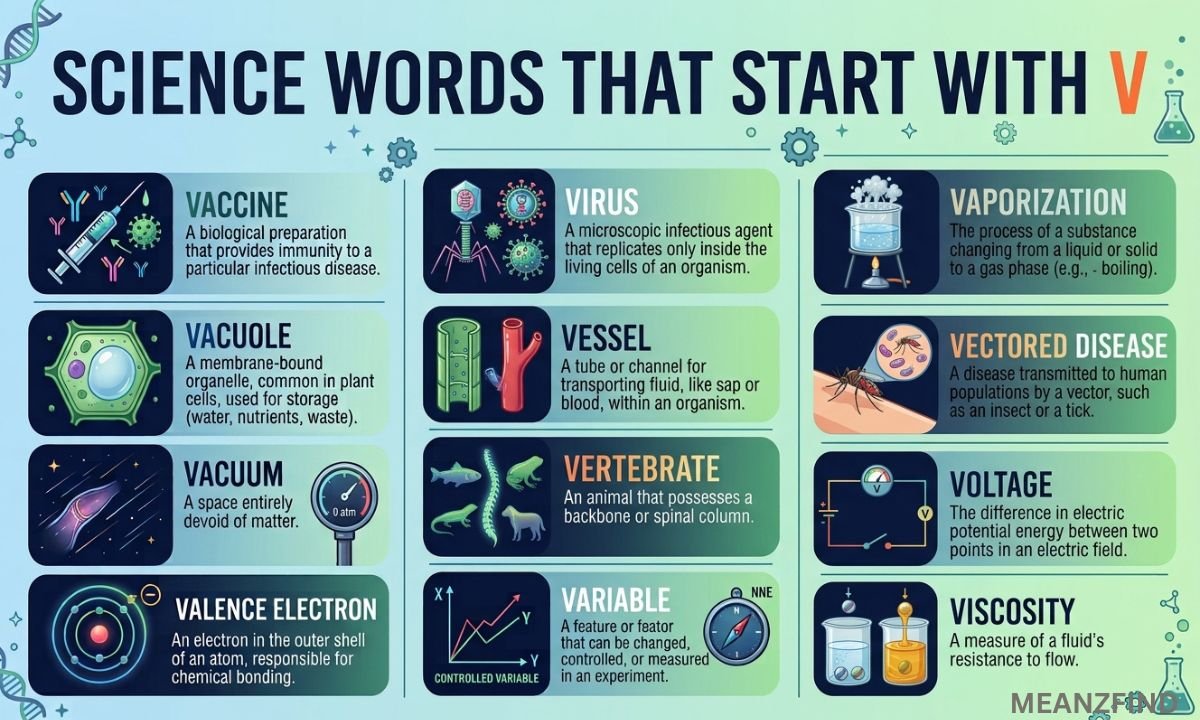
Science is full of interesting words. Many of these words start with the letter V. They help us understand nature, space, and the human body. Learning them can make science more fun and easy to follow.
In this article, we will look at science words that start with V. Each word comes with a simple meaning. You will also find easy examples to help you understand better. This makes learning new terms simple, even for beginners.
Some V words are common, like “volcano” or “vaccine.” Others are less known but still important, like “vertebrate” or “viscosity.” Knowing these words can help in school, in daily life, and in general knowledge.
We have also added some fun facts along the way. These facts make learning more interesting and memorable. By the end, you will have a helpful list of V science words. You can use this list for study, teaching, or just for fun.
What Are Science Words That Start With V?
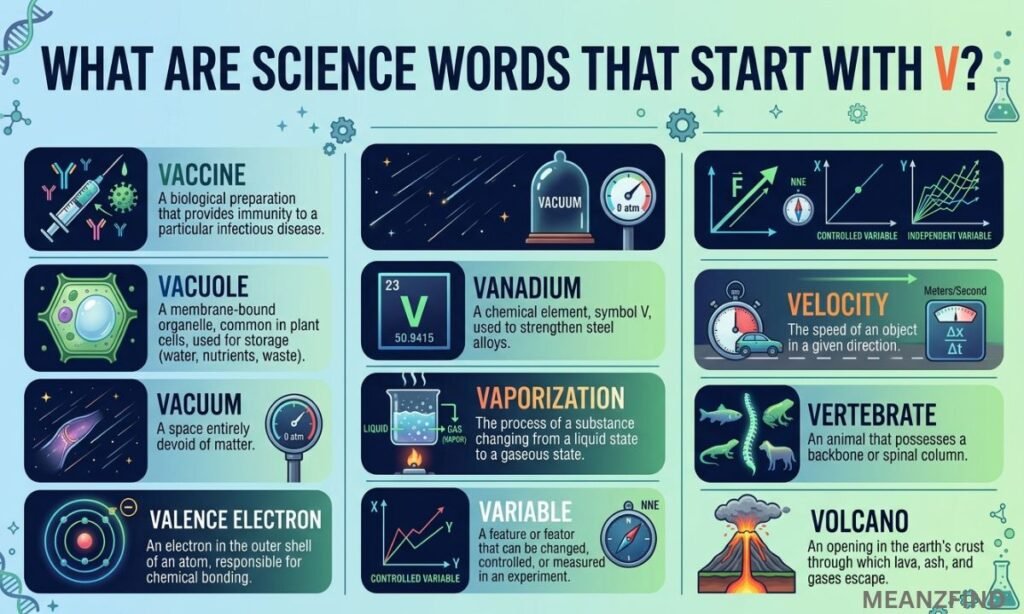
Science words that start with V are terms used in physics, chemistry, biology, and earth science. These words describe things we see, feel, and use every day. From the volume of water in a glass to the vaccine that keeps us healthy, the letter V shows up in many important science ideas.
Kids, students, and even parents often search for these words while doing homework or preparing for a science test. This list covers simple meanings, real-life examples, and fun facts for each word. It is written in easy English so that even a 5th-grade student can understand it without help.
Why Learning V Science Words Matters
Science vocabulary is not just about memorizing hard terms. It helps students:
- Understand science lessons faster in class
- Score better in exams and quizzes
- Explain everyday things like weather, health, and machines
- Build a strong base for higher classes like 6th, 7th, and 8th grade
Once you know these words, science stops feeling like a foreign language. It starts to feel like a set of tools you can use to explain the world around you.
Complete List Of Science Words That Start With V
Here is a quick table with all the major V science words, their subject area, and a one-line meaning. This works as a fast reference before we explain each word in detail.
| Word | Subject | Simple Meaning |
| Velocity | Physics | Speed of an object in a certain direction |
| Volume | Physics/Chemistry | Amount of space something takes up |
| Vibration | Physics | Fast back-and-forth movement |
| Voltage | Physics | Force that pushes electricity through a wire |
| Vacuum | Physics | Space with no air or matter in it |
| Virus | Biology | Tiny germ that causes disease |
| Vaccine | Biology | Medicine that protects the body from disease |
| Viscosity | Chemistry | How thick or thin a liquid is |
| Vaporization | Chemistry | Change of a liquid into a gas |
| Valence | Chemistry | Number of electrons an atom can share or give |
| Vector | Physics/Biology | A quantity with direction, or a disease-carrying organism |
| Vertebrate | Biology | Animal with a backbone |
Now let’s look at each word closely, one at a time, with easy examples and fun facts.
Physics Words That Start With V
Physics is the science of motion, energy, and force. Many V words come from this subject because physics deals with speed, space, and electricity.
Velocity
Velocity means how fast something moves in a certain direction. It is not just about speed — it also tells us where the object is going.
Simple example: A car moving at 60 kilometers per hour toward the north has a velocity of 60 km/h north.
Fun fact: Light travels faster than anything else in the universe. Its velocity is about 300,000 kilometers per second.
Velocity is different from speed because speed only tells “how fast,” while velocity tells “how fast and in which direction.”
Volume
Volume is the amount of space something takes up. It can be measured in liters, milliliters, or cubic centimeters.
Simple example: A water bottle can hold 1 liter of water. That 1 liter is the volume of the bottle.
Fun fact: Even air has volume. A balloon filled with air takes up space just like a balloon filled with water.
Volume is used in cooking, science labs, and even in measuring how much medicine a person should take.
Vibration
Vibration is a fast back-and-forth movement of an object. Sound is actually made by vibrations.
Simple example: When you pluck a guitar string, it vibrates quickly and produces sound.
Fun fact: Your vocal cords vibrate every time you speak or sing. That’s how your voice is created.
Vibrations can be so fast that we cannot see them with our eyes, but we can often hear or feel them.
Voltage
Voltage is the force that pushes electric current through a wire. Think of it like water pressure in a pipe, but for electricity.
Simple example: A regular AA battery has a voltage of about 1.5 volts.
Fun fact: A single bolt of lightning can carry millions of volts of electricity in just a fraction of a second.
Higher voltage means more force pushing the electricity, which is why high-voltage wires need special safety warnings.
Vacuum
A vacuum is a space that has no air, no gas, and almost no matter in it at all.
Simple example: Outer space is mostly a vacuum because there is very little air or matter floating around.
Fun fact: Sound cannot travel through a vacuum because sound needs air or another material to move through. This is why space is silent.
Vacuum cleaners are named after this word because they create a low-pressure space that sucks in dust and dirt.
Vector (Physics Meaning)
In physics, a vector is a quantity that has both size and direction. It is different from a plain number, which only shows size.
Simple example: “10 meters per second east” is a vector because it shows both speed and direction.
Fun fact: Arrows are used to draw vectors in science diagrams. The length of the arrow shows size, and the direction it points shows direction.
Biology Words That Start With V
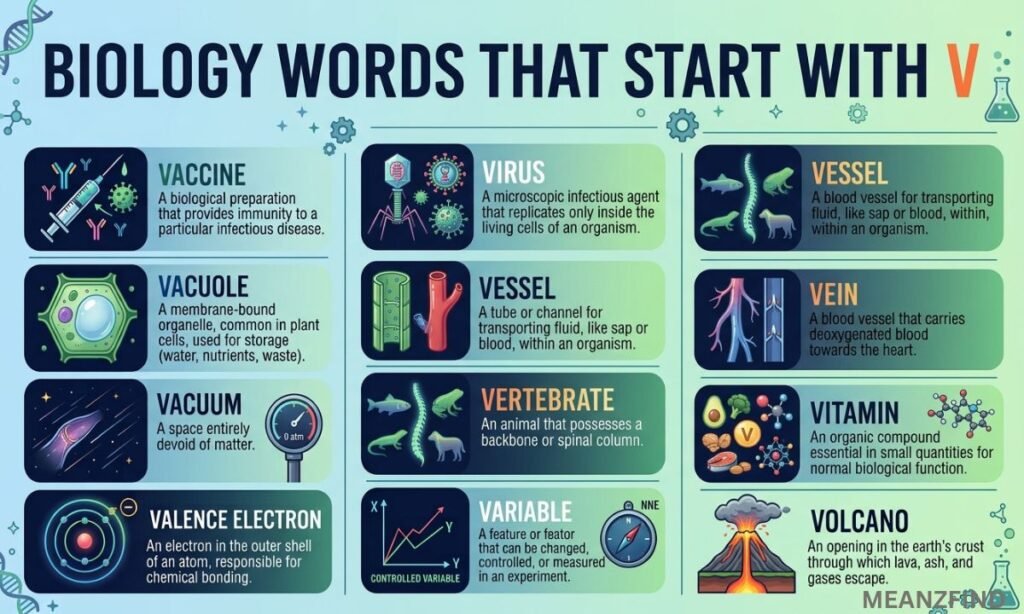
Biology is the science of living things — humans, animals, plants, and tiny organisms we cannot see.
Virus
A virus is a very tiny germ that can make people, animals, or plants sick. Viruses are so small that you need a powerful microscope to see them.
Simple example: The common cold and the flu are both caused by viruses.
Fun fact: A virus cannot grow or reproduce on its own. It needs to enter a living cell first to make copies of itself.
Viruses are one of the smallest living or semi-living things in nature, yet they can cause big health problems.
Vaccine
A vaccine is a special medicine that trains your body to fight off a disease before you actually get sick.
Simple example: The measles vaccine helps protect children from catching measles.
Fun fact: Vaccines work by showing your immune system a weak or dead version of a germ, so your body learns how to fight the real one later.
Vaccines have helped remove some diseases almost completely from the world, saving millions of lives.
Vertebrate
A vertebrate is any animal that has a backbone inside its body. This includes humans, fish, birds, reptiles, and mammals.
Simple example: A dog is a vertebrate because it has a spine running down its back.
Fun fact: Less than 5% of all known animal species on Earth are vertebrates. Most animals, like insects and worms, are invertebrates, meaning they have no backbone.
Vertebrates are usually easier to study because their backbone protects important body parts like the spinal cord.
Vector (Biology Meaning)
In biology, a vector means something different than in physics. Here, a vector is a living thing that carries and spreads disease from one host to another.
Simple example: A mosquito is a vector because it can spread diseases like malaria and dengue when it bites people.
Fun fact: Mosquitoes are considered one of the deadliest animals on Earth, not because of their bite, but because of the diseases they carry as vectors.
Chemistry Words That Start With V
Chemistry looks at what things are made of and how they change. Several important V words come from chemistry lessons.
Viscosity
Viscosity tells us how thick or thin a liquid is, or how easily it flows.
Simple example: Honey has high viscosity because it flows slowly. Water has low viscosity because it flows quickly.
Fun fact: Ketchup is a strange liquid because its viscosity changes when you shake or squeeze the bottle, which is why it sometimes won’t pour and then suddenly rushes out.
Viscosity is important in cooking, engine oil, and even in blood flow inside our bodies.
Vaporization
Vaporization is the process where a liquid changes into a gas. This usually happens when a liquid is heated.
Simple example: When water boils on a stove, it turns into steam. This is vaporization.
Fun fact: Sweat cools your body through vaporization. As sweat turns into vapor and leaves your skin, it takes heat away with it, cooling you down.
There are two types of vaporization: boiling, which happens quickly with heat, and evaporation, which happens slowly at any temperature.
Valence
Valence refers to the number of electrons an atom can give, take, or share when it bonds with other atoms.
Simple example: Oxygen has a valence of 2, which means it usually forms two bonds with other atoms, like in water (H2O).
Fun fact: Valence is the reason atoms combine to form molecules at all. Without valence electrons, atoms would not be able to “hold hands” and build the materials around us.
Valence electrons decide how an element behaves in chemical reactions, making this one of the most important ideas in chemistry class.
Science Words That Start With V for Kids
Younger students often need shorter, simpler explanations. Here is an easy list made especially for kids, using everyday comparisons.
| Word | Kid-Friendly Meaning |
| Velocity | How fast something moves and where it’s going |
| Volume | How much space is inside something |
| Vibration | Something shaking really fast |
| Voltage | The push that moves electricity |
| Vacuum | A space with nothing in it, not even air |
| Virus | A tiny germ that makes you sick |
| Vaccine | A shot that keeps germs from hurting you |
| Vertebrate | An animal with bones in its back |
Kids can remember these words better by connecting them to things they already know, like guitars for vibration or bottles for volume.
Fun Ways Kids Can Remember V Words
- Say the word out loud three times to remember its sound
- Draw a small picture next to each word
- Use the word in a silly sentence, like “The vacuum has no air, so I can’t breathe there!”
- Match the word to something at home, like a battery for voltage
Science Words That Start With V By Grade Level
Different grades focus on different depths of these words. Here is a simple breakdown to help students and teachers know what to expect.
Science Words That Start With V — 5th Grade
In 5th grade, students usually learn the basic meaning of each word along with simple examples.
- Volume
- Vibration
- Vacuum
- Virus
- Vaccine
- Vertebrate
At this level, the focus is on recognizing the word and connecting it to something familiar, not on deep formulas or chemical structures.
Science Words That Start With V — 6th Grade
By 6th grade, students start connecting these words to small experiments and simple diagrams.
- Velocity
- Voltage
- Viscosity
- Vaporization
- Vertebrate (in more detail, comparing to invertebrates)
Students may also start using basic formulas, such as calculating speed and direction for velocity problems.
Science Words That Start With V — 7th Grade
In 7th grade, the topics become more detailed, especially in chemistry and human biology.
- Valence
- Vaporization (linked with states of matter)
- Vector (both physics and biology meaning)
- Voltage (linked with circuits)
Students at this stage often do simple lab activities, like measuring the volume of liquids or testing viscosity with different fluids.
Science Words That Start With V — 8th Grade
By 8th grade, students are expected to use these words in tests, projects, and even simple lab reports.
- Velocity and acceleration together
- Valence electrons and chemical bonding
- Voltage, current, and circuits
- Vector-borne diseases in biology
At this level, students should be able to explain each word in their own sentences, not just repeat the definition from a textbook.
Comparison Table: Physics vs Biology vs Chemistry V Words
This table makes it easy to see how V words are grouped by subject, which is helpful for study guides and quick revision.
| Subject | V Words | Common Use |
| Physics | Velocity, Volume, Vibration, Voltage, Vacuum, Vector | Motion, energy, space, electricity |
| Biology | Virus, Vaccine, Vertebrate, Vector | Living things, disease, human body |
| Chemistry | Viscosity, Vaporization, Valence | States of matter, atoms, bonding |
This grouping helps students see that V is not just a random letter — it plays a big role across every branch of science.
Life Science Words That Start With V
Life science, also called biology, focuses only on living things. Here are the main life science V words in one place for quick study.
- Virus – a tiny germ that causes illness
- Vaccine – medicine that protects against disease
- Vertebrate – an animal with a backbone
- Vector – a living thing that spreads disease, like a mosquito or tick
These four words are often tested together in school because they connect health, animals, and disease into one topic.
Why Life Science V Words Are Important
Life science words help students understand their own bodies and the animals around them. Knowing what a virus is, for example, helps students understand why washing hands and getting vaccines matters. Knowing what a vertebrate is helps students classify animals correctly during science projects.
Quick Revision List: All Science Words That Start With V
Use this simple list as a last-minute revision before a test or quiz.
- Velocity – speed with direction
- Volume – amount of space something takes up
- Vibration – fast back-and-forth movement
- Voltage – force pushing electricity
- Vacuum – empty space with no air
- Virus – tiny germ that causes sickness
- Vaccine – medicine that prevents disease
- Viscosity – thickness of a liquid
- Vaporization – liquid turning into gas
- Valence – electrons an atom shares or gives
- Vector – quantity with direction, or disease carrier
- Vertebrate – animal with a backbone
Keep this list handy for homework, tests, or quick science trivia at home.
FINAL WORDS
We have now looked at many science words that start with V. Each word came with an easy meaning and example. These words cover topics like space, biology, chemistry, and the human body. Learning them step by step makes science feel less difficult.
Words like “volcano,” “vaccine,” and “vertebrate” are useful in daily life and school. Other words, like “viscosity” or “vacuum,” help explain how things work in nature. Knowing these terms builds a stronger science vocabulary. It also helps you understand new topics more easily in the future.
Science vocabulary is not just for exams. It helps us understand the world around us. From weather to the human body, these V words show up in many places. This makes learning them useful beyond just the classroom.
You can use this list as a quick reference anytime. Teachers can use it for lessons or vocabulary practice. Students can use it to study or prepare for tests. Even curious readers can enjoy learning something new.
We hope this list made science words starting with V simple and clear. Keep exploring new words to grow your knowledge. Science is full of exciting terms waiting to be discovered. Learning a little every day adds up to a lot over time.
FAQs
What is a scientific word that starts with the letter “V”?
Velocity, volume, and vaccine are common scientific words starting with V. These words are used in physics, biology, and chemistry to explain motion, space, and health.
What does V stand for in science?
V usually stands for “Volt” in electricity or “Velocity” in physics, depending on the topic. In chemistry, V can also represent “Volume” in gas and liquid measurements.
What are 10 science words?
Velocity, volume, vibration, voltage, vacuum, virus, vaccine, viscosity, vector, and vertebrate are 10 common science words. Each one belongs to a different branch of science like physics, biology, or chemistry.
What are 5 science words?
Volume, virus, vaccine, voltage, and vibration are 5 simple science words. These are often taught in early school grades because they connect to daily life.
What is V in physics?
In physics, V usually represents “Velocity,” which means speed with direction. It can also stand for “Voltage” when talking about electricity and circuits.
What is V in class 10 physics?
In class 10 physics, V mostly refers to “Voltage” in electricity chapters, measured in volts. It can also mean “Velocity” when studying motion and speed problems.
What are some good v words?
Good V science words include velocity, vaccine, virus, voltage, and vertebrate. These words are easy to learn and often appear in school textbooks.
What is science A to Z?
Science A to Z means learning scientific words in alphabetical order, from “Atom” to “Zygote.” It helps students build a full vocabulary across every letter, including V.
Can you give me 50 scientific words with meanings?
A list of 50 scientific words would include terms like atom, energy, velocity, virus, and vaccine, each with a simple one-line meaning. Such lists are usually organized alphabetically to make learning and searching easier.
Which formula is V?
V is often used in the formula V = IR, which means Voltage equals Current multiplied by Resistance. In motion, V = D/T is also common, meaning Velocity equals Distance divided by Time.
Does power equal I * V?
Yes, in electricity, Power (P) equals Current (I) multiplied by Voltage (V), written as P = IV. This formula is one of the most basic rules used in electrical science.
What is V in physics in light?
In light and wave physics, V usually stands for “Velocity,” which shows how fast light travels through a medium. The speed of light in a vacuum is a well-known example of this V value.