
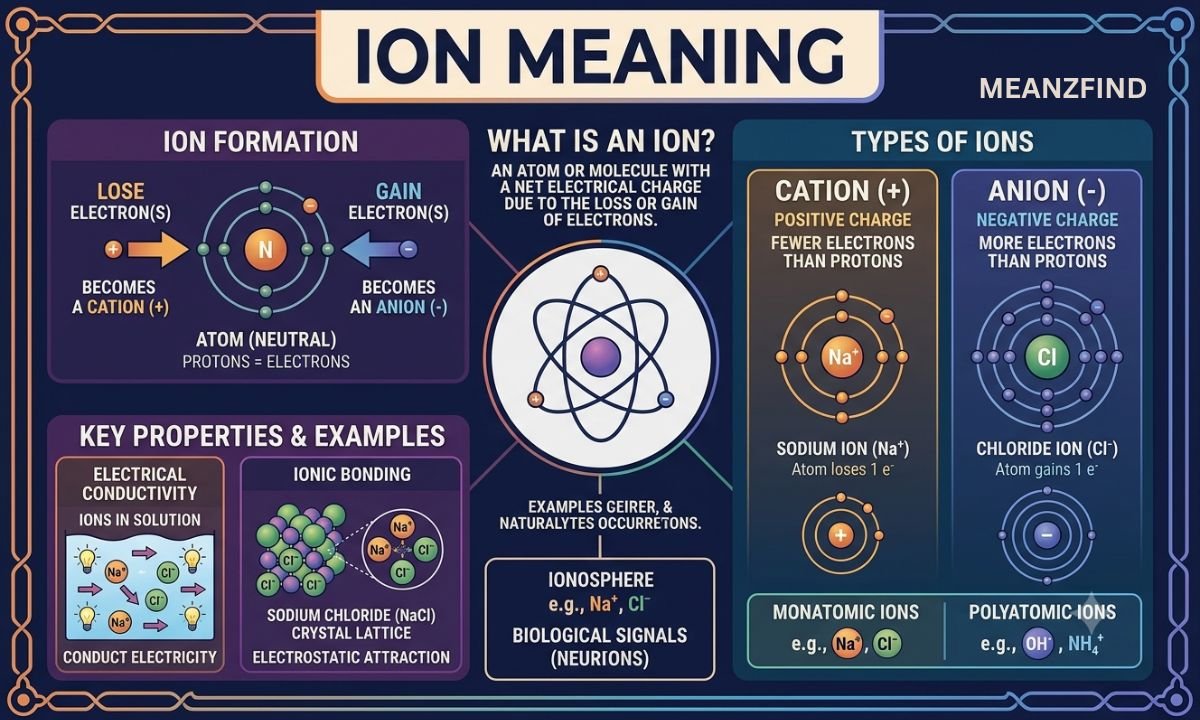
Have you ever wondered what an ion really is? It’s a word we hear often in chemistry class, but it can sound confusing at first. In simple terms, an ion is just an atom or molecule with an electric charge.
Atoms are usually neutral. This means they have an equal number of protons and electrons. But when an atom loses or gains electrons, it becomes charged, and that’s when it turns into an ion.
There are two main types of ions. One is called a cation, which has a positive charge. The other is called an anion, which has a negative charge. Both play a big role in chemistry and everyday life.
Cations form when an atom loses electrons. This loss makes the atom positively charged. A common example is sodium, which loses one electron to become Na⁺.
Anions form when an atom gains electrons. This gain makes the atom negatively charged. Chlorine is a good example, as it gains one electron to become Cl⁻.
Ions are all around us, even if we don’t notice them. They are found in salt, water, and even inside our bodies. Understanding ions helps us understand how many everyday things actually work.
What Does ION Mean?
The word ION has two very different lives. In science, an ion is a tiny particle with an electric charge. In texting and social media, “ion” is short slang for “I don’t.”
Both meanings are correct. The right one depends on where you see the word. A chemistry book means science. A text message from a friend usually means slang.
This guide covers every major meaning of ION. You will learn the science definition, the slang meaning, and how the word changes across chat apps, biology, physics, and even aircraft terms.
ION Meaning in Different Contexts (Chat, Social Media, Professional Fields)
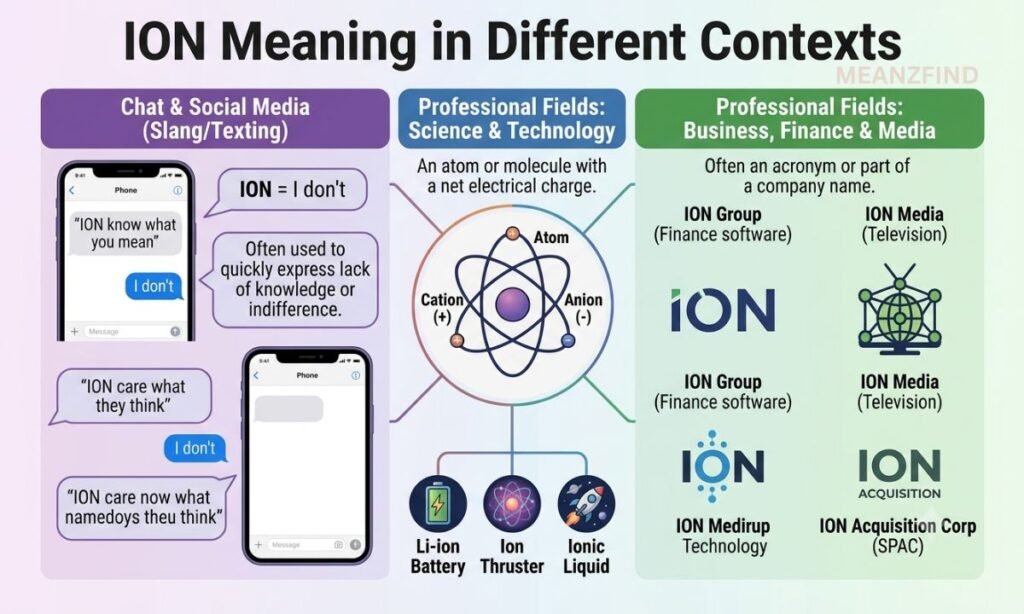
The same three letters mean totally different things depending on where you find them. Here is a quick look before we go deeper.
| Context | Meaning of ION | Example |
| Chemistry class | A charged atom or molecule | Salt breaks into ions in water |
| Physics | A charged particle | Ions move in an electric field |
| Texting / Chat | Short for “I don’t” | “ion know what to do” |
| Instagram / TikTok | Casual slang, same as chat | “ion care tbh” |
| Aircraft industry | Sometimes a brand or part code | ION engine systems |
| Word building (suffix) | Turns a verb into a noun | Act + ion = action |
Knowing the context is the first step to understanding what someone means. A scientist and a teenager can both say “ion” and mean completely different things.
ION Meaning Slang
In slang, ION means “I don’t.” People use it to save time while typing. It is very common in text messages, tweets, and short video captions.
Here are a few normal examples:
- “ion know why he did that.”
- “ion wanna go out today.”
- “ion think that’s true.”
Notice the pattern. “Ion” always replaces “I don’t” at the start of a sentence. It is not used the same way as the science word.
Why People Use This Slang
Short slang words save time. They also feel more relaxed and friendly than full sentences. Many young people use them to sound casual, not formal.
Slang like this spreads fast because of social media. Once a few popular accounts use a word, millions of people copy it within weeks.
Suffix ION Meaning
In grammar, “-ion” is a suffix. A suffix is a small piece added to the end of a word. It changes the word’s job in a sentence.
Adding “-ion” usually turns a verb (an action word) into a noun (a naming word). This is a simple but powerful rule in English.
Examples of the ION Suffix
| Verb | Noun with -ion |
| Act | Action |
| Create | Creation |
| Decide | Decision |
| Connect | Connection |
| Educate | Education |
| Celebrate | Celebration |
This suffix is one of the most common in the English language. Learning it helps students build vocabulary faster, because one root word can create a whole new word.
Simple Rule to Remember
If a verb ends in “-ate,” you often just add “-ion” and remove the “e.” For example, “celebrate” becomes “celebration.”
If a verb ends in “-ct,” like “act” or “connect,” you can usually just add “-ion” directly.
ION Meaning in Chemistry
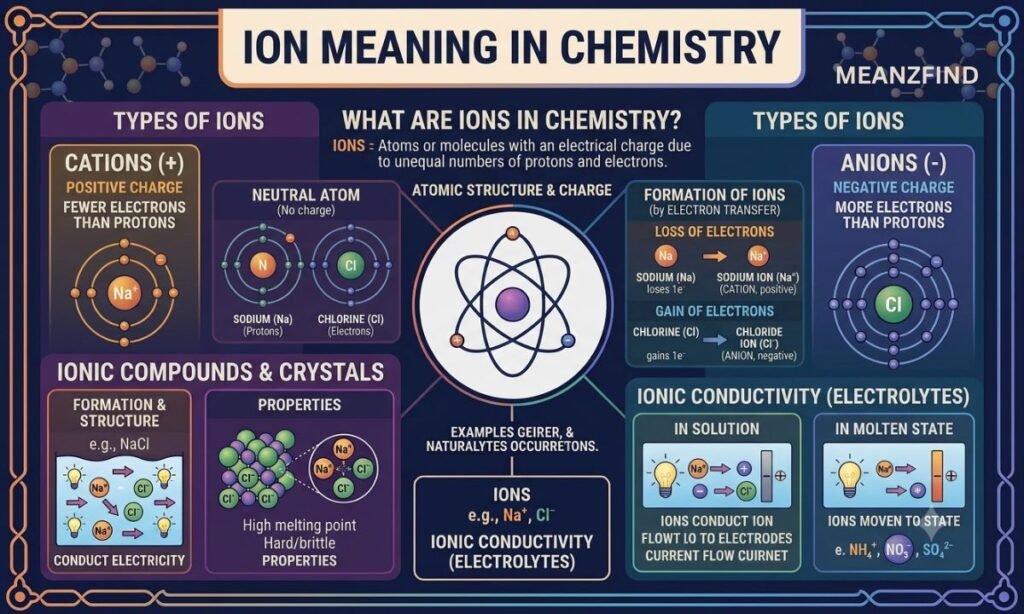
Now let’s look at the real science meaning. This is the most important and most searched definition of ION.
An ion is an atom or a group of atoms that has an electric charge. This charge can be positive or negative. Atoms become ions when they lose or gain tiny particles called electrons.
Why Do Atoms Become Ions?
Every atom wants to be stable. A normal atom has an equal number of protons (positive) and electrons (negative). This balance makes the atom neutral, meaning it has no charge.
But sometimes an atom loses an electron or gains an extra one. This breaks the balance. The atom is no longer neutral, so it becomes an ion.
Two Main Types of Ions
There are two types of ions in chemistry, and this is a key point students must remember.
1. Cation (Positive Ion)
- Formed when an atom loses electrons
- Has more protons than electrons
- Carries a positive charge
- Example: Sodium loses one electron to become Na⁺
2. Anion (Negative Ion)
- Formed when an atom gains electrons
- Has more electrons than protons
- Carries a negative charge
- Example: Chlorine gains one electron to become Cl⁻
Simple Table: Cation vs Anion
| Feature | Cation | Anion |
| Charge | Positive | Negative |
| Electron change | Loses electrons | Gains electrons |
| Symbol example | Na⁺, K⁺, Ca²⁺ | Cl⁻, O²⁻, F⁻ |
| Attracted to | Negative electrode | Positive electrode |
Common Examples of Ions in Chemistry
- Salt (NaCl) breaks apart into Na⁺ and Cl⁻ ions when dissolved in water.
- Baking soda contains sodium and bicarbonate ions.
- Battery acid is full of charged ions that help create electricity.
How Ions Are Formed (Step-by-Step)
- An atom starts out neutral, with equal protons and electrons.
- Energy or a chemical reaction causes the atom to lose or gain an electron.
- The atom now has an unequal number of protons and electrons.
- This imbalance creates a charge, and the atom becomes an ion.
Ions are the reason many chemical reactions happen at all. Without ions, we would not have batteries, salt water, or even proper digestion in our stomachs.
ION Meaning in Physics
In physics, an ion is still a charged particle, but the focus is different. Physics looks at how ions move, how they carry electricity, and how they behave in fields and gases.
Ions and Electricity
Ions help carry electric current in liquids and gases. This is different from metals, where electrons alone carry the current.
When you see a lightning bolt, you are actually seeing ions in action. Air molecules become ionized (turned into ions) by strong electric energy, which creates the flash of light.
Ionization in Physics
Ionization is the process of turning a neutral atom into an ion. This can happen through:
- Heat (thermal ionization)
- Light or radiation
- Strong electric fields
- Collisions between particles
Real-Life Physics Examples
- Neon signs glow because gas atoms become ionized and release light.
- The sun is made of plasma, which is a soup of ions and free electrons.
- X-ray machines use ionizing radiation to take pictures inside the body.
Physics and chemistry overlap here. Chemistry explains why ions form. Physics explains how they move, carry energy, and create light or electricity.
ION Meaning in Biology
Ions are not just found in labs. They are inside every living body, including yours. In biology, ions control many important body functions.
Why Ions Matter in Living Things
Cells in our body need ions to work properly. Without ions, nerves could not send signals, and muscles could not move.
Common Ions in the Body
| Ion Name | Symbol | Main Job in the Body |
| Sodium | Na⁺ | Nerve signals, fluid balance |
| Potassium | K⁺ | Muscle function, heart rhythm |
| Calcium | Ca²⁺ | Strong bones, muscle movement |
| Chloride | Cl⁻ | Fluid balance, digestion |
| Magnesium | Mg²⁺ | Energy production, muscle relaxation |
How Ions Help Nerves and Muscles
Nerve cells use sodium and potassium ions to send messages. These ions move in and out of the cell very quickly, creating a tiny electrical signal.
This signal travels along the nerve like a wave. That is how your brain tells your hand to move, all thanks to ions.
ION Meaning in the Human Body
Since this topic matters so much, it deserves its own closer look. The human body is full of natural ions, and they keep us alive every single second.
Electrolytes Are Ions
You may have heard the word “electrolytes” on sports drink ads. Electrolytes are simply ions dissolved in body fluids like blood and sweat.
- Sodium and potassium keep muscles working correctly.
- Calcium helps blood clot and bones stay strong.
- Chloride helps keep fluid levels balanced.
What Happens When Ion Levels Are Off
If ion levels become too high or too low, the body can suffer. This is why doctors often check “electrolyte levels” in blood tests.
- Low sodium can cause confusion or weakness.
- Low potassium can cause an irregular heartbeat.
- Low calcium can cause muscle cramps.
This shows that ions are not just a chemistry class topic. They are a real part of staying healthy every day.
ION Meaning Gen Z
Gen Z did not invent the slang “ion,” but they made it popular worldwide. It is now one of the most recognized short forms in online writing.
How Gen Z Uses ION
Gen Z uses “ion” to sound quick, honest, and low-effort in a fun way. It fits perfectly into fast-paced chats and captions.
- “ion trust that at all.”
- “ion feel like going out tonight.”
- “ion even remember what happened.”
Related Gen Z Slang Words
Other similar short slang words are common too:
- idk – I don’t know
- ngl – not gonna lie
- fr – for real
- tbh – to be honest
“Ion” fits right into this group. It follows the same idea of shrinking common phrases into something faster to type.
ION Meaning in Chat
In general chat apps and text messages, “ion” almost always means “I don’t.” This is the slang meaning, not the science one.
People use it casually, without capital letters, and without punctuation. It feels more like spoken language than formal writing.
Example Chat Messages
- “ion have money rn.”
- “ion wanna talk about it.”
- “ion get why she’s mad.”
This style matches how people actually talk. It skips extra words and gets straight to the point.
ION Meaning on WhatsApp
On WhatsApp, “ion” is used the same way as in regular texting. It usually appears in casual chats between friends or family members close in age.
Since WhatsApp is used worldwide, this slang is more common among younger users. Older users may not recognize it right away.
Tips for Understanding ION on WhatsApp
- Look at the sentence after “ion.” If it makes sense as “I don’t,” that confirms the slang meaning.
- Check the tone of the chat. Casual, fast-paced chats often use short slang like this.
ION Meaning on Instagram
On Instagram, “ion” often appears in captions, comments, and story replies. It fits Instagram’s short and casual writing style perfectly.
Common Instagram Examples
- “ion post much but I’m still here.”
- “ion care what people think.”
- “ion know why this photo took so long.”
Instagram captions are meant to be quick and personal. Slang like “ion” helps posts feel more relatable and less like formal writing.
ION Meaning on TikTok
TikTok is one of the biggest reasons “ion” became so popular. Short video captions and comments use it constantly.
Why TikTok Made ION Popular
TikTok videos are short, so captions need to be short too. Slang like “ion” fits perfectly into a fast, snappy caption style.
- “ion even know how I did that.”
- “ion think this trend will last.”
- “ion wanna explain, just watch.”
Many trends and sounds on TikTok also repeat popular slang, which helps words like “ion” spread even faster to new users.
ION Meaning in Physics (Deeper Look)
We already covered the basics of physics, but let’s go a little deeper into how ions connect to bigger science ideas.
Plasma: The Fourth State of Matter
Plasma is often called the fourth state of matter, after solid, liquid, and gas. Plasma is made almost entirely of ions and free electrons.
Stars, including our sun, are giant balls of plasma. This means stars are full of ions moving and glowing with energy.
Ion Engines
Some spacecraft use something called an ion engine or ion thruster. These engines push out charged particles (ions) to slowly move a spacecraft forward in space.
Ion engines are not powerful for quick takeoffs, but they are extremely efficient for long space journeys, since they use very little fuel over time.
ION Meaning in Medical Field
In medicine, ions play a major role in diagnosing and treating patients. Doctors regularly test ion levels to understand a patient’s health.
Common Medical Ion Tests
- Sodium test – checks fluid balance and nerve function
- Potassium test – checks heart and muscle health
- Calcium test – checks bones and blood clotting
- Chloride test – checks kidney and fluid balance
Ions in Medical Treatment
- IV fluids given in hospitals often contain sodium and other ions to restore balance.
- Rehydration drinks replace lost ions after sickness, sweating, or diarrhea.
- Ionizing radiation is used carefully in treatments like radiotherapy for cancer.
Doctors take ion balance seriously because even small changes can affect the heart, brain, and muscles quickly.
ION Meaning in Aircraft Terminology
In aviation and aerospace fields, “ION” can appear as part of technology names, engine systems, or company terms, rather than the basic science word alone.
Ion-Related Technology in Aircraft and Space
- Ion thrusters are used in satellites and some spacecraft for smooth, fuel-efficient movement.
- Ionization smoke detectors are used in aircraft cabins to detect smoke using charged particles.
- Some aircraft parts and systems use “ION” as a brand or model name, which is different from the science meaning.
It is important to check context here. Sometimes “ION” in aircraft terms is simply a product name, not the scientific charged particle.
ION Meaning in Common Misconceptions
Many people mix up ion-related words or misunderstand how ions work. Let’s clear up the most common mistakes.
Misconception 1: Ions Are Always Dangerous
Many people think “ionizing radiation” means all ions are harmful. This is not true. Ions in your body, like sodium and potassium, are completely necessary and safe in normal amounts.
Misconception 2: Atoms and Ions Are the Same Thing
An atom is neutral. An ion is charged. They are related, but not the same. Every ion starts as an atom, but not every atom is an ion.
Misconception 3: “Ion” Slang and Science Meaning Are Connected
Some people assume the slang word “ion” came from the science word. This is false. They are simply spelled the same way but have completely separate origins and meanings.
Misconception 4: All Ions Are Negative
Many students assume “ion” always means negative charge. In reality, ions can be positive (cations) or negative (anions).
ION Meaning in Similar Terms & Alternatives
Several science words look or sound like “ion” but mean different things. Knowing the difference helps avoid confusion in exams and reading.
| Term | Meaning | How It’s Different from Ion |
| Atom | Smallest unit of matter, neutral | Has no charge, unlike an ion |
| Molecule | Two or more atoms joined together | Can be neutral or become an ion |
| Isotope | Atoms of the same element with different weights | Based on neutrons, not charge |
| Electron | A tiny negative particle inside an atom | Just one part of what makes an ion |
| Proton | A positive particle inside an atom’s center | Does not move to create ions easily |
| Plasma | A gas-like state made of ions | A whole state of matter, not a single particle |
Differences from Similar Words
It helps to compare ion with words that sound alike but are not related in meaning.
- Ion vs Iron: “Iron” is a metal element (Fe). “Ion” is a charged particle. They sound close but mean completely different things.
- Ion vs Aeon: “Aeon” means a very long period of time. It has nothing to do with charge or chemistry.
- Ion vs Eon: Same as above, “eon” is about time, not science particles.
These sound-alike mix-ups are common, especially for new English learners or young students.
Relevance in Online Conversations & Dating Apps
The slang meaning of “ion” is very common in online conversations, including dating apps. People use it to sound casual, honest, and relaxed while chatting with new matches.
Why ION Fits Dating App Culture
Dating app chats are usually short and quick. Long, formal sentences can feel stiff or awkward. Slang like “ion” keeps the mood light and friendly.
- “ion usually match with people, but hey.”
- “ion mind either place for the date.”
- “ion wanna rush things, let’s just talk first.”
Reading Tone Correctly
On dating apps, tone matters a lot. “Ion” often signals a relaxed, non-serious mood rather than a formal or nervous one. Understanding this can help avoid misreading someone’s intent in a chat.
Background
The scientific idea of ions goes back to early chemistry and physics research, where scientists needed a word for atoms that carried an electric charge. Over time, this word became a core part of school science lessons worldwide.
The slang version grew separately, shaped by fast texting habits and social media culture. It shows how language keeps changing, with old words picking up brand-new meanings among younger generations.
Both meanings now live side by side. Search engines, students, and casual chatters all look up “ion meaning” for very different reasons, which is exactly why understanding the full picture matters.
FINAL WORD
Ions may seem like a small part of chemistry, but they matter a lot. They help explain how atoms behave and interact with each other. Once you understand ions, many chemistry topics become much easier.
We learned that an ion is simply an atom or molecule with a charge. This charge comes from losing or gaining electrons. It’s a small change, but it makes a big difference.
We also looked at the two main types of ions. Cations carry a positive charge, while anions carry a negative charge. Together, they help explain how different substances form and react.
Everyday examples make this topic even clearer. Sodium turning into Na⁺ and chlorine turning into Cl⁻ show how common ions really are. These simple examples make chemistry feel less complicated.
Ions are not just found in textbooks. They exist in salt, water, and even in our own bodies. This shows how important ions are in real life, not just in the classroom.
In the end, understanding ions gives us a stronger base in chemistry. It helps us see how atoms connect, react, and create the world around us. With this knowledge, learning other chemistry topics becomes much simpler.
FAQs
What does ion mean in text?
In text messages, “ion” is short slang for “I don’t.” People use it to type faster and sound more casual.
What is ion in Gen Z slang?
Gen Z uses “ion” the same way, as a quick way to say “I don’t” in chats, captions, and comments. It’s popular because it feels relaxed and low-effort.
What is the full meaning of ion?
“Ion” is not really an abbreviation with a full spelled-out form. As slang it means “I don’t,” and in science it means a charged atom or molecule.
What does ion know mean in texting?
“Ion know” simply means “I don’t know” when typed casually. It’s one of the most common uses of this slang online.
What is an ion?
In science, an ion is an atom or molecule that has an electric charge. It becomes charged after losing or gaining electrons.
What is meant by an ion?
An ion means a particle that is no longer neutral because its protons and electrons are unequal. This charge can be positive or negative.
Is ion slang for “I don’t”?
Yes, in texting and social media, “ion” is slang for “I don’t.” It is not related to the science meaning at all.
What does ion mean as slang?
As slang, “ion” always stands for “I don’t” at the start of a sentence. It’s used to keep messages short and casual.
What does “ion” mean from a girl?
When a girl uses “ion” in a text, it means “I don’t,” just like anyone else using it. The tone depends on the rest of the sentence, not the word itself.
Is called an ion?
A particle is called an ion when it carries an electric charge due to losing or gaining electrons. Without that charge, it’s simply called an atom.