
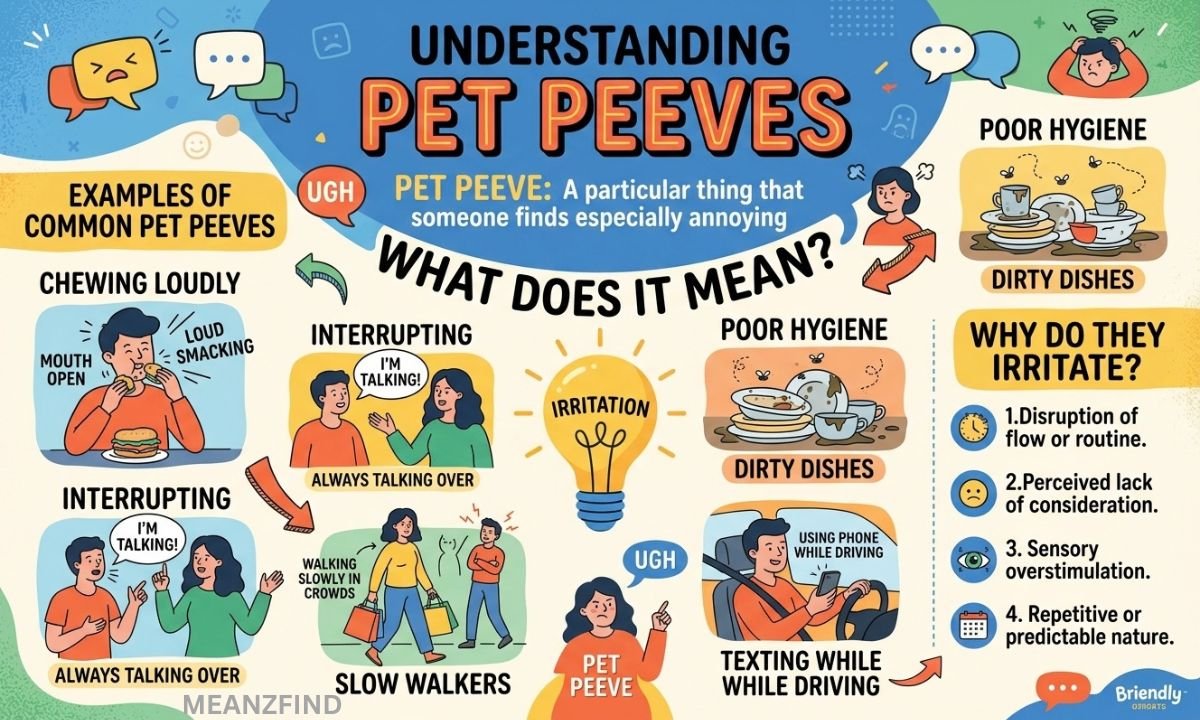
We all have something that bugs us more than it should. A dropped plate, a loud chewer, a message left on “read.” These small things are called pet peeves. They are personal, and they often make no sense to anyone else.
The word “peeve” comes from “peevish,” an old English word for cranky or irritable. People started using “pet peeve” in the early 1900s. The “pet” part means it is a favorite annoyance, one we keep close and complain about often. Over time, the phrase became common in everyday speech.
Pet peeves show up everywhere in daily life. Some people hate loud chewing. Others can’t stand slow walkers or messy handwriting. Even small habits, like leaving lights on or mispronouncing words, can become a lifelong pet peeve for someone.
What is Pet Peeves Meaning
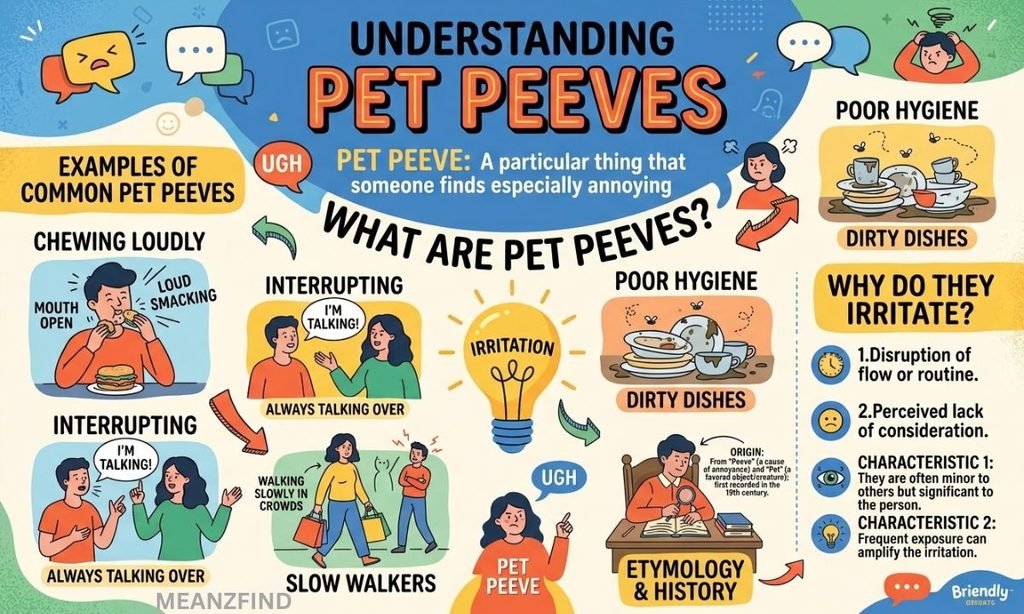
A pet peeve is something small that bothers you a lot, even if it does not bother other people. It is a personal annoyance. It is not a big problem, but it feels big to you.
The word “meaning” here simply asks what the phrase stands for. People search for “pet peeves meaning” because they hear the phrase in chats, videos, or conversations and want a clear answer.
In short, a pet peeve is your own private button that gets pushed easily. Everyone has at least one, even if they don’t talk about it often.
Pet Peeves – Quick Meaning
If you want the short answer, here it is in one line.
Pet peeve meaning: a small habit, sound, or action that annoys one specific person more than it would annoy most other people.
Here are the quick facts about the phrase:
- It is a noun.
- It is usually used in plural form as “pet peeves.”
- It describes a personal dislike, not a public rule.
- It is often shared in a light, joking way.
- It can be about people, habits, sounds, or situations.
Origin & Background of the Term
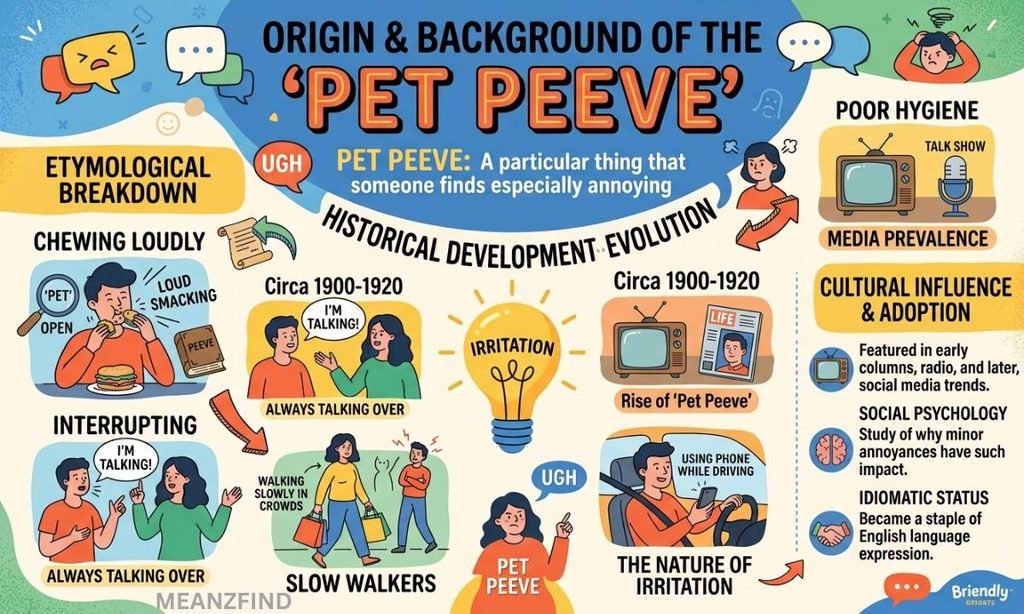
The word “peeve” comes from an older English word, “peevish.” Peevish means cranky, moody, or easily annoyed. This word has been used since the 1300s in English writing.
“Peeve” as its own short word became popular around the early 1900s. Newspaper writers and comic strip artists helped make it common. It was an easy, catchy way to say “annoyance.”
The word “pet” was added later. In this phrase, “pet” does not mean an animal. It means something you keep close, care about, or return to often, almost like a personal collection.
So when both words joined together, “pet peeve” was born. It means an annoyance that a person holds onto and mentions often, almost like it’s their own special complaint.
Real-Life Conversations (How People Actually Use It)
The phrase “pet peeve” is used all the time in daily chats. It shows up in texting apps, comment sections, and casual talk between friends.
Below are real examples of how it appears in different online spaces.
WhatsApp Chat
Friend 1: People who leave you on one tick for hours. Pure pet peeve of mine.
Friend 2: Same! Or when someone types “k” instead of “okay.”
Instagram DM
User A: One of my biggest pet peeves is when people don’t return borrowed things.
User B: Mine is loud phone speakers in public. Use headphones please 😩
TikTok Comments
Comment 1: “This is literally my pet peeve, I can’t watch people do this.”
Comment 2: “Not me realizing my pet peeve is a whole personality trait now 💀”
These examples show that people use the phrase casually. It is almost never used in a serious or angry way. It is more like a light complaint shared for fun or connection.
Emotional & Psychological Meaning
Pet peeves are not random. They often connect to something deeper about a person’s values or past experiences.
Here is what pet peeves can reveal, in simple terms:
- Sensory sensitivity: Some people are more sensitive to sounds, smells, or textures, so small things bother them more.
- Personal values: If someone values honesty, being lied to (even about small things) becomes a strong pet peeve.
- Past experiences: A habit that reminds someone of a bad memory can turn into a pet peeve.
- Need for control: People who like order often get annoyed by messiness or unpredictability.
Psychologists say pet peeves are a normal part of human personality. They are not a sign of anger issues. They simply show what a person notices most in their environment.
Having pet peeves also helps people bond. When two people share the same pet peeve, they instantly feel understood.
Usage in Different Contexts
The phrase “pet peeve” changes tone slightly depending on where it is used. Here is how it appears in different settings.
Social Media
On platforms like Instagram, TikTok, and Twitter/X, pet peeve posts are often made for fun. People post lists like “5 things that are my pet peeve” to get likes, comments, and shares. It works well because almost everyone relates to at least one item.
Friends & Relationships
Between friends or partners, sharing pet peeves builds closeness. It shows trust because you are telling someone your small, private annoyances. Friends often tease each other gently about their pet peeves too.
Work & Professional Settings
At work, pet peeves are usually kept polite and mild. Common ones include:
- Meetings that start late
- People who don’t reply to emails
- Loud eating at the office desk
- Interrupting during discussions
In professional spaces, people rarely say “this is my pet peeve” directly to someone. It is more often shared privately with a coworker they trust.
Casual vs Serious Tone
| Setting | Tone Used | Example Phrase |
| Friends group chat | Very casual, joking | “Bro that’s my pet peeve 😂” |
| Social media post | Fun, relatable | “Tell me your pet peeves below!” |
| Work conversation | Mild, polite | “It’s a small pet peeve, but…” |
| Formal writing | Neutral, explanatory | “A common pet peeve among readers is…” |
Common Misunderstandings
Many people use or understand “pet peeve” incorrectly. Let’s clear up the biggest mix-ups.
Pet peeves are not the same as hate
A pet peeve is a mild, small annoyance. Hate is a strong, deep emotion. Saying “loud chewing is my pet peeve” is very different from saying “I hate loud chewing.” Pet peeves are usually said with a light tone, not real anger.
They’re not universal
Just because something is your pet peeve does not mean it bothers everyone. In fact, that’s the whole point of the word. It highlights a personal reaction, not a shared rule everyone must follow.
They’re not always logical
Some pet peeves make no clear sense, and that’s okay. A person might not like the sound of chewing ice, even though there’s no real reason for it. Pet peeves don’t need logic to be valid.
Not everything annoying is a pet peeve
Big problems like rudeness, disrespect, or unsafe behavior are not pet peeves. They are real issues. A pet peeve is small and personal, not something that causes real harm or danger.
Comparison Table
Here is a simple table to compare pet peeves with similar-sounding words.
| Term | Meaning | Intensity | Example |
| Pet peeve | Small personal annoyance | Low | Loud chewing sounds |
| Dislike | General “I don’t like this” feeling | Low to medium | Not liking spicy food |
| Hate | Strong negative emotion | High | Hating cruelty or dishonesty |
| Trigger | Something causing strong emotional or stress reaction | High | A memory linked to trauma |
| Annoyance | General short-term irritation | Medium | Traffic, long queues |
This table shows that a pet peeve sits on the milder end of the emotional scale. It is meant to be talked about lightly, not treated as a big deal.
Variations / Types of Pet Peeves
Pet peeves usually fall into a few common categories. Here are the main types people talk about.
- Sound-based pet peeves – loud chewing, tapping pens, nail filing.
- Behavior-based pet peeves – interrupting, being late, not replying to messages.
- Habit-based pet peeves – leaving lights on, not closing doors, messy rooms.
- Language-based pet peeves – bad grammar, mispronounced words, typing “u” instead of “you.”
- Digital pet peeves – double texting, leaving chats on “seen,” slow typers in group chats.
- Social pet peeves – people who talk during movies, cutting in line, oversharing.
Most people have pet peeves from more than one category. That’s completely normal.
Pet Peeves Meaning Examples
Real examples always make meanings easier to understand. Here is a simple list of common pet peeves people mention:
- Chewing loudly with an open mouth
- Leaving dirty dishes in the sink
- Slow walkers blocking the path
- People who don’t say “thank you”
- Tapping feet or pens during quiet moments
- Talking loudly on the phone in public
- Interrupting someone mid-sentence
- Not using turn signals while driving
- Leaving the toilet seat up
- Replying with just “ok” to a long message
Each of these examples is small on its own, but for the person who has that pet peeve, it can feel very noticeable and repetitive.
Pet Peeves Meaning in Relationships
In romantic relationships, pet peeves play a special role. They are the small habits partners notice about each other every single day.
Common relationship pet peeves include:
- Not putting the cap back on toothpaste
- Leaving wet towels on the bed
- Being glued to the phone during conversations
- Forgetting small promises, like buying milk
- Taking too long to reply to texts
These pet peeves are usually not relationship-breaking. Instead, they are part of learning to live closely with another person. Talking about them calmly, instead of hiding annoyance, actually helps relationships grow stronger.
Tip: Sharing a pet peeve with a partner in a kind, honest way is healthier than staying quiet and feeling annoyed for a long time.
Disorganization is One of My Pet Peeves Meaning
This specific sentence is searched a lot, so let’s break it down clearly.
“Disorganization is one of my pet peeves” means:
- The person is talking about messy, unplanned, or chaotic situations.
- It could be a messy room, unclear instructions, or disorganized work habits.
- The word “one of” shows they have more than one pet peeve, and this is just one example.
- It is usually said to explain a personal preference for order and structure.
For example, someone might say this at work to explain why they like clear to-do lists, or at home to explain why messy rooms bother them more than they bother others.
How to Respond When Someone Uses “Pet Peeve”
If someone tells you their pet peeve, there are many good ways to respond depending on the mood.
Casual Replies
- “Haha, same here!”
- “Oh really? That’s a new one for me.”
- “I get that, it can be annoying.”
Funny Replies
- “Wow, calling the pet peeve police right now 🚨”
- “Noted. I will never do that near you again.”
- “That’s such a specific thing to be annoyed by, I love it.”
Mature / Confident Replies
- “Thanks for telling me, I’ll try to be more mindful of that.”
- “That makes sense, everyone has their own triggers.”
- “I appreciate you sharing that instead of staying quiet about it.”
Private or Respectful Replies
- “I understand, I won’t bring it up around others.”
- “That’s fair, I’ll keep that in mind privately.”
- “Thanks for trusting me with that.”
Choosing the right reply depends on how close you are with the person and the setting you’re in.
Regional & Cultural Usage
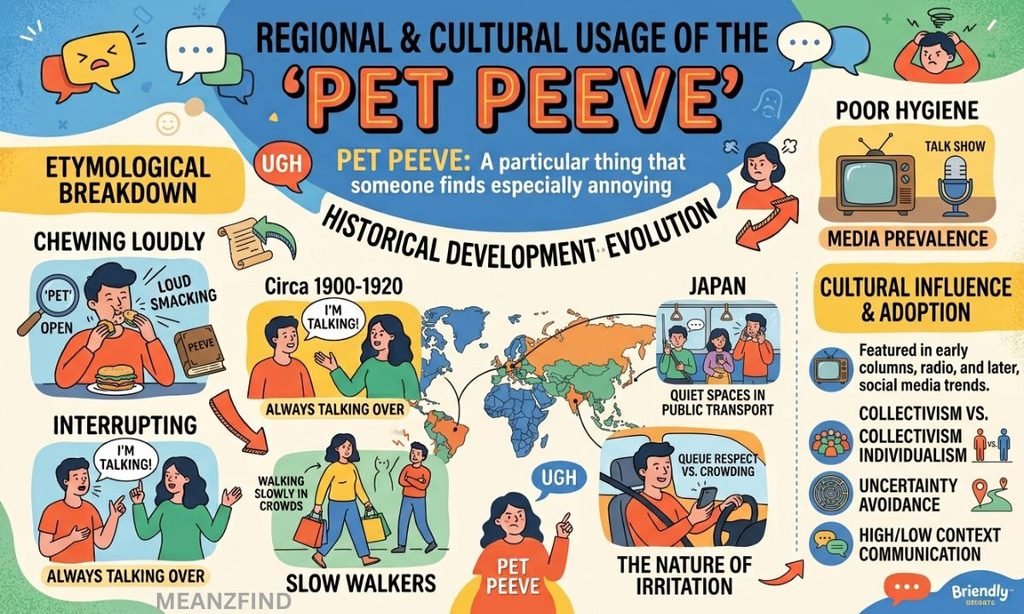
The idea of a “pet peeve” exists everywhere, but the way it’s expressed changes a little across cultures.
Western Culture
In countries like the USA, UK, Canada, and Australia, “pet peeve” is a very common, everyday phrase. It is used casually in conversations, TV shows, and social media without hesitation.
Asian Culture
In many Asian cultures, people may have the same feelings but express them more indirectly. Instead of directly naming a “pet peeve,” people might just avoid the situation politely rather than talk about it openly.
Middle Eastern Culture
In Middle Eastern conversations, small annoyances are often shared within close family or friend circles rather than publicly. The concept exists, but public complaining is less common than private sharing.
Global Internet Usage
Online, especially in English-language spaces, “pet peeve” has become a global internet phrase. Non-native English speakers also use it often because it’s short, easy, and widely understood through social media trends.
Relationship Pet Peeves Meaning
To add more detail beyond the earlier section, relationship pet peeves specifically mean the small daily habits that build up over time between two people who are emotionally close.
These are different from normal pet peeves because:
- They come from someone you care about, so the annoyance mixes with love.
- They often relate to daily routines, like chores or communication habits.
- They usually get resolved through conversation, not distance.
The healthiest relationships are not the ones without pet peeves. They are the ones where partners can laugh about them and talk about them without fighting.
What’s Your Pet Peeves Meaning
By now, the meaning should feel clear and simple. A pet peeve is not a big issue. It’s a small, personal thing that annoys you more than it annoys someone else.
So here’s a fun thought to end on: what’s your pet peeve? Is it loud chewing? Slow walkers? People who don’t reply to texts? Think about it for a second; almost everyone has one ready to share.
Pet peeves are one of the most relatable parts of being human. They are small, personal, and often a little funny once we talk about them out loud. Understanding where the word comes from and how it’s used makes it easier to spot in daily life.
Whether it shows up in a text message, a work meeting, or a relationship, a pet peeve is never meant to be a big deal. It’s just a tiny window into what each person notices and feels strongly about, even in small moments.
So the next time someone shares their pet peeve, take it as a fun little detail about who they are. And maybe, just maybe, share one of your own too.
FINAL THOUGHTS
Pet peeves are a normal part of being human. They remind us that everyone notices the world a little differently. What bothers one person might not bother another at all. That’s what makes them so personal and, sometimes, so funny.
Knowing the meaning and origin of the phrase helps us see it in a new light. It’s not just slang. It has real history behind it, tied to old words like “peevish.” Understanding where it comes from makes the phrase feel less random and more interesting.
Sharing pet peeves can actually bring people closer. It opens up conversations and often leads to laughter. Friends and family love comparing their odd little annoyances. Sometimes you find out you share the exact same one.
In the end, pet peeves are small, harmless quirks. They don’t need to be fixed or explained. They’re just part of what makes each person unique. So the next time something tiny bothers you, remember, it’s just your own personal pet peeve.
FAQs
What does pet peeves mean in simple words?
A pet peeve is a small thing that annoys one person more than others. It’s a personal, everyday annoyance, not a big problem.
Are pet peeves negative?
Pet peeves are mildly negative, but they are normal and harmless. They are more about personal taste than real anger or hate.
Can pet peeves change over time?
Yes, pet peeves can change as people grow, learn, or have new experiences. Something that bothered you years ago might not bother you now.
Is it rude to mention a pet peeve?
No, mentioning a pet peeve politely is not rude at all. It becomes rude only if said in an angry or hurtful way.
Do pet peeves reveal personality?
Yes, pet peeves often show what a person values, like order, honesty, or quiet spaces. They give small clues about someone’s personality.
Can couples have pet peeves about each other?
Yes, couples often notice small habits in each other that become pet peeves. Talking about them calmly usually makes the relationship stronger.