
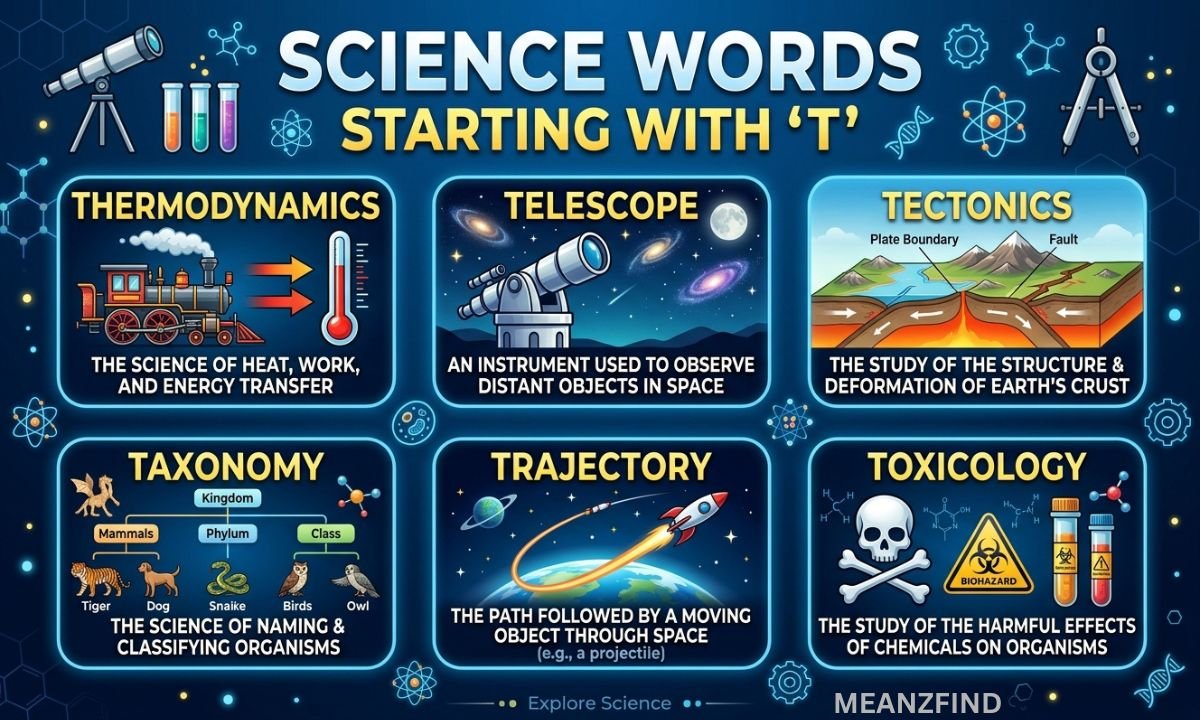
Science is full of interesting words, and many of them start with the letter T. These words help us understand plants, animals, weather, space, and even our own bodies. Learning them can make science class more fun and easy to follow. Kids and adults alike can enjoy exploring these terms.
In this article, we will look at simple science words that begin with T. Each word comes with an easy definition and a clear example. This way, you don’t just memorize a word, you actually understand what it means. It’s a great way to build your science vocabulary step by step.
Whether you are a student, a teacher, or just curious about science, this list is for you. You will find words related to biology, chemistry, physics, and more. By the end, you’ll know several new T words and how to use them. Let’s dive into the world of science, one letter at a time.
Why Learning Science Words That Start With T Matters
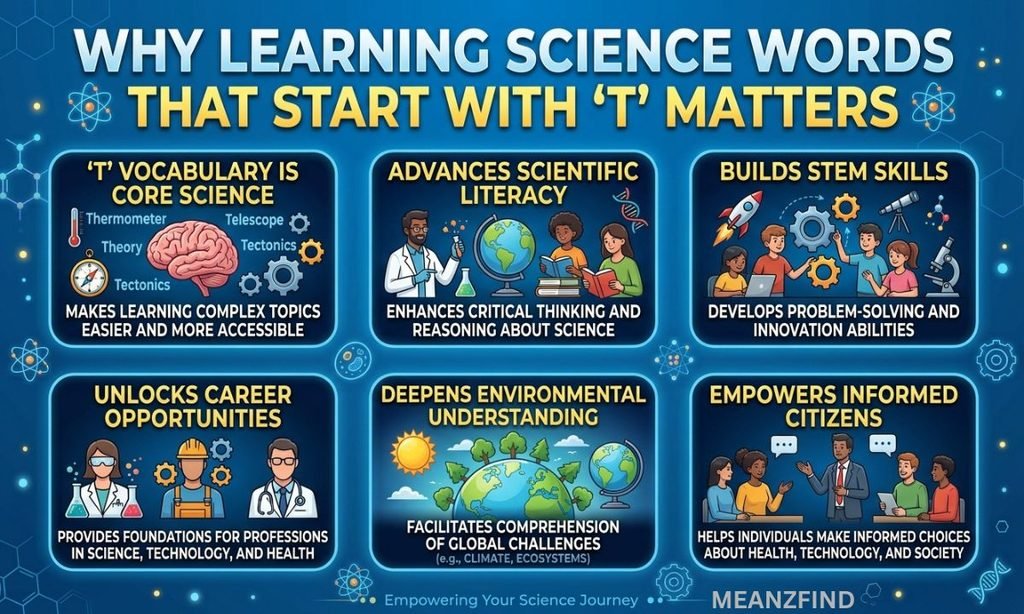
Science vocabulary is like a toolbox. Once you know the right words, you can explain ideas clearly and understand textbooks without confusion.
Many students lose marks not because they don’t understand the concept, but because they don’t understand the word used to describe it. Learning terms like temperature, torque, or transcription with simple meanings removes that problem completely.
These words also connect to real life. You feel temperature every day, you see turbines in windmills, and you use touchscreens on phones. Science is not far away from us — it is all around us.
Physical Science Words That Start With T
Physical science covers physics and chemistry. It explains how matter, energy, and forces work.
Temperature
Temperature tells us how hot or cold something is. It is measured using a thermometer in units like Celsius or Fahrenheit.
Example: The temperature of boiling water is 100 degrees Celsius.
Thermodynamics
Thermodynamics is the study of heat, energy, and how they move from one place to another. It explains why hot food cools down and why engines produce power.
Example: A refrigerator works using the rules of thermodynamics to keep food cold.
Torque
Torque is a force that makes something rotate or turn around a point. The bigger the torque, the easier it is to turn an object.
Example: Using a longer wrench gives you more torque to loosen a tight bolt.
Titration
Titration is a method used in chemistry to find out how much of one substance reacts with another. Scientists slowly add one liquid to another until a reaction is complete.
Example: Titration is often used in labs to check the acidity of a liquid.
Turbulence
Turbulence means a rough, irregular movement of air or liquid instead of a smooth flow. It often happens during storms or fast-moving water.
Example: The airplane shook because of turbulence caused by strong winds.
Turbine
A turbine is a machine with blades that spins when air, water, steam, or gas passes through it. This spinning motion is often used to create electricity.
Example: Wind turbines turn wind energy into electrical power.
Here is a quick table for physical science words:
| Word | Simple Meaning |
| Temperature | How hot or cold something is |
| Thermodynamics | Study of heat and energy movement |
| Torque | Force that causes rotation |
| Titration | Method to measure chemical reactions |
| Turbulence | Rough, uneven flow of air or liquid |
| Turbine | Machine that spins to create energy |
Earth Science Words That Start With T
Earth science studies our planet — its layers, rocks, weather, and natural changes.
Tectonic Plates
Tectonic plates are huge pieces of the Earth’s outer layer that slowly move over time. Their movement causes earthquakes, mountains, and volcanoes.
Example: The collision of tectonic plates formed the Himalayan mountains.
Transpiration
Transpiration is the process where plants release water vapor into the air through tiny openings in their leaves. It is part of the water cycle.
Example: On a hot day, transpiration helps cool down the plant.
Topography
Although not on your original list, topography naturally fits here and adds value. It refers to the shape and features of land, like hills, valleys, and plains.
Example: A topography map shows the height and slope of different areas.
Troposphere
The troposphere is the lowest layer of Earth’s atmosphere, where we live and where weather happens. It contains most of the air we breathe.
Example: Clouds and rain form mainly in the troposphere.
Earth science words are important for understanding weather reports, natural disasters, and how our planet changes.
| Word | Simple Meaning |
| Tectonic Plates | Large moving pieces of Earth’s crust |
| Transpiration | Water release from plant leaves |
| Topography | Shape and features of land |
| Troposphere | Lowest layer of the atmosphere |
Computer Science Words That Start With T
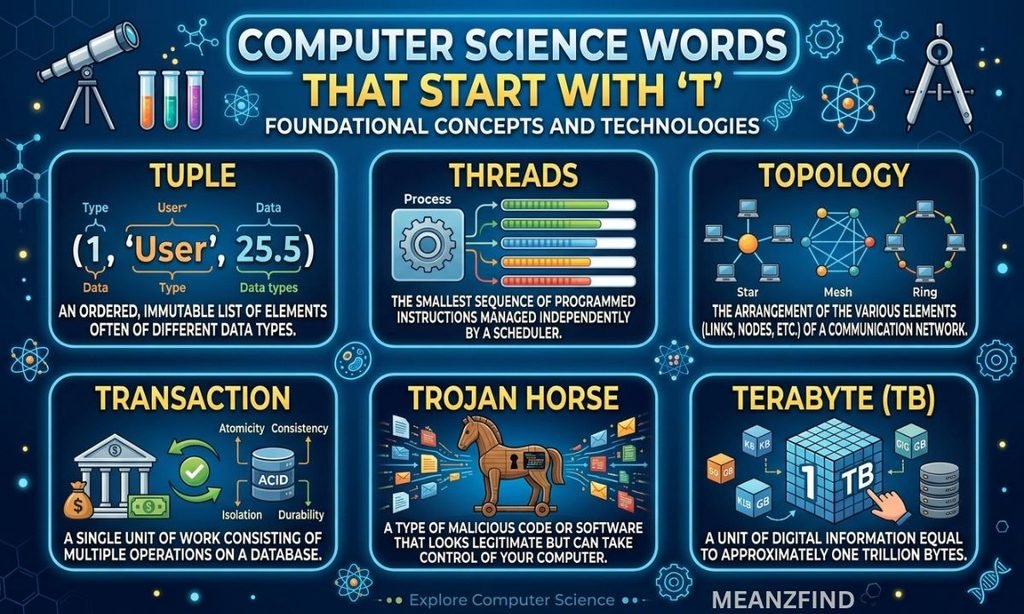
Computer science explains how computers, programs, and data work together.
Terabyte
A terabyte is a unit used to measure digital storage space. It is much bigger than a megabyte or gigabyte.
Example: A modern laptop hard drive can store one terabyte of data.
Touchscreen
A touchscreen is a display that a person can control by tapping or swiping with their fingers. It removes the need for a separate mouse or keyboard.
Example: Smartphones use touchscreens to open apps and type messages.
Token
In computer science, a token is a small piece of data or a single unit of meaning that a program reads, such as a word or symbol in code.
Example: When code is checked, it is broken into tokens for the computer to understand.
Type (Data Type)
A data type tells the computer what kind of information is being stored, such as numbers, text, or true/false values.
Example: A “string” data type is used to store text like names.
| Word | Simple Meaning |
| Terabyte | Large unit of digital storage |
| Touchscreen | Screen you control by touching |
| Token | Small unit of data in programming |
| Type (Data Type) | Category of information a computer stores |
Environmental Science Words That Start With T
Environmental science studies how living things interact with their surroundings and how to protect nature.
Toxicology
Toxicology is the study of harmful substances and how they affect living things. It helps scientists understand pollution and chemical safety.
Example: Toxicology reports show how dangerous a chemical spill can be for fish.
Trophic Level
A trophic level shows the position of an organism in a food chain, such as producer, consumer, or decomposer.
Example: Plants are at the first trophic level because they make their own food.
Tundra
Tundra is a cold environment with very few trees, found near the North and South Poles. It has frozen soil called permafrost.
Example: Polar bears live in the tundra region.
| Word | Simple Meaning |
| Toxicology | Study of harmful substances |
| Trophic Level | Position in a food chain |
| Tundra | Cold, treeless environment |
Biology Words That Start With T
Biology explains living things — plants, animals, and the human body.
Taxonomy
Taxonomy is the science of naming, describing, and classifying living things into groups based on their features.
Example: Taxonomy helps scientists group animals like lions and tigers under the cat family.
Tissue
Tissue is a group of similar cells that work together to do a specific job in the body.
Example: Muscle tissue helps the body move.
Trait
A trait is a feature or characteristic passed from parents to their children, such as eye color or height.
Example: Curly hair can be a trait inherited from a parent.
Transcription
Transcription is the process where genetic information in DNA is copied into RNA. This is an important step in making proteins in the body.
Example: Transcription happens inside the nucleus of a cell.
Tropism
Tropism is the way a plant grows or moves in response to something in its environment, like light or gravity.
Example: A plant bending toward sunlight shows positive tropism.
| Word | Simple Meaning |
| Taxonomy | Classifying living things into groups |
| Tissue | Group of similar cells with a job |
| Trait | Inherited feature or characteristic |
| Transcription | Copying DNA information into RNA |
| Tropism | Plant growth response to environment |
More Useful Science Words Starting With T
Here are extra T words that are commonly asked about in science classes and add more value to this list.
- Telescope: A tool used to see faraway objects clearly, especially stars and planets.
- Thermometer: A device used to measure temperature.
- Tide: The rise and fall of ocean water caused mainly by the moon’s gravity.
- Thrust: A pushing force, often used to describe how rockets or airplanes move forward.
- Tension: A pulling force created in a rope, string, or cable when it is stretched.
- Topsoil: The upper layer of soil that contains nutrients needed for plant growth.
- Toxin: A poisonous substance made by living things, such as bacteria or plants.
These words often appear together with the main list, so knowing them gives students a complete picture.
Science Words That Start With T for 7th Grade
Seventh-grade science usually focuses on basic physics, biology, and earth science concepts. These T words are perfect for that level:
- Temperature
- Tissue
- Trait
- Tundra
- Turbine
- Telescope
- Thermometer
- Tide
These words are simple to understand and are commonly used in 7th-grade textbooks and exams. Practicing them helps build a strong base for higher classes.
Science Words That Start With T for 8th Grade
Eighth-grade science becomes slightly more advanced, introducing chemistry reactions, human body systems, and earth movements. These T words fit well for that level:
- Thermodynamics
- Tectonic Plates
- Titration
- Torque
- Transcription
- Tropism
- Toxicology
- Troposphere
Students in 8th grade often see these words in chapters about chemical reactions, genetics, and the structure of the Earth.
Complete List of Science Words That Start With T
Below is the full list of important science words that start with T, combined from every subject area for quick revision.
| Word | Subject Area | Simple Meaning |
| Temperature | Physical Science | How hot or cold something is |
| Thermodynamics | Physical Science | Study of heat and energy |
| Torque | Physical Science | Force causing rotation |
| Titration | Physical Science | Measuring chemical reactions |
| Turbulence | Physical Science | Rough flow of air or liquid |
| Turbine | Physical Science | Machine that spins to make energy |
| Tectonic Plates | Earth Science | Moving pieces of Earth’s crust |
| Transpiration | Earth Science | Water release from plants |
| Troposphere | Earth Science | Lowest layer of atmosphere |
| Terabyte | Computer Science | Large storage unit |
| Touchscreen | Computer Science | Screen controlled by touch |
| Token | Computer Science | Small unit of code data |
| Toxicology | Environmental Science | Study of harmful substances |
| Tundra | Environmental Science | Cold, treeless land |
| Taxonomy | Biology | Classifying living things |
| Tissue | Biology | Group of cells with a job |
| Trait | Biology | Inherited characteristic |
| Transcription | Biology | Copying DNA to RNA |
| Tropism | Biology | Plant response to environment |
| Telescope | General Science | Tool to see distant objects |
This table works well as a quick revision sheet before exams or quizzes.
Tips to Remember Science Words Starting With T
Memorizing science words becomes much easier with a few simple tricks.
- Connect words to pictures. Imagine a spinning turbine or a plant bending toward light for tropism.
- Use the word in a sentence. Writing your own example helps the meaning stick in your memory.
- Group similar words together. Keep biology words separate from physics words to avoid confusion.
- Practice with flashcards. Write the word on one side and the meaning on the other.
- Teach someone else. Explaining a word to a friend or family member helps you understand it better yourself.
Repeating these steps a few times a week will help you remember these words for a long time, not just for one test.
FINAL WORDS
Learning science words that start with T can be a fun and rewarding journey. Each word opens a door to a new idea in biology, chemistry, physics, or space. The more words you know, the easier it becomes to understand science topics. Small steps like this build strong knowledge over time.
These T words are useful for students preparing for exams or classroom quizzes. They are also great for teachers looking for simple ways to explain tricky topics. Even parents can use this list to help their kids with homework. Everyone can benefit from a clear and easy vocabulary list.
Science is not just about hard facts, it is also about curiosity. Words like temperature, tissue, and telescope connect to things we see every day. Once you understand these words, science feels less scary and more exciting. It becomes a subject you enjoy instead of one you fear.
We tried to keep each definition short and simple to understand. Real examples were added so the words make more sense in daily life. This makes learning faster and more practical for readers of all ages. You don’t need to be an expert to understand basic science terms.
Keep this list handy whenever you study science or help someone else learn it. Revisiting these words from time to time will help you remember them longer. Science vocabulary grows the more you read, write, and practice it. With a little effort, these T words will soon become part of your everyday language.
FAQs
What are 50 science words?
Fifty science words include terms like atom, cell, energy, gravity, temperature, tissue, torque, tectonic, thermodynamics, and taxonomy. These words cover physics, biology, chemistry, and earth science topics used in everyday learning.
Can you give me 20 scientific words?
Twenty scientific words include energy, matter, force, cell, atom, gene, temperature, torque, tissue, and taxonomy. Others include ecosystem, molecule, gravity, velocity, tundra, transpiration, turbine, thermodynamics, toxin, and titration.
What are the T words?
T words in science include temperature, thermodynamics, tectonic plates, taxonomy, transpiration, titration, and torque. Other useful ones are tissue, turbine, tropism, toxicology, and telescope.
What is science in 20 words?
Science is the careful study of nature and the world through observation, testing, and evidence-based reasoning. It explains how things work using facts, experiments, and logical proof.
What are 15 fields of science?
Fifteen fields include physics, chemistry, biology, earth science, environmental science, computer science, astronomy, and genetics. Others include ecology, geology, meteorology, botany, zoology, microbiology, and toxicology.
What are 10 unique words?
Unique science words include torque, tropism, transpiration, tectonic, titration, thermodynamics, taxonomy, turbulence, toxicology, and troposphere. These terms are specific to science and rarely used in everyday conversation.
Why Are Science Words That Start With T Important?
Science words starting with T help explain major ideas in physics, biology, and earth science clearly and accurately. Knowing them improves understanding of textbooks, exams, and real-world scientific concepts.
Which T-word is Most Commonly Used in Science?
Temperature is the most commonly used T-word in science because it appears in physics, chemistry, biology, and daily life. It is a basic concept taught from early school grades onward.
Outstanding Science Words That Start With O: A Complete Exploration of Key Terms and Concepts
Outstanding O words in science include oxygen, organism, osmosis, orbit, and ozone. These terms are essential in biology, chemistry, and space science.
Top Science Words That Start With S: Definitions, Examples, and Their Importance in Modern Science
Top S words include species, solution, star, sound, and system. These words are widely used across biology, chemistry, physics, and astronomy.
Opposite of Benefit: Meaning, Examples, Synonyms, and Usage Guide
The opposite of benefit is harm, disadvantage, or drawback. These words describe negative effects instead of positive outcomes.
Science Words That Start With B: Important Terms Used in Science
Science words starting with B include biology, bacteria, biome, buoyancy, and bond. These terms are common in life sciences and chemistry.
Science Words That Start With J: Key Terms and Their Importance in Modern Science
Science words starting with J include joule, juvenile, and jet stream. These terms appear mainly in physics, biology, and meteorology.
X-Factor Science: Powerful Science Words That Start With X
Powerful X words in science include xylem, X-ray, and xenon. These terms are important in botany, medical science, and chemistry.
Let me know if you’d like these expanded further, reformatted, or if you need similar content for a different letter or topic.