
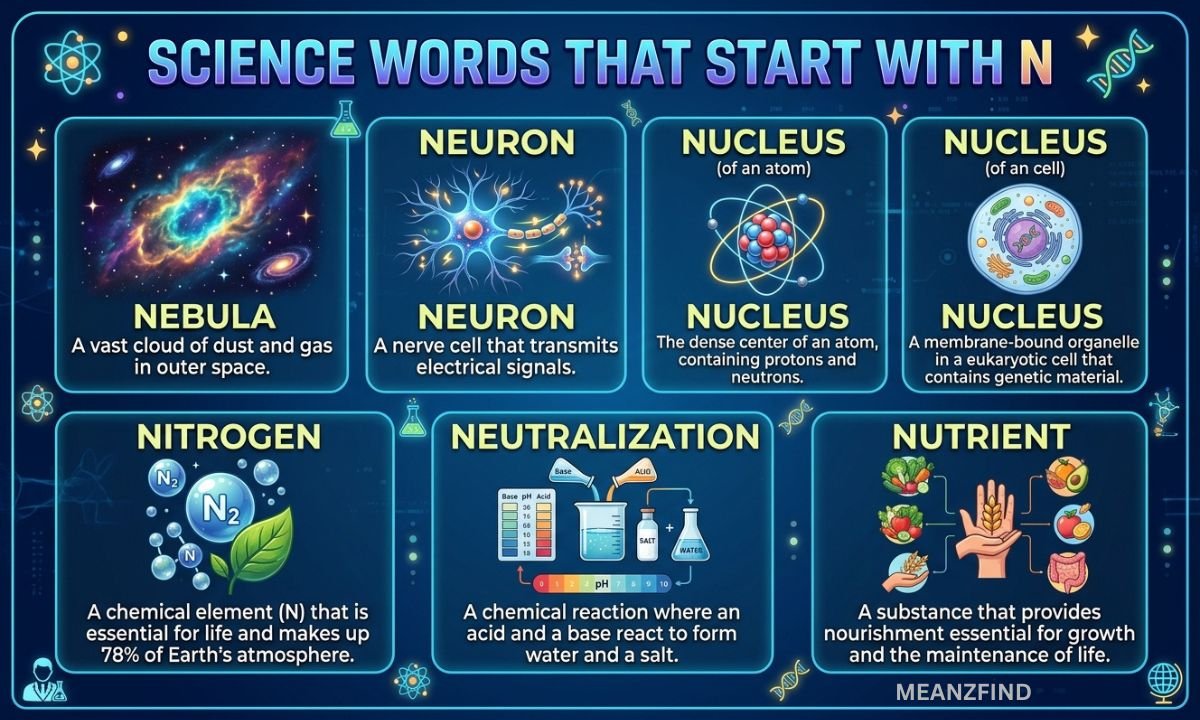
Science is full of interesting words. Many of these words help us understand the world around us. Some science words start with the letter N. These words are used in biology, chemistry, physics, and other subjects.
Learning new science words can be fun and easy. Students often see these words in textbooks and class lessons. Knowing what they mean helps students understand lessons better. It also makes reading science topics less confusing.
This list will show you science words that start with N. Each word comes with a simple meaning. You can use this list for homework, tests, or just to learn something new. It is a great way to build your science vocabulary step by step.
Earth Science Words That Start With N
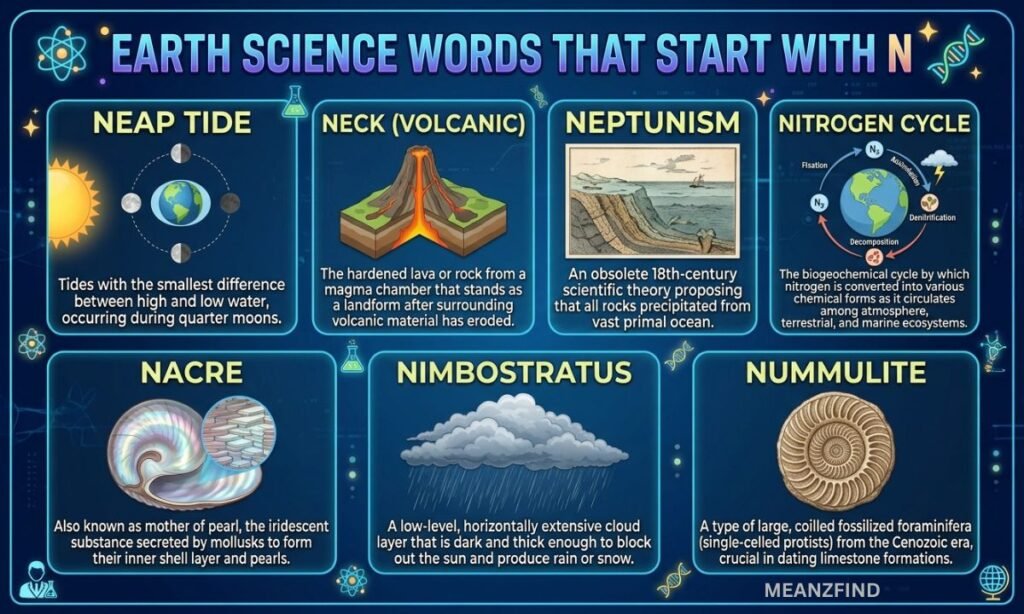
Earth science looks at our planet, its rocks, weather, and natural features. Here are some important N words used in this field.
Nature: The Foundation of Scientific Study
Nature means everything that exists in the physical world without human help. This includes plants, animals, mountains, rivers, and weather. Scientists study nature to learn how the world works. Nature is the starting point for almost every branch of science.
Kids often connect with nature by watching birds, plants, or the weather outside. This simple curiosity is actually the first step in scientific thinking. Every scientist begins by observing the natural world around them.
Niche: An Organism’s Role in an Ecosystem
A niche is the specific role or job that a living thing has in its environment. It includes what an animal eats, where it lives, and how it survives. Every species has its own niche in an ecosystem.
For example, a bee’s niche includes pollinating flowers and making honey. No two species can share the exact same niche in the same place for long. This idea helps scientists understand how ecosystems stay balanced.
Nitrogen: An Essential Element for Life
Nitrogen is a gas that makes up most of the air we breathe. In fact, nearly 78 percent of Earth’s atmosphere is nitrogen. Plants need nitrogen to grow, and animals need it to build proteins in their bodies.
Farmers often add nitrogen to soil to help crops grow better. Without nitrogen, living things could not build the proteins needed for life. This makes nitrogen one of the most important elements on our planet.
Physical Science Words That Start With N
Physical science covers physics, chemistry, and the study of matter and energy. These N words appear often in physical science lessons.
Neutron: A Key Subatomic Particle
A neutron is a tiny particle found inside the nucleus of an atom. It has no electric charge, which means it is neutral. Neutrons work together with protons to hold the atom’s center together.
Every atom (except regular hydrogen) has at least one neutron. Neutrons also help scientists figure out different versions of an element, called isotopes. Understanding neutrons helps students learn how atoms are built.
Newton: A Unit of Force
A newton is a unit used to measure force. It is named after the scientist Isaac Newton, who studied gravity and motion. One newton is the force needed to move a one-kilogram object at a certain speed.
Scientists use newtons to measure things like the pull of gravity or the push needed to move an object. This unit is common in physics class. It helps students calculate how strong a force really is.
Nuclear Energy: Power from the Atom
Nuclear energy is power that comes from splitting or joining atoms. This process releases a huge amount of energy. Power plants use nuclear energy to create electricity for homes and cities.
Nuclear energy is very strong compared to other energy sources. It does not release smoke like burning coal or gas. However, it must be handled carefully because it can be dangerous if not managed well.
Nebula: The Birthplace of Stars
A nebula is a giant cloud of gas and dust found in space. Nebulae are often called “star nurseries” because new stars are born inside them. Gravity pulls the gas and dust together until a new star forms.
Nebulae can be huge, stretching across many light-years of space. They come in different shapes and colors, which makes them a popular topic in astronomy. Studying nebulae helps scientists understand how stars and solar systems begin.
Neutrino: The Elusive Particle
A neutrino is an extremely tiny particle with almost no mass. It has no electric charge and barely interacts with matter at all. Trillions of neutrinos pass through your body every second, and you never feel a thing.
Neutrinos are created by the sun, nuclear reactions, and exploding stars. Because they are so hard to detect, scientists build special underground labs to study them. Neutrinos help researchers learn more about the universe and how it works.
Biology Words That Start With N
Biology is the study of living things. These words are especially useful for students learning about the human body and cells.
Neuron: The Building Block of the Nervous System
A neuron is a special cell that sends messages through your body. Neurons make up your brain, spinal cord, and nerves. They carry signals that let you move, think, and feel.
Your brain has billions of neurons working together every second. Neurons connect with each other to form pathways for information. Without neurons, your body could not send or receive any signals at all.
Nucleus: The Control Center of the Cell
The nucleus is a part found inside most cells. It acts like the control center, holding the cell’s DNA and instructions. The nucleus tells the rest of the cell what to do and when to do it.
Think of the nucleus like the brain of a tiny cell. It is usually round and sits near the center of the cell. Almost every plant and animal cell has a nucleus, except for a few special ones like red blood cells.
Neurotransmitter: Chemical Messengers of the Brain
A neurotransmitter is a chemical that carries messages between neurons. These chemicals cross tiny gaps called synapses to pass along signals. Neurotransmitters control things like mood, sleep, hunger, and muscle movement.
Common neurotransmitters include dopamine and serotonin. Dopamine helps you feel happy and motivated. Serotonin helps control your mood and sleep patterns.
Nucleotide: The Building Block of DNA
A nucleotide is a small unit that makes up DNA and RNA. Think of nucleotides like letters that spell out the instructions for life. Millions of nucleotides connect together to form your genetic code.
Each nucleotide has three parts: a sugar, a phosphate, and a base. These parts link together in long chains inside your cells. Nucleotides carry the information that makes every living thing unique.
Nanotechnology: Science at the Smallest Scale
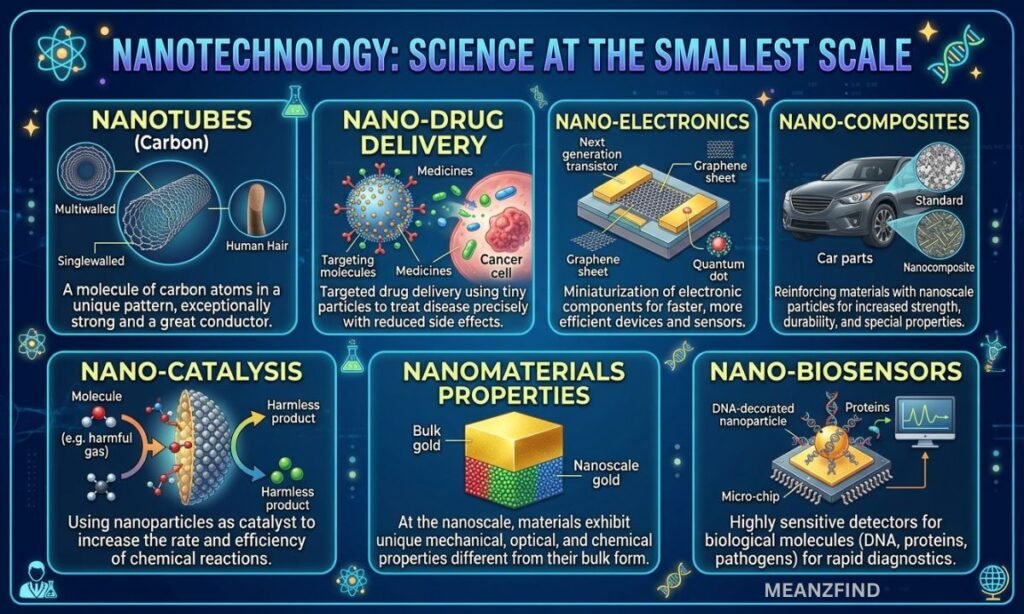
Nanotechnology is the science of building and using extremely tiny materials. These materials are measured in nanometers, which are far smaller than anything you can see with your eyes. A single nanometer is about one-billionth of a meter.
Scientists use nanotechnology to create stronger materials, better medicine, and faster computer chips. Doctors are even studying nanotechnology to help treat diseases at the cell level. This field is growing fast and shaping the future of science and technology.
Below is a simple comparison to help you understand how small nanotechnology really is.
| Object | Approximate Size |
| A human hair | 80,000–100,000 nanometers wide |
| A red blood cell | About 7,000 nanometers wide |
| A DNA strand | About 2.5 nanometers wide |
| A nanoparticle | 1–100 nanometers |
Environmental Science Words That Start With N
Environmental science studies how living things interact with their surroundings. These N words are common in this subject.
- Natural Resource – Something from nature that people use, like water, trees, or minerals.
- Nitrogen Cycle – The process where nitrogen moves between the air, soil, and living things.
- Non-renewable Resource – A resource that cannot be replaced quickly, like oil or coal.
- Nutrient – A substance that living things need to grow and stay healthy.
- Native Species – A plant or animal that naturally lives in a certain area.
These words help students understand how nature stays balanced and how humans affect the environment.
Computer Science Words That Start With N
Computer science also has its own set of N words. Students learning about technology will see these terms often.
- Network – A group of connected computers that share information.
- Node – A single point or device connected within a network.
- Numeric Data – Data made up of numbers instead of letters or symbols.
- Notation – A system of symbols used to represent information, like binary notation.
- NoSQL – A type of database that stores data differently from traditional databases.
Learning these words helps students understand how computers talk to each other and store information.
Science Words That Start With N for Kids
Younger students need simple explanations to build a strong foundation. Here is an easy-to-read table with kid-friendly definitions.
| Word | Simple Meaning |
| Nature | Everything in the world that is not made by people |
| Neuron | A cell that sends messages in your brain |
| Nucleus | The control center inside a cell |
| Nutrient | Something in food that helps your body grow |
| Nest | A home built by birds or small animals |
| Nocturnal | An animal that is active at night |
These simple words are a great starting point for kids who are just beginning to explore science.
Why Learning Science Words That Start With N Matters
Building a strong science vocabulary helps students in many ways. It is not just about memorizing words for a test. These words connect to real ideas that explain how the world works.
Here are some reasons this vocabulary list is helpful:
- It improves reading comprehension in science textbooks.
- It helps students do better on science tests and quizzes.
- It builds confidence when discussing science topics in class.
- It connects different subjects like biology, physics, and technology.
- It sparks curiosity about how nature and science work together.
Quick Reference Table: Science Words That Start With N
Here is a full summary table combining many of the words covered in this article.
| Word | Science Field | Simple Definition |
| Nature | Earth Science | The physical world without human influence |
| Niche | Biology | An organism’s role in its ecosystem |
| Nitrogen | Chemistry | A gas element important for life |
| Neutron | Physics | A neutral particle inside an atom |
| Newton | Physics | A unit used to measure force |
| Nuclear Energy | Physics | Power made from splitting or joining atoms |
| Nebula | Astronomy | A cloud of gas and dust in space |
| Neutrino | Physics | A tiny, hard-to-detect particle |
| Neuron | Biology | A cell that sends messages in the nervous system |
| Nucleus | Biology | The control center of a cell |
| Neurotransmitter | Biology | A chemical that sends messages between neurons |
| Nucleotide | Biology | A building block of DNA |
| Nanotechnology | Technology | Science that works at a very tiny scale |
| Network | Computer Science | A group of connected computers |
| Node | Computer Science | A single point in a network |
FINAL WORDS
Learning science words that start with N is a great way to grow your vocabulary. These words appear often in school lessons and textbooks. Knowing their meanings makes science easier to understand. It also helps you feel more confident in class.
This list covered many useful terms from different science topics. You saw words from biology, chemistry, and physics. Each word was explained in simple language. This makes it easy for students of all ages to follow along.
Practice is important when learning new words. Try using these N words in your own sentences. You can also quiz yourself or a friend. This will help the words stick in your memory.
We hope this list made learning fun and simple. Science vocabulary does not have to feel hard or boring. With a little practice, these words will become easy to remember. Keep exploring new words to keep growing your science knowledge.
FAQs
What are 10 science words?
Ten common science words are atom, cell, energy, force, gravity, matter, molecule, nucleus, organism, and photosynthesis. These words appear across biology, chemistry, and physics lessons.
What are 50 science words?
Fifty science words would include terms like atom, cell, DNA, ecosystem, energy, force, gravity, habitat, molecule, nucleus, and many more from biology, chemistry, physics, and Earth science. A full list is best organized by subject to make learning easier.
What are scientific words a to z?
Scientific words from A to Z cover one important term for each letter, such as Atom, Bacteria, Cell, DNA, Energy, and so on through Zygote. This kind of list helps students build vocabulary across every science subject.
What are some words for science?
Some general words linked to science include research, experiment, hypothesis, observation, and discovery. These words describe how scientists study and learn about the world.
What are 15 fields of science?
Fifteen fields of science include biology, chemistry, physics, astronomy, geology, ecology, botany, zoology, genetics, meteorology, oceanography, microbiology, physiology, neuroscience, and environmental science. Each field studies a different part of nature or life.
What is science in 20 words?
Science is the study of the natural world through observation, testing, and evidence to understand how things work and why. It helps explain nature using facts.
What are some scientific terms that start with the letter N?
Scientific terms starting with N include neuron, nucleus, neutron, nitrogen, nebula, nanotechnology, and neurotransmitter. These words appear in biology, chemistry, physics, and astronomy.
What are 20 science facts?
Science facts are true statements proven through research, such as “water boils at 100°C” or “the human body has 206 bones.” These facts come from careful testing and observation.
What are the ABCs of science?
The ABCs of science means learning one science word for each letter of the alphabet, like Atom, Biology, Cell, and Density. This method makes vocabulary building simple and fun for young learners.
What are 20 branches of science?
Twenty branches of science include biology, chemistry, physics, astronomy, geology, botany, zoology, ecology, genetics, meteorology, oceanography, microbiology, anatomy, physiology, neuroscience, immunology, biochemistry, geophysics, paleontology, and environmental science. Each branch focuses on a specific area of study.
What are the 50 types of scientists?
Types of scientists include biologists, chemists, physicists, astronomers, geologists, botanists, zoologists, ecologists, and many specialized experts like marine biologists or volcanologists. Each type studies a specific field within science.
What is natural science?
Natural science is the branch of science that studies the physical world, including plants, animals, rocks, weather, and space. It relies on observation and experiments to explain how nature works.