
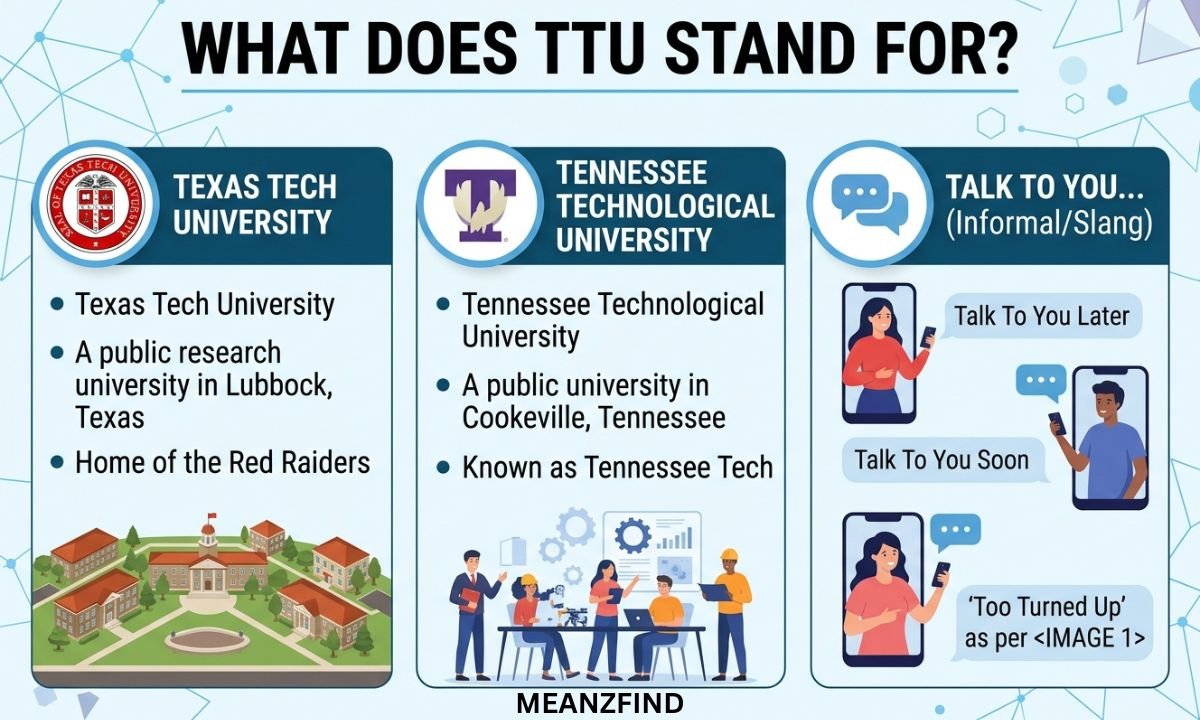
You may have seen “TTU” in a text or a social media comment and wondered what it means. It looks short and simple, but the meaning can change with the context. Many people get confused when they see it for the first time. This guide will clear that up fast.
In most chats, TTU stands for “talk to you.” People use it to end a chat or say they will speak again soon. For example, someone may write “TTU later” before they log off. It saves time and keeps the message short and casual.
TTU can also mean other things, like Texas Tech University. The right meaning depends on who sends it and where. In this article, you will learn what TTU means in text, chat, and social media. You will also see simple examples and easy replies you can use.
What Does TTU Mean In Text
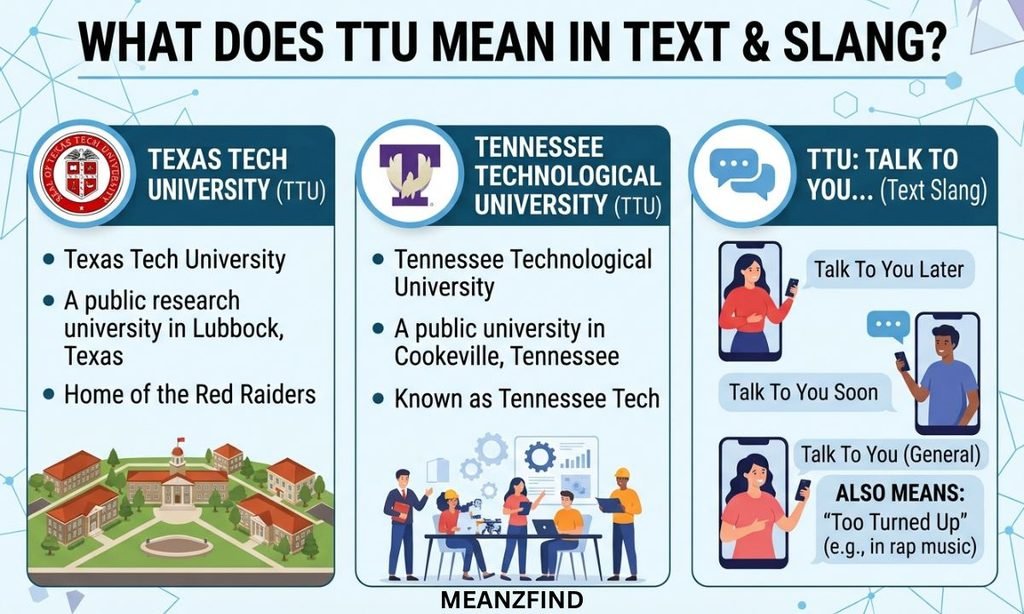
TTU means “talk to you.” It is a short way to say you will speak with someone soon. People use it at the end of a chat, in a quick goodbye, or when they plan to reply later.
You will see it in text messages, WhatsApp chats, Instagram DMs, and comment sections. It is a casual term. It fits best between friends, family, and people you chat with often.
Here are a few quick facts:
- Full form: Talk to you
- Type: Texting slang and chat abbreviation
- Tone: Casual and friendly
- Best for: Close friends, family, and online chats
- Not for: Formal emails or work letters
TTU Mean In Text
When someone writes “TTU” in a message, they are almost always saying goodbye for now. They are not upset. They are not hiding a secret meaning. They simply want to keep the message short.
Think about how fast we type on phones. Long words take time. So people cut them down. “Talk to you” becomes “TTU,” just like “be right back” becomes “BRB.”
Sometimes TTU also works as a promise. It tells the other person, “I will message you again.” That small promise helps keep a friendship warm.
TTU Meaning in Text – Quick Definition
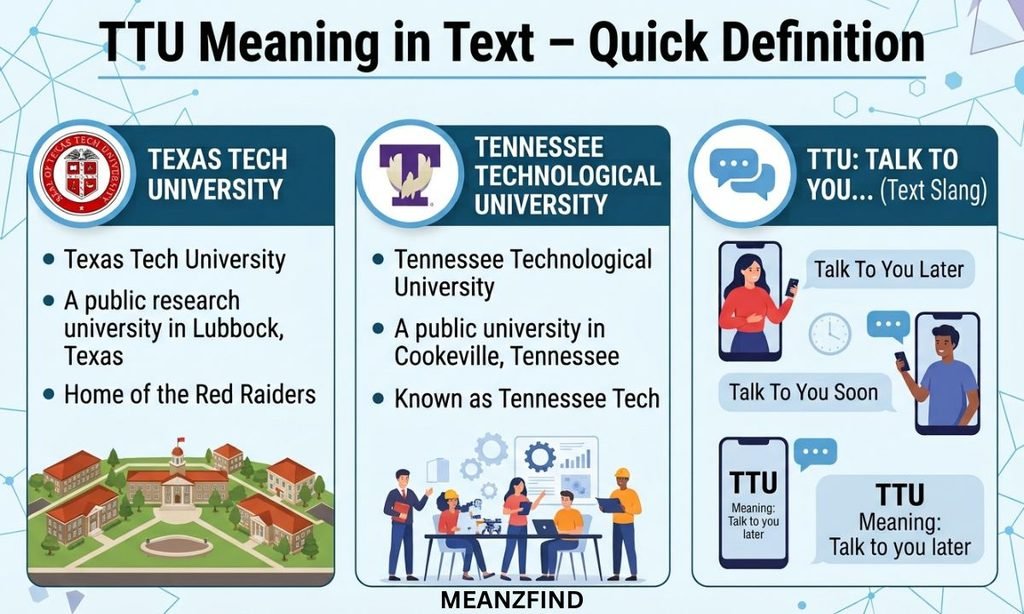
Simple Meaning:
TTU = Talk to you.
It is a short sign-off. It tells the reader that the chat is ending, but the connection is not.
Quick Examples:
- “I have to go to class now. TTU later!”
- “Dinner is ready. TTU tomorrow.”
- “Okay, TTU soon. Have a good night.”
- “Battery is low. TTU in the morning.”
- “Meeting starts now. TTU after work.”
Each example shows the same idea. The sender is leaving the chat but plans to return.
Origin & Background
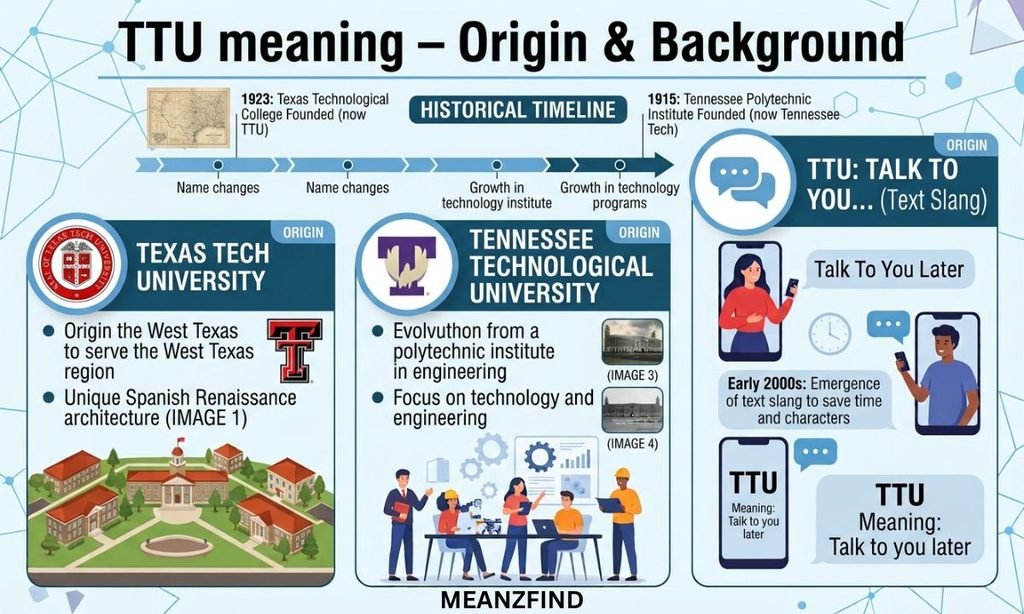
Texting slang is older than most people think. In the early days of mobile phones, a single text message could only hold 160 characters. Each letter counted. People had to find ways to say more with less.
That is why short forms like LOL, BRB, and TTYL became popular. They saved space and time. TTU came from the same habit. People shortened “talk to you” into three simple letters.
TTYL means “talk to you later.” TTU is the shorter cousin. It drops the “later” part. Today, people use TTU on apps like WhatsApp, Snapchat, Instagram, and Telegram.
Even though phones now allow long messages, the habit stayed. Short words feel quick, relaxed, and modern. That is why TTU is still alive today.
Real-Life Conversations (How People Actually Use TTU)
Seeing real chats is the best way to understand a slang term. Below are three common places where people use TTU.
1. WhatsApp Chat
Ali: Are you free tonight?
Sara: I am at my cousin’s house. I will be busy.
Ali: No problem. TTU tomorrow.
Sara: Sure. Good night!
Here, Ali uses TTU to say he will message her the next day. It sounds warm and easy.
2. Instagram DMs
Mia: Loved your latest post!
Jake: Thank you so much! I have to run to practice now. TTU later.
Mia: Go for it. Good luck!
Instagram chats are fast and playful. TTU fits well because it is short and friendly.
3. Text Message
Mom: Did you reach home?
Zain: Yes, just got in. Going to shower. TTU after.
Mom: Okay, beta. Eat something.
This shows how a young person may use TTU with a parent. It still sounds polite and kind.
Emotional & Psychological Meaning
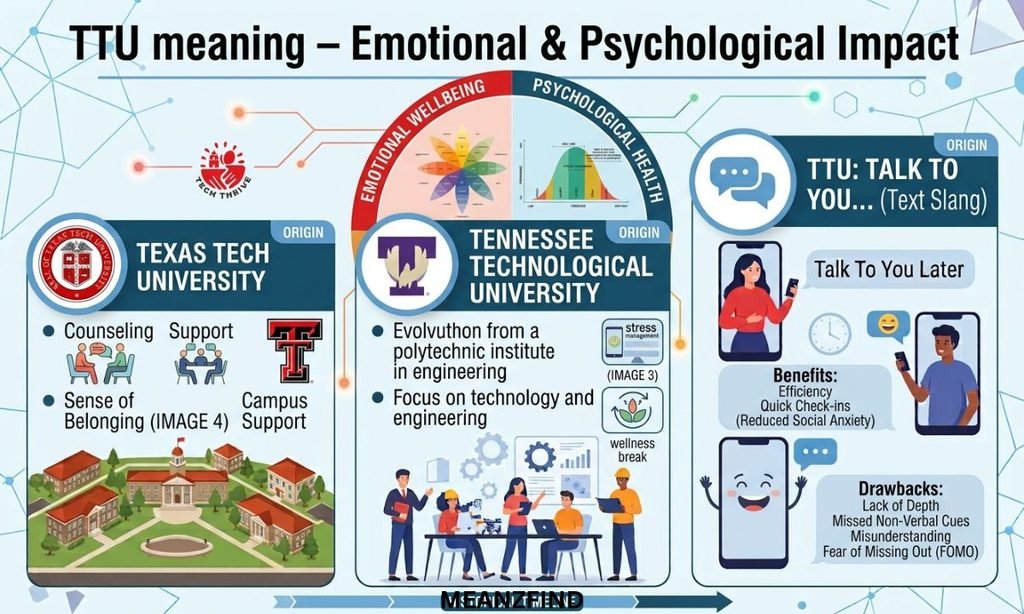
TTU may look like just three letters. But small words can carry feelings. Let us look at what TTU says without saying it out loud.
1. It Maintains Connection
When you end a chat with TTU, you leave the door open. The other person knows you are not ignoring them. You are only stepping away for a bit.
This helps friendships feel steady. Nobody feels dropped or forgotten.
2. It Reduces Social Pressure
Ending a conversation can feel awkward. You may not know how to say goodbye. TTU solves that problem.
It is light and easy. You do not need to give a long reason. You just say TTU and move on.
3. It Signals Politeness
Leaving a chat without a word can feel rude. A quick TTU shows respect. It tells the other person that their time matters to you.
Even a small sign-off can make someone feel valued.
4. It Reflects Modern Communication Style
Today, people live fast. We chat while walking, eating, and studying. We do not always have time for long messages.
TTU fits this style. It is quick, clear, and friendly. It shows how language changes to match our daily lives.
Usage in Different Contexts
TTU does not mean different things in different places. But the way people use it can change. Here is how it works in four common settings.
1. Social Media
On social media, people use TTU in DMs, story replies, and comments. It is often paired with emojis, like a smile or a wave.
Example: “Great video! TTU soon 😊”
It keeps replies short and friendly. It is common among teens and young adults.
2. Friends & Relationships
Between friends, TTU feels natural. It shows ease and comfort. You do not need to explain yourself.
In dating or close relationships, TTU can also show care. It tells your partner that you will be back soon. Just remember that long gaps after TTU can make people feel ignored. If you say it, try to follow through.
3. Work or Professional Settings
At work, it is better to be careful. TTU is slang. It may look too casual in formal emails, client messages, or reports.
If your team uses a quick chat app and the mood is relaxed, TTU may be fine. But when in doubt, write “Talk to you soon” in full. It looks neat and professional.
4. Casual vs Serious Tone
TTU is a casual term. It does not fit serious or sad moments. If someone shares bad news, a quick TTU may feel cold.
In those cases, use a kinder and longer message. For example: “I am here for you. I will call you tonight.”
| Setting | Is TTU Okay? | Better Choice if Not |
| Friends chat | Yes | – |
| Family chat | Yes | – |
| Social media DMs | Yes | – |
| Work chat (relaxed team) | Maybe | “Talk to you soon” |
| Formal email | No | “Looking forward to speaking soon” |
| Serious or sad talk | No | A warm, full sentence |
Common Misunderstandings
Many people mix up short slang words. Let us clear up the most common mistakes about TTU.
1. Thinking It Means Something Deep or Hidden
Some people think TTU has a secret meaning. It does not. In most chats, it simply means “talk to you.”
If you feel unsure, look at the rest of the message. The meaning is usually easy to see.
2. Confusing It with TTYL
TTU and TTYL are close, but not the same. TTYL means “talk to you later.” It points to a time in the future. TTU is more open. It can mean now, soon, or later.
3. Assuming It’s Rude
Some people feel a short message is cold. But TTU is not rude. It is a normal way to end a chat.
If the sender seems friendly in the rest of the message, there is nothing to worry about.
4. Using It in Formal Situations
TTU can look unprofessional in an official message. A teacher, boss, or client may not know the term. Always use full words in such cases.
Comparison Table
Here is a simple table to compare TTU with other popular chat sign-offs.
| Slang | Full Form | Meaning | Tone |
| TTU | Talk to you | Short goodbye, plan to chat again | Casual |
| TTYL | Talk to you later | Goodbye with a “later” plan | Casual |
| TTYS | Talk to you soon | Goodbye with a “soon” plan | Casual |
| TTFN | Ta-ta for now | Playful goodbye | Fun |
| BRB | Be right back | Leaving for a short time | Casual |
| GTG | Got to go | Leaving right now | Casual |
| BBL | Be back later | Leaving, returning later | Casual |
Key Insight:
TTU is the shortest and simplest of the “talk to you” family. It is flexible. It works for now, soon, or later. That is why many people like it.
Variations / Types of TTU
TTU has a few forms. Each one adds a small change in meaning or feeling.
- TTU: The basic form. Means “talk to you.”
- TTU soon: A friendly promise to chat again very soon.
- TTU later: The same as TTYL. It says the chat will continue later.
- TTU tomorrow: You plan to reply the next day.
- TTU tonight: You will message again in the evening.
- Ttu: Written in lowercase. It feels relaxed and casual.
- TTU 😊 / TTU ❤️: Emojis add warmth and emotion.
- TTU!!: Extra marks show excitement.
Pick the version that matches your mood. A smile emoji can make a short message feel much kinder.
How to Respond When Someone Uses TTU
Replying to TTU is easy. You do not need a long answer. Match the tone of the person who wrote it.
1. Casual Replies
- “Okay, bye!”
- “Sure, see you.”
- “Alright, talk soon.”
- “Cool, catch you later.”
2. Friendly Replies
- “Sounds good! Take care 😊”
- “Okay, have a great day!”
- “Sure thing. Talk to you soon!”
- “No worries. Message me when you are free.”
3. Funny Replies
- “Okay, but do not ghost me!”
- “TTU too. Do not forget me, okay?”
- “Fine, go. I will be here eating snacks.”
- “Deal. But you owe me a long chat.”
4. Mature / Confident Replies
- “Sounds good. Talk soon.”
- “Understood. Take your time.”
- “Sure. I will be around.”
- “Great. Let us catch up later.”
5. Private or Respectful Replies
- “Okay, thank you for letting me know.”
- “No problem. Take care.”
- “Sure. Message me when you are ready.”
- “Understood. Have a peaceful day.”
Choose the style that fits your bond with the person. Friends can joke. Elders and new contacts deserve a more respectful tone.
Regional & Cultural Usage
Chat slang travels fast across the world. But each region uses it in its own way.
Western Culture
In the United States, the United Kingdom, and Canada, people use texting slang a lot. TTU and TTYL are common among teens and young adults. In casual chats, nobody finds them strange.
Western workplaces may allow some slang in quick chat apps. Still, formal emails stay clean and complete.
Asian Culture
In countries like Pakistan, India, and the Philippines, people often mix English slang with local languages. A message may read, “Abhi busy hoon, TTU later.” This blend is very common.
Respect also matters here. Many people avoid slang with elders or teachers. They use full words to show politeness.
Middle Eastern Culture
In the Middle East, many people chat in Arabic, English, or a mix of both. Young people often use English slang like TTU on social apps. Some also write Arabic words in English letters.
Just like elsewhere, formal and family settings often call for fuller, more respectful language.
Global Internet Usage
Online, slang spreads quickly. Gamers, students, and creators use short forms every day. TTU is easy to understand even for people who speak English as a second language.
Because it is simple and short, it works across many countries. It has become part of the shared language of the internet.
| Region | How TTU Is Used | Common Style |
| Western | Casual chats, DMs | Short and relaxed |
| Asian | Mixed with local languages | Polite with elders |
| Middle Eastern | Mixed Arabic and English | Respectful in formal settings |
| Global online | Gaming, social apps | Quick and simple |
TTU Meaning Medical
Outside of texting, TTU can also appear in medical settings. In some places, it may be used as a short note for terms like “to the umbilicus” or other clinical phrases. Meanings can differ by hospital, country, and department.
Because of this, you should never guess a medical abbreviation. If you see TTU on a medical paper or report, ask your doctor or nurse. They can explain exactly what it means in that case.
In short, the medical use is not the same as the texting use. Always check the setting before you decide what the letters stand for.
Ttu Meaning Technology
In the world of technology, TTU can stand for different things based on the field. Here are a few common ideas:
- Time to use: The time it takes before a product or feature is ready to use.
- Technical terms in networking or software: Some teams use TTU as a short code inside their own projects.
- Texas Tech University: Many people online use TTU as a short name for the school. You may see it in sports news, college posts, and student pages.
Tech and school uses depend on context. If the chat is about college life or sports, TTU may point to the university. If it is a friendly goodbye message, it means “talk to you.”
| Context | Likely Meaning |
| Friendly text or DM | Talk to you |
| College or sports talk | Texas Tech University |
| Medical paper | Ask a doctor or nurse |
| Tech or project notes | Depends on the team or product |
Tips For TTU Mean In Text
Use these simple tips to understand and use TTU the right way.
- Read the full message. The rest of the chat will show the meaning.
- Check who sent it. A friend likely means “talk to you.” A college fan may mean the university.
- Know your audience. Use TTU with friends and family. Avoid it with bosses and teachers.
- Keep your word. If you say TTU, try to message again. It builds trust.
- Add warmth. A smile or heart emoji can make your goodbye kinder.
- Match the mood. Skip TTU during serious or sad talks.
- Do not overuse it. Too much slang can make your messages hard to read.
- Ask if you are unsure. A quick “What does TTU mean?” is better than a wrong guess.
- Write full words in formal chats. “Talk to you soon” always looks neat.
- Be kind. Even a short goodbye can brighten someone’s day.
FINAL WORDS
TTU is a short and simple term, but it can mean different things. In most texts and chats, it means “talk to you.” People use it to keep a message quick and friendly. Once you know this, it is easy to spot.
Context is the key to getting the meaning right. Look at who sent the message and what they said before it. A friend who writes “TTU soon” means they will talk to you later. A post about college sports may point to Texas Tech University.
Using TTU is easy. Use it with friends, family, or people you chat with often. Keep it out of formal emails and work messages. In those places, it is better to write the full words.
Now you know what TTU means in text, chat, and social media. Next time you see it, you will not have to guess. You can reply with confidence and keep the chat going. Share this guide with anyone who still feels confused.
FAQs
What does TTU stand for?
TTU stands for “talk to you.” People use it to end a chat and show they will speak again soon.
What is TTU short for?
TTU is short for “talk to you.” It is a quick, casual way to say goodbye in texts and DMs.
What does ttus mean in texting?
TTUS usually means “talk to you soon.” It is the same as TTU, with a friendly promise to reply quickly.
What does “TTU” mean on TikTok?
On TikTok, TTU means “talk to you.” People use it in comments and DMs to end a chat politely.
What does wu mean in text slang?
WU means “what’s up.” It is a quick way to greet someone or start a chat.
What does TC mean in Gen Z slang?
TC means “take care.” Gen Z uses it as a kind goodbye at the end of a message.
What is a short form in chat?
A short form is a shorter version of a word or phrase, like LOL or BRB. People use it to type faster and keep messages casual.
What is the full form in chat?
A full form is the complete phrase behind a short form. For example, the full form of TTU is “talk to you.”