
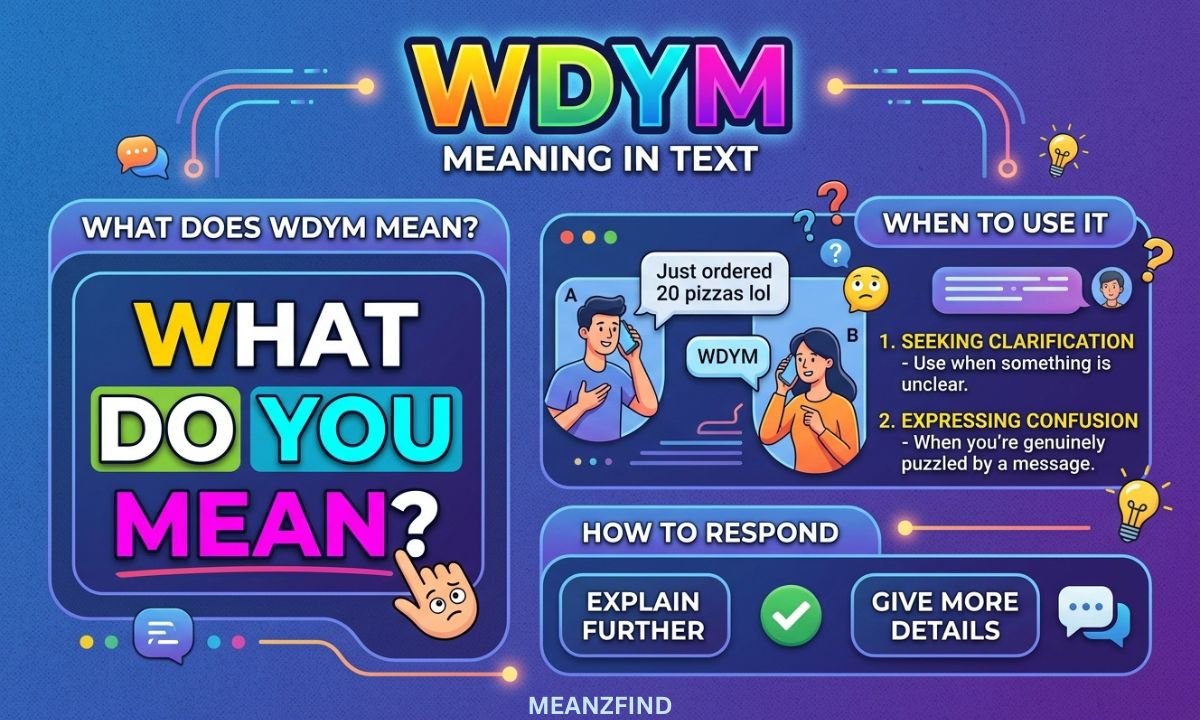
You have probably seen “WDYM” in a chat and wondered what it means. It stands for “what do you mean.” People use it when they don’t understand something and want you to explain it. It is short, quick, and very common in everyday texting.
You can find WDYM on WhatsApp, Instagram, Snapchat, TikTok, and X. Most people type it in lowercase, like “wdym?” It works as a simple question, but the tone can change with the situation. Sometimes it sounds curious, and sometimes it sounds a little annoyed or surprised.
In this guide, you will learn what WDYM means in text and on social media. You will see how to use it and how to reply when someone sends it. You will also get easy examples to make everything clear. By the end, you will know exactly when to use it.
WDYM Meaning in Text – Quick Meaning
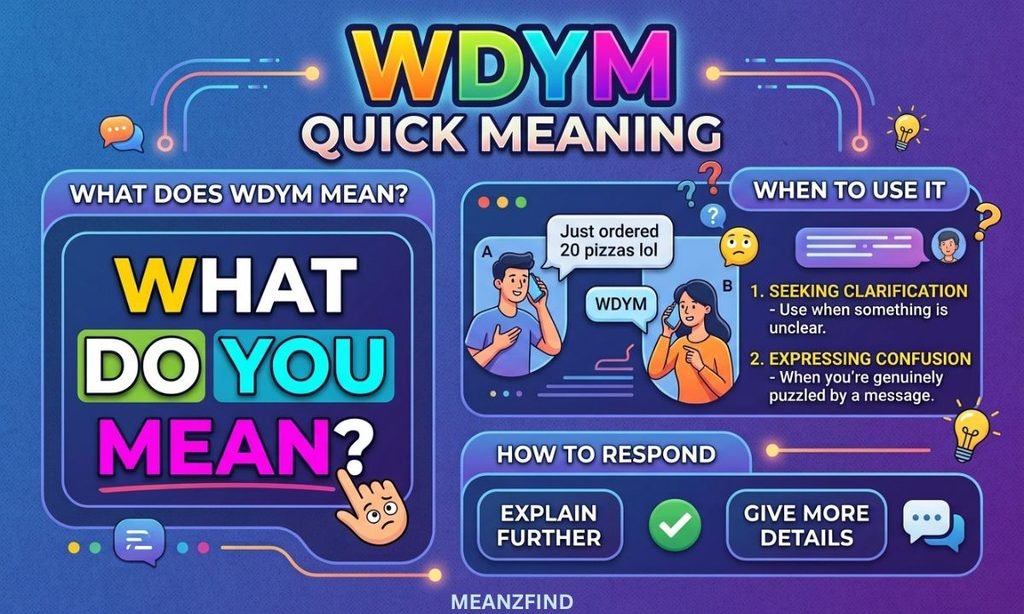
WDYM stands for “what do you mean?” People type it when they do not understand something and want a clearer answer. It is one of the most common short forms in texting, chats, and comments.
Simple Definition
WDYM is a question. It asks the other person to explain what they just said. You can read it as “I did not get that” or “Can you say that again in a clearer way?”
Most people write it in lowercase, like “wdym” or “wdym?” Some write it in capitals, like “WDYM??” The letters stay the same, but the feeling can change. We will look at that later in this guide.
Common Uses
People use WDYM for many reasons. Here are the most common ones:
- To ask for a clearer explanation
- To show they are confused
- To show surprise or shock
- To push back on a strange claim
- To keep a chat going and ask for more detail
- To tease a friend in a playful way
Quick Examples
Here are some short chats to show how it works.
- “I can’t come tomorrow.” → “wdym? you promised.”
- “That movie was mid.” → “wdym mid? it was great.”
- “I have news.” → “wdym news? tell me now.”
- “We need to talk.” → “wdym? did I do something?”
In each case, the reply asks for more information. That is the whole idea behind WDYM.
Origin & Background
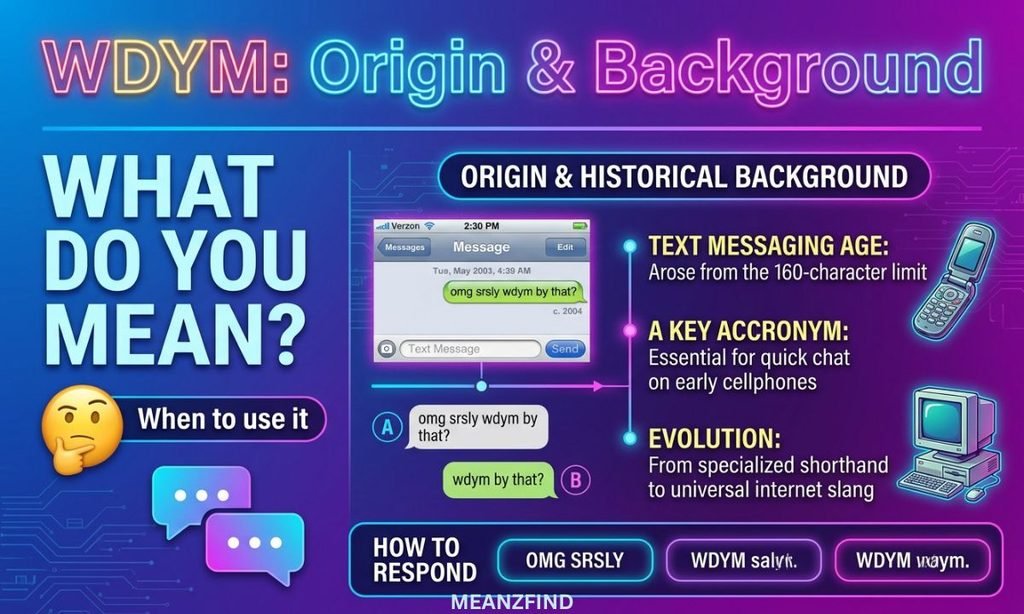
No single person invented WDYM. It grew out of early texting and online chat. Long ago, phone messages had tight length limits. People cut long phrases into short ones to save space and time.
Early chat rooms and instant messengers added to this habit. Typing was slow, and people wanted fast replies. Short forms like “brb,” “lol,” and “idk” became normal. “WDYM” joined this group because “what do you mean” is a question people ask all day long.
Today, character limits matter less. But the habit stayed. Young people use short forms because they feel quick, casual, and friendly. Apps like WhatsApp, Instagram, Snapchat, and TikTok pushed WDYM into everyday life.
The phrase also has a second life as a tone marker. Over time, people learned that “wdym” can sound calm, curious, or upset. That small change in feeling is a big part of why it is so popular.
Real-Life Conversations
The best way to understand WDYM is to see it in real chats. Below are four common places where people use it.
WhatsApp Example
Chat between two friends:
Sara: I think I’ll skip the party.
Ali: wdym skip? everyone is going
Sara: I’m just tired today.
Ali: ok that makes sense
Here, Ali is surprised. He uses WDYM to ask why Sara wants to skip. The tone is soft. He is not angry. He just wants to know the reason.
Instagram DM Example
Chat after a story reply:
Mina: Your new haircut is different.
Zoya: wdym different? good or bad?
Mina: Good! It just looks fresh.
Zoya: haha thank you
Zoya feels a little unsure. She uses WDYM to get a clear answer. Notice that she adds “good or bad” to explain what she is worried about.
TikTok Comments Example
Comment thread under a video:
User 1: This is the worst recipe ever.
User 2: wdym? I made it yesterday and it was perfect
User 1: Mine burnt, maybe I messed up.
User 2: ah yeah check your oven heat
Public comments often use WDYM to challenge a claim. Here, User 2 disagrees but stays polite. Because many people can read the reply, the tone is usually a bit more careful.
Text Message Example
Chat between a brother and sister:
Hamza: I’ll be there around the usual time.
Ayesha: wdym usual time? you said 6
Hamza: Oh sorry, I mean 6.
Ayesha: ok thanks
This is a simple, helpful use. Ayesha is not upset. She just needs the right time. WDYM saves her from guessing.
Emotional & Psychological Meaning
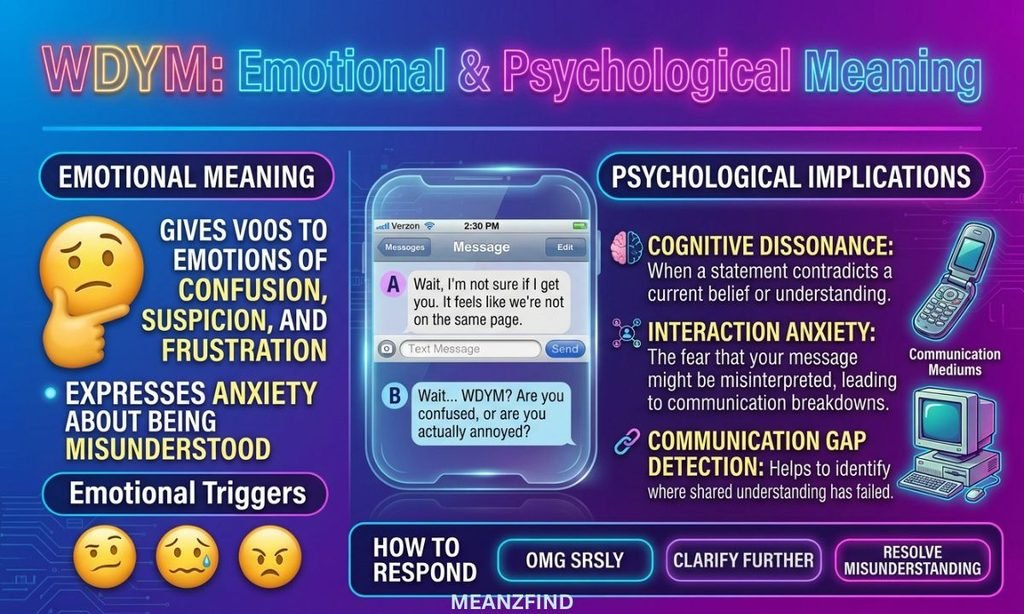
WDYM looks small, but it can carry big feelings. The same three letters can show many moods. Here is what may be going on in the other person’s mind.
Confusion. This is the most common reason. The person did not understand and wants help. A calm “wdym?” is usually a request for more detail.
Surprise. Sometimes the message is unexpected. The person uses WDYM to say, “Wait, what? I did not see that coming.”
Worry. People often send WDYM when they fear bad news. A message like “we need to talk” often gets the reply “wdym?” because the reader feels nervous.
Defense. If someone feels blamed, they may type “wdym??” to push back. They want you to prove or explain your point.
Curiosity. In a friendly chat, WDYM can mean “I am interested, go on.”
Playfulness. Friends often use it to tease each other. A funny “wdym lol” does not carry any anger.
Our brains read text without a voice or face. That means we fill in the missing tone ourselves. If we are already stressed, we may read WDYM as rude. If we are relaxed, we read it as friendly. This is why context matters so much.
A quick tip: look at the small signs. Punctuation, emojis, and capital letters tell you a lot. “wdym 😂” feels light. “WDYM.” feels cold. “wdym??” feels shocked or upset.
Usage in Different Contexts
WDYM does not work the same way everywhere. Where you use it changes how it feels.
Social Media
On social media, WDYM is very common. People use it in comments, replies, and direct messages. It is casual, fast, and expected.
In public comments, it often appears in debates and jokes. A reply like “wdym this is fake?” can start a long thread. On stories and DMs, it is more private and usually friendly.
Creators also see WDYM a lot. Viewers use it when a video feels unclear or surprising. If many people write it, that is a sign the creator should explain more.
Friends & Relationships
With friends, WDYM is easy and relaxed. You can use it freely, and nobody will mind. Friends often add jokes or emojis to keep the mood light.
In close relationships, the feeling can get deeper. A partner may use “wdym” when they feel hurt or confused. In these moments, a quick and kind answer helps a lot. A cold or slow reply can make things worse.
Try not to guess the meaning. If someone you care about sends WDYM, ask what they feel. A short, warm reply often clears things up.
Work or Professional Settings
In most workplaces, WDYM is too casual. It can look lazy or even rude in an email. Your boss or client may prefer full words.
Instead, you can write one of these:
- “Could you please clarify?”
- “Can you explain that a little more?”
- “I want to be sure I understand. What do you mean by that?”
There are small exceptions. Some teams chat on messaging apps and use casual language. If your team does this, WDYM may be fine with close coworkers. Still, when in doubt, use full words.
Casual vs Serious Tone
Tone is the biggest key. Here is a simple guide.
| Situation | Is WDYM okay? | Better choice |
| Chat with a close friend | Yes | Use it freely |
| Comment on a funny video | Yes | Add an emoji for tone |
| Serious family talk | Maybe | Use full words |
| School email to a teacher | No | “Could you please explain?” |
| Message to your boss | Usually no | “Can you clarify, please?” |
| Argument or fight | Careful | Stay calm and kind |
When the topic is serious, slow down. Full words show care and respect.
Common Misunderstandings
Many people read WDYM the wrong way. These four mistakes cause most of the trouble.
Mistake 1: Assuming It’s Rude
Many people think WDYM is always rude. This is not true. Most of the time, it is just a plain question. The person simply wants more detail.
Before you feel hurt, check the full message. Look at the words and the mood around it. A short message does not mean a mean message.
Mistake 2: Thinking It’s Always Challenging Someone
Some people believe WDYM always means “I disagree with you.” That is also wrong. Often it only means “I did not understand.”
Yes, it can show pushback. But that only happens in some chats. In many cases, it is just a gentle request.
Mistake 3: Using It in Formal Communication
This one is about the sender. Some people use WDYM with teachers, bosses, or clients. This can look careless. In formal messages, full words feel more polite and clear.
If you are unsure, pick the longer version. It never hurts to be polite.
Mistake 4: Ignoring Context
The biggest mistake is reading WDYM without context. The same word can mean worry, joy, or anger. You need to see who sent it, when they sent it, and what came before it.
Read the whole chat, not just one line. This simple habit solves most confusion.
Comparison Table
Here is a quick table showing how different versions feel.
| Message | Likely feeling | Typical use |
| wdym | Neutral, curious | General question |
| wdym? | Soft, interested | Friendly chat |
| WDYM?? | Shocked or upset | Strong reaction |
| wdym lol | Playful | Joking with friends |
| wdym 😭 | Dramatic, funny | Teasing |
| wdym. | Cold or annoyed | Serious pushback |
| wdym by that? | Calm, clear | Asking for detail |
Key Insight
WDYM is a tool, not a mood. The mood comes from the words around it. Punctuation, emojis, and timing tell you the real feeling. When you read it, pause and look at the whole picture.
Variations and Types of WDYM
People ask “what do you mean” in many ways. Here are the most common ones, from short forms to full sentences.
1. WYM
WYM is a shorter form. It stands for “what you mean” and is used like WDYM. It is faster to type and feels even more casual.
Example: “wym you can’t come?”
2. What Do You Mean Exactly?
This is the full version with a bit more push. The word “exactly” shows the person wants real detail. It sounds a little more serious.
Example: “What do you mean exactly? I want to understand.”
3. Can You Explain?
This version is calm and polite. It works well in school, at work, and with new people. It asks for help without any pressure.
Example: “Can you explain that part again?”
4. I’m Confused
This one is honest and direct. It tells the other person how you feel. It often gets a kind and helpful reply.
Example: “I’m confused. Can you say it in a simpler way?”
5. Elaborate
This is a short, firm word. It asks for more detail. It can sound a bit strong, so use it with care.
Example: “Elaborate. I want the full story.”
6. Clarify That
This works well in serious talks. It asks the person to make a point clear. It can feel formal.
Example: “Please clarify that. I did not follow.”
7. What Are You Saying?
This one can sound sharp. It often shows shock or disbelief. Tone matters a lot here.
Example: “What are you saying? You are leaving?”
8. How So?
This is short and smart. It asks for the reason behind a claim. It is common in friendly debates.
Example: “You think it will rain? How so?”
9. What Makes You Think That?
This is a deeper question. It asks for the reason behind a belief. It is great for calm and mature talks.
Example: “What makes you think that? I’m curious.”
10. Tell Me More
This is warm and open. It shows real interest. It invites the other person to share.
Example: “That sounds interesting. Tell me more.”
Here is a simple table to compare them.
| Phrase | Tone | Best place to use |
| WDYM | Casual | Friends, social media |
| WYM | Very casual | Quick chats |
| What do you mean exactly? | Firm | Serious talks |
| Can you explain? | Polite | School, work |
| I’m confused | Honest | Any place |
| Elaborate | Strong | Careful use |
| Clarify that | Formal | Work, serious talks |
| What are you saying? | Shocked | Close chats |
| How so? | Curious | Friendly debates |
| What makes you think that? | Mature | Calm talks |
| Tell me more | Warm | Friends, family |
How to Respond When Someone Uses It
A good reply keeps the chat smooth. The best answer depends on the person and the mood. Here are four styles you can use.
Casual Replies
Use these with friends and people you know well.
- “I mean I’m not sure I can make it.”
- “Just what I said, haha.”
- “Let me explain properly.”
- “I meant the second thing.”
- “Ok wait, let me say it better.”
Keep it short and light. A simple answer is often enough.
Funny Replies
Humor works well when the mood is playful. Use it only when the other person is joking too.
- “wdym wdym? you know what I mean 😂”
- “It means what it means, my friend.”
- “Even I don’t know, but it sounded cool.”
- “I meant to say something smart. It failed.”
- “Give me a minute, my brain is buffering.”
Do not use jokes if the other person is upset. That can make things worse.
Mature and Confident Replies
Use these when the topic is serious or when you want to stay calm.
- “Let me explain what I meant.”
- “I can see how that was unclear. Here is what I meant.”
- “I should have said it better. What I meant was this.”
- “That’s fair to ask. Let me clear it up.”
These replies show maturity. They also build trust, because you take responsibility for clear words.
Private or Respectful Replies
Sometimes a topic is personal. You may not want to share in text. In that case, a polite reply helps.
- “I’d rather explain this in person.”
- “Can we talk about this later when we are alone?”
- “It’s a bit private. Can I call you?”
- “I’m not ready to share that yet, but thank you for asking.”
Setting a boundary is fine. A kind and clear reply protects both sides.
Regional & Cultural Usage
WDYM is used all over the world. But the feeling can change a little from place to place.
Western Culture
In the US, UK, Canada, and Australia, WDYM is very common. Young people use it daily in texts and online chats. It is seen as normal and friendly. People rarely feel hurt by it.
Direct talk is also more accepted in many Western chats. So a quick “wdym?” is often just a plain request.
Asian Culture
In many Asian countries, people also use WDYM, especially young people on social apps. English short forms mix with local languages. You may see messages like “wdym yaar” in South Asia, where friends add local words for warmth.
In some cultures, being polite and soft matters a lot. Older people may find a short WDYM too blunt. In that case, a longer and kinder question works better.
Middle Eastern Culture
In the Middle East, many young people chat in a mix of Arabic and English. WDYM appears often in this mix. Friends use it casually, just as in other places.
Respect and tone matter greatly in many families and communities. With elders, full words and polite language are the safer choice.
Global Internet Usage
Online, WDYM has become a shared global habit. Gamers, creators, students, and fans use it everywhere. Because the internet crosses borders, many people learn it quickly.
Even so, always remember who you are talking to. A phrase that feels normal to one person may feel sharp to another. A friendly tone works in every culture.
WDYN Meaning Texting
You may also see “WDYN” in a chat. What does it mean?
In most cases, WDYN is a typo for WDYM. The letters N and M sit next to each other on a keyboard. It is easy to hit the wrong one when typing fast. So if someone writes “wdyn?” after you say something unclear, they most likely mean “what do you mean?”
In rare cases, people use WDYN to mean “what do you need?” This is not common, and it is not standard slang. If the chat does not make sense with “what do you mean,” look at the full message. Or just ask the person.
A good rule is this:
- If it follows a confusing message, it is probably “what do you mean.”
- If it follows a request or a problem, it may be “what do you need.”
- If you are still not sure, ask politely.
WDYM Meaning in Text From a Boy
When a boy sends WDYM, the meaning depends on the person. There is no special boy code. Still, here are a few common patterns.
Simple confusion. Most of the time, he just did not understand. He wants a clearer answer. Reply with a short, direct explanation.
Playful teasing. If he adds “lol” or an emoji, he is likely joking. This often happens in friendly or flirty chats.
Checking interest. Sometimes a boy uses WDYM to learn how you feel. For example, if you say “I like spending time with you,” he may reply “wdym?” He may want to know if you mean it as a friend or something more.
Nervous or unsure. If the topic is serious, he may feel worried. A calm and honest answer helps him relax.
Here is a short example:
You: I think we should talk soon.
Him: wdym? is everything ok?
He is nervous here. A kind reply like “Yes, all good, just want to catch up” can help.
Do not read too much into one message. Look at how he usually texts you. That tells you much more than three letters.
WDYM Meaning in Text From a Girl
When a girl sends WDYM, the same rule applies. The meaning depends on the person, the chat, and the mood. Here are some common patterns.
Simple confusion. Often, she needs a clearer message. A short, kind explanation works best.
Wanting more detail. She may use WDYM because she cares about the topic. She wants to know the full story, not just a part of it.
Feeling unsure or hurt. If a message felt cold or unclear, she may reply “wdym?” to check your meaning. A warm answer helps her feel safe.
Playful or flirty. With a smile or emoji, it can be a fun way to keep the chat going.
Here is a short example:
You: You looked different today.
Her: wdym different? 😅
She feels a little shy or unsure here. A kind reply like “Different in a good way, you looked happy” clears things up fast.
Again, avoid guessing. Check the tone and the history of the chat. If you are not sure, ask her gently what she feels. Kind words almost always work.
FINAL WORDS
WDYM is a simple way to say “what do you mean.” People use it when a message feels unclear or surprising. It saves time and keeps the chat moving. That is why it shows up on almost every messaging app today.
The meaning stays the same, but the tone can change. A friendly “wdym?” shows you are curious and want more detail. A sharp “WDYM??” can sound upset or shocked. Always read the full message and the mood before you decide how to take it.
If you want to use WDYM, keep it simple. Use it when you truly need a clearer answer. Avoid it in formal chats, like emails to your boss or teacher. In those cases, write “What do you mean?” in full words.
Now you know what WDYM means in text and social media. You also know how to use it and how to reply to it. Use it with the right tone, and your chats will feel natural and clear. Next time you see it, you will know exactly what the other person wants.
FAQs
What Does WDYM Mean in Texting?
WDYM stands for “what do you mean?” People use it to ask someone to explain a message that felt unclear or surprising.
Is WDYM Rude?
No, WDYM is not rude by itself. It is a simple question, but a cold tone, like “WDYM.” or “WDYM??”, can sound annoyed.
What Is the Difference Between WDYM and WYM?
Both mean “what do you mean,” and people use them the same way. WYM is just a shorter, more casual version that is quicker to type.
Can I Use WDYM at Work?
It is better to avoid WDYM in emails or messages to your boss or clients. Write “Could you please clarify?” instead, unless your team chats casually.
Why Do People Use WDYM?
People use WDYM because it is fast, easy, and feels natural in chats. It helps them ask for a clearer answer without typing the full question.
Is WDYM Popular on Social Media?
Yes, WDYM is very popular on apps like WhatsApp, Instagram, Snapchat, and TikTok. You will see it often in comments, replies, and direct messages.
Does WDYM Always Mean Confusion?
No, it does not always mean confusion. It can also show surprise, worry, curiosity, or playful teasing, depending on the tone and the chat.