
You have probably seen “IMAO” in a chat and wondered what it means. It looks like “LMAO,” but it is not the same. People use it a lot in texts, comments, and social media posts. It is short, and it adds a bit of attitude to a message.
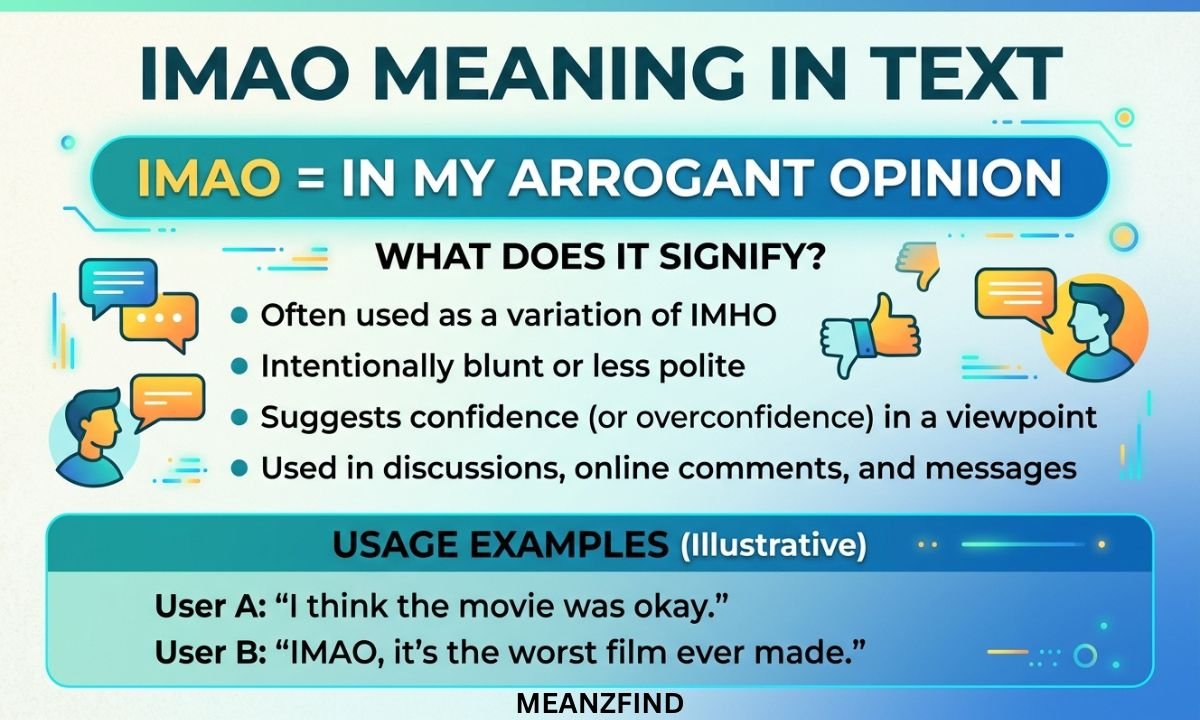
IMAO usually stands for “In My Arrogant Opinion.” Some people also say “In My Awful Opinion.” It is a playful twist on IMHO, which means “In My Humble Opinion.” The difference is the tone. IMAO sounds bold, cheeky, and a little sarcastic.
In this guide, you will learn what IMAO means and how people use it. You will see simple examples and easy replies. You will also learn when to use it and when to skip it. By the end, you will know how to use it with confidence in 2026.
IMAO Meaning – Quick Explanation
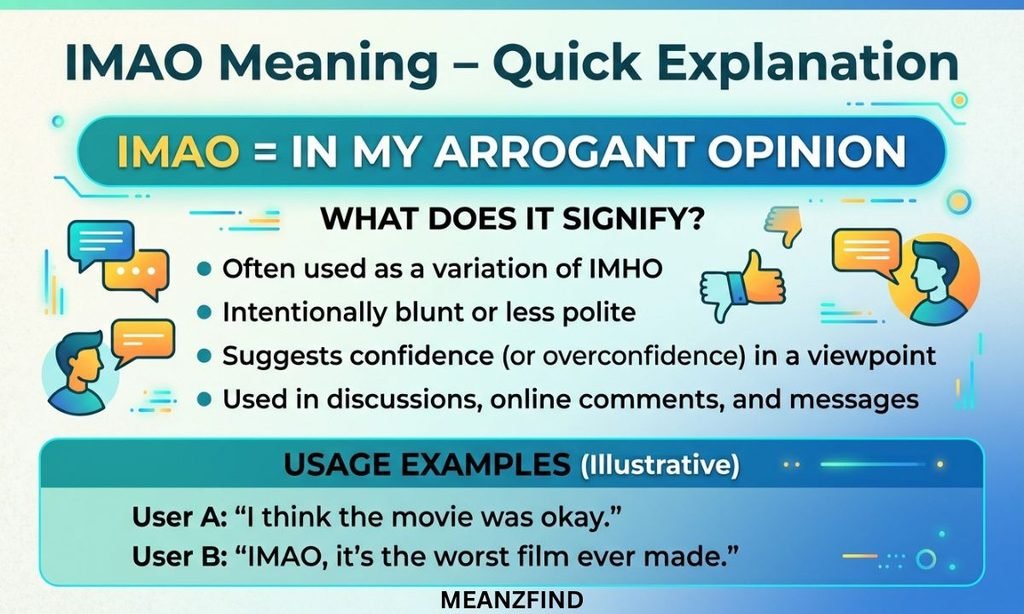
IMAO stands for “In My Arrogant Opinion.” It is internet slang. People use it to share an opinion in a bold and funny way.
Think of it as the cheeky cousin of IMHO. IMHO sounds polite and soft. IMAO sounds proud and playful.
Simple Meaning
IMAO = In My Arrogant Opinion.
When someone types it, they are saying, “Here is my view, and I am going to sound extra sure about it.” Most of the time, they are joking.
Common Intent Behind IMAO
People use IMAO for a few simple reasons:
- To share a strong opinion in a funny way
- To tease a friend without being mean
- To act dramatic about small things like food, music, or movies
- To sound confident without starting a real fight
- To add some personality to a plain sentence
Short Examples
- “IMAO, pizza with pineapple is the best pizza.”
- “IMAO, Mondays should not exist.”
- “IMAO, my playlist is better than yours.”
- “IMAO, that movie was way too long.”
See how light these topics are? That is the sweet spot for IMAO. It works best when nothing serious is at stake.
IMAO Meaning
Let’s break the word into small pieces.
| Letter | Stands For | Simple Idea |
| I | In | Starts the phrase |
| M | My | This is my own view |
| A | Arrogant | Acting proud, in a joking way |
| O | Opinion | What I think |
“Arrogant” means acting like you are better or smarter than other people. In real life, that is not a nice trait. But online, people use the word as a joke.
When you write “in my arrogant opinion,” you admit that you sound a bit full of yourself. That honest joke makes the message funny instead of rude. The reader understands that you are playing a role.
So the real meaning of IMAO is not “I am better than you.” It is closer to “I know this sounds bossy, but here is what I think.”
IMAO Meaning in Text
In a text chat, IMAO usually shows up at the start of a sentence. It works like a small label that says, “Opinion coming, with attitude.”
Here are the most common ways people place it:
- At the start: “IMAO, this song is overrated.”
- At the end: “This song is overrated, IMAO.”
- On its own: “IMAO.” (Usually as a reply to someone else’s opinion.)
It does not matter if you type IMAO, imao, or Imao. All three mean the same thing. Most people type it in lowercase when they chat fast.
How Do You Say IMAO?
Most people say it letter by letter: “I-M-A-O.” Some people say it like a word: “im-AY-oh.” But honestly, IMAO is mostly typed, not spoken.
Tone Clues Inside a Text
Since IMAO is all about tone, the words around it matter. Look for these small hints:
- A laughing emoji means the person is joking.
- A smirking face means the person is teasing.
- Capital letters can mean extra drama.
- A very serious topic can mean the person is not joking.
When you see IMAO, read the whole message. The rest of the sentence tells you how to take it.
Origin & Background of IMAO
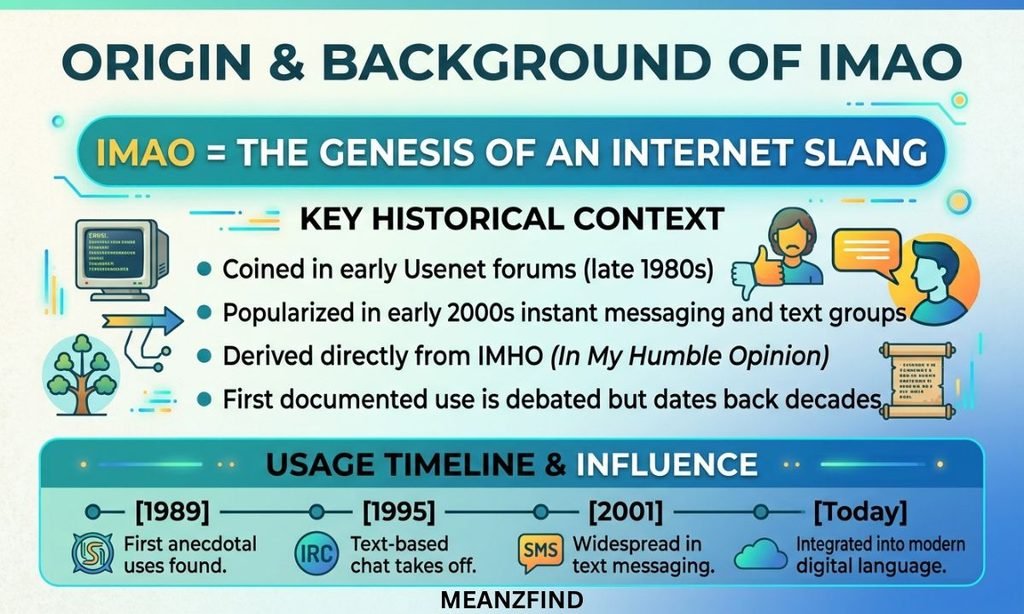
IMAO grew out of another short phrase: IMHO, which means “In My Humble Opinion.” Online chat, forums, and email made IMHO very popular. People used it to sound polite before they shared a view.
Then people got playful. Many thought, “Nobody is really that humble.” So they flipped the word “humble” into “arrogant.” That is how IMAO was born.
No one knows the exact day or the exact person who typed it first. Different websites give different dates, so be careful with any page that claims one perfect year. What we do know is simple. IMAO came from online chat culture as a joking opposite of IMHO.
How It Evolved
The story of IMAO happened in small steps:
- Polite stage: People used IMHO to sound kind and soft.
- Joke stage: People flipped it into IMAO to sound funny and bold.
- Spread stage: The term moved from forums and email into text messages and apps.
- Remix stage: People made new versions, like IMNSHO (“In My Not So Humble Opinion”).
Today, IMAO is a small but steady piece of internet slang. It is not as big as LOL or LMAO. But many people still know it, and many use it.
Internet Influence
The internet loves short words. Typing is slower than talking, so people cut long phrases down to a few letters. IMAO fits that habit perfectly.
The internet also loves humor and attitude. IMAO packs both into four letters. That is one reason it has lasted so long.
There is one more reason it spread. IMAO looks a lot like LMAO. When people see the two terms side by side, they get curious, and they search for the difference. That curiosity keeps IMAO alive.
Real-Life Conversations (How People Actually Use IMAO)
Theory is nice, but real chats are better. Here is how people actually use IMAO on different apps.
WhatsApp Chat
WhatsApp chats are usually between friends and family. People use IMAO to joke about small opinions.
Sara: Which is better, tea or coffee? Ali: IMAO, tea wins every time ☕ Sara: Wrong. Coffee is the king. Ali: IMAO, you have no taste 😂
Here, both people are teasing each other. Nobody is angry. The word IMAO keeps the mood light.
In group chats, IMAO often appears when someone shares a food, movie, or sports opinion. The group then jumps in with their own views.
Instagram DMs
In Instagram DMs, people often react to photos, reels, and stories. IMAO helps them share a quick opinion without writing a lot.
Hira: Look at my new haircut! Zoya: IMAO, it’s your best look yet 🔥 Hira: Stop, you’re too kind!
In this case, IMAO adds a little style to a compliment. It makes the praise sound bold and fun.
TikTok Comments
TikTok comment sections are full of strong opinions. People use IMAO to jump into a debate in a funny way.
- “IMAO, this is the best trend of the year.”
- “IMAO, the second song was better.”
- “IMAO, nobody cooks pasta like this guy.”
On TikTok, IMAO often gets likes and replies because it sounds confident and playful. It can also start friendly arguments. That is normal in comment sections.
Emotional & Psychological Meaning
Why do people use IMAO instead of just saying “I think”? The answer lies in feelings.
It Shows Confidence
IMAO lets a person sound sure of themselves. It feels like standing tall while sharing a view. Many people enjoy that little boost.
It Protects the Speaker
Here is a clever trick. When you say “in my arrogant opinion,” you call yourself arrogant first. That means no one can easily say it later. The joke acts like a shield.
It Builds Closeness
People only use IMAO with others they feel comfortable with. If you use it with a friend, it says, “We are close enough to tease each other.” Shared jokes can bring people closer.
It Softens Strong Opinions
A hard statement like “That song is terrible” can sound mean. Add IMAO, and it feels lighter. The listener knows it is a joke, not an attack.
It Can Hide Real Feelings
Sometimes a person uses a joke to say something they truly mean. They may hide a real opinion behind a funny label. If someone uses IMAO again and again about the same topic, they may care about it more than they show.
Usage in Different Contexts
IMAO does not fit every place. Let’s look at where it works well and where it does not.
Social Media
Social media is the home of IMAO. It fits in comments, captions, replies, and group chats.
- Good use: Fun opinions about music, food, games, and trends.
- Careful use: Debates about news, religion, or politics. A joke can start a fight there.
Since many people read your comment, keep it kind. A playful tone is great. A mean tone is not.
Friends & Relationships
With close friends, IMAO is very safe. You already know each other’s humor. A little teasing is part of the fun.
With a partner or crush, IMAO can feel flirty. For example: “IMAO, you are the best cook I know.” That sounds sweet and confident.
But be careful with new friends. They may not know your humor yet. They may think you really are arrogant.
Work or Professional Settings
In most work chats, skip IMAO. It is slang, and slang can look unprofessional. A boss or a client may not understand it. They may even think you are being rude.
There is one small exception. Some teams have a relaxed, joking chat. In that case, a light IMAO can work with close coworkers. Watch how others write first. If nobody uses slang, you should not either.
Casual vs Serious Tone
Here is a simple table to remember.
| Situation | Is IMAO a Good Idea? | Why |
| Chat with close friends | Yes | Everyone gets the joke |
| Fun comment on a meme | Yes | Light and playful |
| Chat with a teacher | No | Too casual |
| Email to a boss | No | Looks unprofessional |
| Serious or sad topic | No | Sounds cold or rude |
| Argument or fight | No | Adds fuel to the fire |
The rule is easy. Light topic and friendly people? Go ahead. Serious topic or formal person? Skip it.
Common Misunderstandings About IMAO
Because IMAO looks like other slang, people mix it up a lot. Here are the four biggest mistakes.
1. Thinking It Has a Separate Official Meaning
Some people believe IMAO has a secret official meaning. It does not. Slang has no rulebook and no boss. The most common meaning is “In My Arrogant Opinion,” and that is the one most people know.
A few people use different words for the “A,” like “awesome” or “awful.” These are side versions, not official ones. We will cover them in the variations section below.
2. Assuming It Is Always a Typo
Many people see IMAO and think, “They meant to write LMAO.” That can happen, because the letters look close and fingers move fast. But in most cases, IMAO is typed on purpose.
Here is an easy way to check. If the sentence shares a view or an opinion, it is IMAO. If the sentence is about something funny, the person may have made a typo.
- “IMAO, this game is boring.” → Real IMAO (opinion)
- “That video was so funny imao” → Maybe a typo for LMAO (laughing)
3. Believing It Is Rude
The word “arrogant” sounds harsh, so some people think IMAO is rude. In most cases, it is not. It is a joke that the speaker makes about themselves.
The tone decides everything. Friendly words and a smile emoji make it playful. Angry words and a cold tone can make it feel rude. So the term itself is not rude. How you use it is what counts.
4. Using It in Formal Writing
IMAO is slang. It does not belong in school essays, job applications, reports, or business emails. Even a very friendly teacher may mark it down. Keep it for chats and comments.
When NOT to Use IMAO
Sometimes it is best to skip IMAO. Here are the main times to avoid it:
- Formal messages. School work, job emails, and official letters need clear and polite words.
- Serious topics. Do not use it when people talk about sadness, health, loss, or money problems.
- Arguments. If someone is already upset, IMAO can sound like you are poking them.
- New people. They do not know your humor yet and may take it the wrong way.
- Older or non-online readers. Some people have never seen this slang and may feel confused.
- Group chats with mixed ages. Not everyone may get the joke.
A quick test can help. Ask yourself: “Would this person laugh, or would they feel hurt?” If you are not sure, write the plain version instead, like “I think” or “In my view.”
IMAO vs Similar Terms (Comparison Table)
IMAO sits in a family of short opinion and laughing terms. This table shows how they differ.
| Term | Full Form | Tone | Best Use |
| IMAO | In My Arrogant Opinion | Bold, playful, teasing | Fun opinions with friends |
| IMHO | In My Humble Opinion | Polite, soft | Gentle opinions, even semi-formal |
| IMO | In My Opinion | Neutral | Any normal chat |
| IMNSHO | In My Not So Humble Opinion | Strong, confident | Opinions you feel sure about |
| LMAO | Laughing My A** Off | Funny, laughing | Reacting to something funny |
| LOL | Laughing Out Loud | Light, mild laughter | Almost any friendly chat |
| ROFL | Rolling On the Floor Laughing | Very funny | Big laughs |
IMAO vs IMHO
IMHO says, “I am humble, so please do not mind my view.” IMAO says, “I am proud of my view, and I know it.” One is gentle. The other is cheeky.
IMAO vs LMAO
These two look alike, but they have nothing in common. IMAO is about opinions. LMAO is about laughing. If you want to say something is funny, use LMAO. If you want to share a view, use IMAO.
Variations & Related Forms of IMAO
Slang changes with every group of users. IMAO has a few forms you may see.
- imao (lowercase): The most common way to type it in fast chats.
- IMAO: The full capital version, used for extra drama.
- IMAO! With a mark at the end, it sounds louder and more dramatic.
- In my awful opinion: A rare version where the A means “awful.” It is used for jokes about bad ideas.
- In my awesome opinion: Another rare version. The A means “awesome,” and it sounds proud and happy.
- IMNSHO: A different term that means “In My Not So Humble Opinion.” It has the same spirit as IMAO.
If you see a new meaning, check the rest of the message. The mood of the chat will tell you which meaning fits. When in doubt, you can simply ask, “What does the A stand for?”
How to Respond When Someone Uses IMAO
Your reply depends on your mood and your relationship with the person. Here are ideas for four different styles.
Casual Replies
These are easy and friendly.
- “Ha, fair point!”
- “I see what you mean.”
- “Okay, tell me more.”
- “Not sure I agree, but go on.”
Funny Replies
Use these when you want to play along.
- “Your arrogance is showing 😂”
- “Someone is feeling confident today.”
- “IMAO, you are wrong, and I say it with love.”
- “Wow, the king has spoken.”
Mature / Confident Replies
Use these when you want to share your view calmly.
- “I respect your view, but I see it differently.”
- “That is a fair opinion. Here is mine.”
- “I understand why you think that. I just disagree.”
Private or Respectful Replies
Use these when the topic feels personal or when the person is not a close friend.
- “Thanks for sharing. I would like to think about it.”
- “I see your point. Can we talk about this later?”
- “I would rather not argue, but thank you for telling me.”
Match your tone to theirs. If they joke, joke back. If they sound serious, answer with care.
Regional & Cultural Usage
Slang travels fast, but it does not look the same everywhere.
Western Culture
In the United States, the United Kingdom, and Canada, humor about being “arrogant” is common. People enjoy bold, self-joking opinions. IMAO fits well in this style, mostly among young adults and teens.
Asian Culture
In many parts of Asia, people respect modesty and polite speech. Here, IMAO is mostly used with close friends and in English-language chats. Many people use it with Hinglish, Urdu-English, or other mixed styles. It is less common with elders because of the respect rule.
Middle Eastern Culture
In many Middle Eastern groups, respect for family and elders is very important. Young people use English slang like IMAO in private chats with friends. They usually avoid it in family groups or with older people.
Global Internet Usage
Online, borders matter less. Gamers, students, and social media fans share the same slang worldwide. Still, many people have never heard of IMAO. If you use it in a global chat, be ready to explain it with a quick “in my arrogant opinion.”
IMAO Meaning Slang
As slang, IMAO is a short, casual way to say, “In my arrogant opinion.” It belongs to the group of opinion terms like IMO and IMHO. It carries humor and attitude. You will find it in chats, comments, and captions, not in formal writing.
IMAO Meaning Texting
In texting, IMAO saves time and adds personality. Texters place it at the start of a message to show they are about to share a bold view. It works best between friends who know each other well.
IMAO Meaning in Text Message
In a text message, IMAO signals a playful opinion. A message like “IMAO, we should eat out tonight” means “In my arrogant opinion, we should eat out tonight.” It sounds fun, not bossy. Add an emoji, and the joke is clearer.
IMAO Meaning Laugh
Many people search for this, so here is the clear answer. IMAO does not mean laugh. The laughing term is LMAO. IMAO is only about opinions.
The confusion happens because the two look almost the same. Also, people often add “imao” to jokes. Sometimes it is a typo for LMAO. When the sentence is about something funny and has no opinion in it, the writer probably meant LMAO.
IMAO Meaning Internet Slang
Among internet slang terms, IMAO is a humorous opinion marker. It is part of the same family as IMHO, IMO, and IMNSHO. It is smaller than LOL, but it has a loyal group of fans. It shows that online language is full of jokes, twists, and flipped words.
IMAO Meaning in My Arrogant Opinion
“In my arrogant opinion” is the full form and the main meaning. Each word plays a role:
- In my: This is my personal view.
- Arrogant: I know I sound too sure of myself, and I am joking about it.
- Opinion: This is what I think, not a fact.
That last part matters. IMAO reminds readers that the sentence is an opinion. It is not a rule or a fact.
Tips For IMAO Meaning
Here are simple tips to use IMAO the right way.
- Know your audience. Use it with friends, not with bosses or teachers.
- Pick light topics. Food, movies, music, and games are perfect.
- Add a friendly sign. An emoji or a smile word shows you are joking.
- Do not use it to hurt. If your sentence could make someone sad, skip it.
- Do not use it too much. Using IMAO in every message gets boring fast.
- Keep it out of formal writing. Use “in my opinion” or “I think” instead.
- Explain it if needed. If a friend looks confused, share the full form.
- Read the mood. If the chat feels tense, drop the joke.
- Do not mix it up with LMAO. One is for opinions, and the other is for laughing.
- Be ready for a reply. A bold opinion often starts a friendly debate.
FINAL WORDS
IMAO is a fun and simple slang term. It stands for “In My Arrogant Opinion.” People use it to share a view with a bold and playful tone. It is the cheeky cousin of IMHO.
The key is to know the tone. IMAO is not a serious way to argue. It works best when you are joking or teasing. With friends, it feels natural and light.
Be careful in formal chats. Avoid it with your boss, your teacher, or someone you just met. It can sound rude or too cocky in the wrong place. When in doubt, use IMHO or just write “I think.”
Now you know what IMAO means and how to use it. Try it in your next casual chat and see how it feels. Keep it friendly and keep it fun. Slang is simple when you know the vibe.
FAQs
What Does IMAO Mean in Chat?
In chat, IMAO means “In My Arrogant Opinion.” People use it to share a bold view in a joking way.
What Is the Full Meaning of IMAO?
The full meaning of IMAO is “In My Arrogant Opinion.” It is a playful twist on IMHO, which means “In My Humble Opinion.”
What Is LMAO and IMAO?
LMAO means “Laughing My A** Off,” and people use it to show something is funny. IMAO means “In My Arrogant Opinion,” and people use it to share a bold opinion.
How to Use IMAO?
Put IMAO at the start or end of a sentence when you share a playful opinion, like “IMAO, tea is better than coffee.” Use it with friends and on light topics, not in formal messages.
What Does “IMAO” Mean on TikTok?
On TikTok, IMAO means “In My Arrogant Opinion,” and people drop it into comments to share a confident take. It often sounds funny and cheeky, and it can start friendly debates.
What Does “In My Arrogant Opinion” Mean?
It means “this is what I think, and I know I sound a bit too sure of myself.” The speaker is joking about their own confidence.
How Do You Pronounce “IMAO”?
Most people say it letter by letter: “I-M-A-O.” Some say it like a word: “im-AY-oh.”