
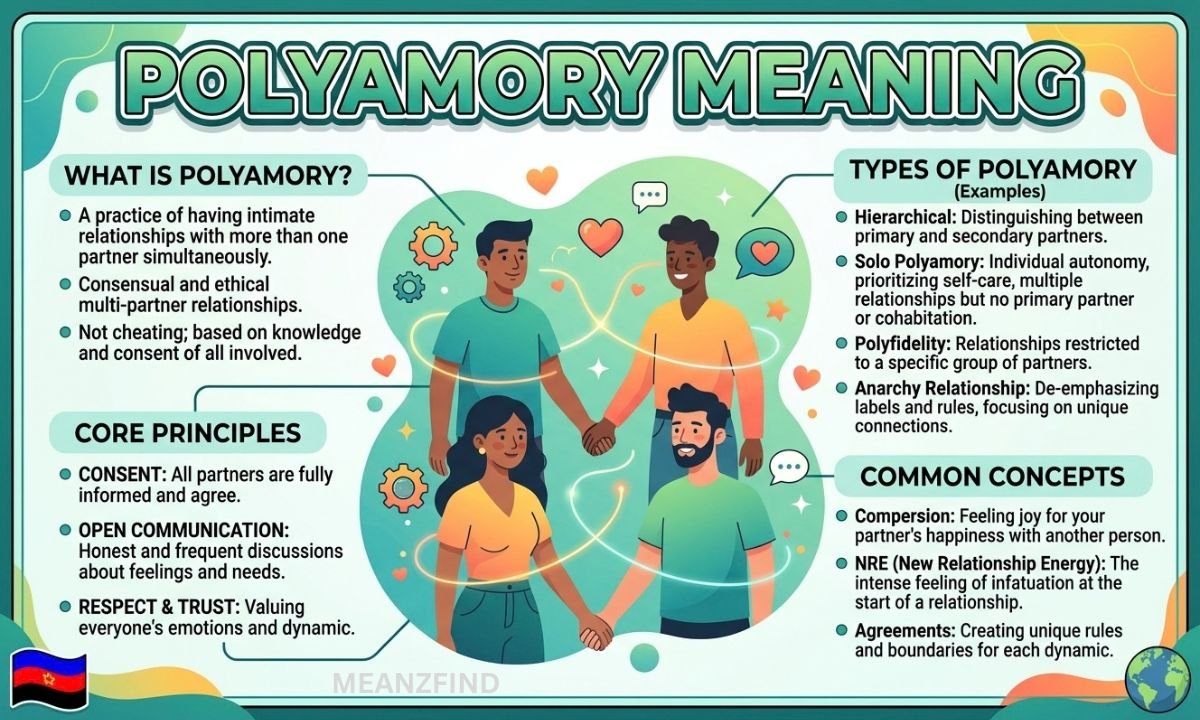
Polyamory means having more than one romantic relationship at the same time. Everyone involved knows about it and agrees to it. It is not about hiding things or breaking trust. It is about being open and honest with every partner.
Many people get this term wrong. They think it is the same as cheating or casual dating. It is not. In polyamory, love, care, and respect matter just as much as they do in any other relationship. The big difference is that love is not limited to one person.
Every healthy polyamorous relationship runs on clear rules. These include honesty, consent, good communication, and respect for each partner’s feelings. In this guide, you will learn the exact meaning of polyamory, how it works, and the key rules that keep it healthy.
Polyamory Meaning – Quick Definition
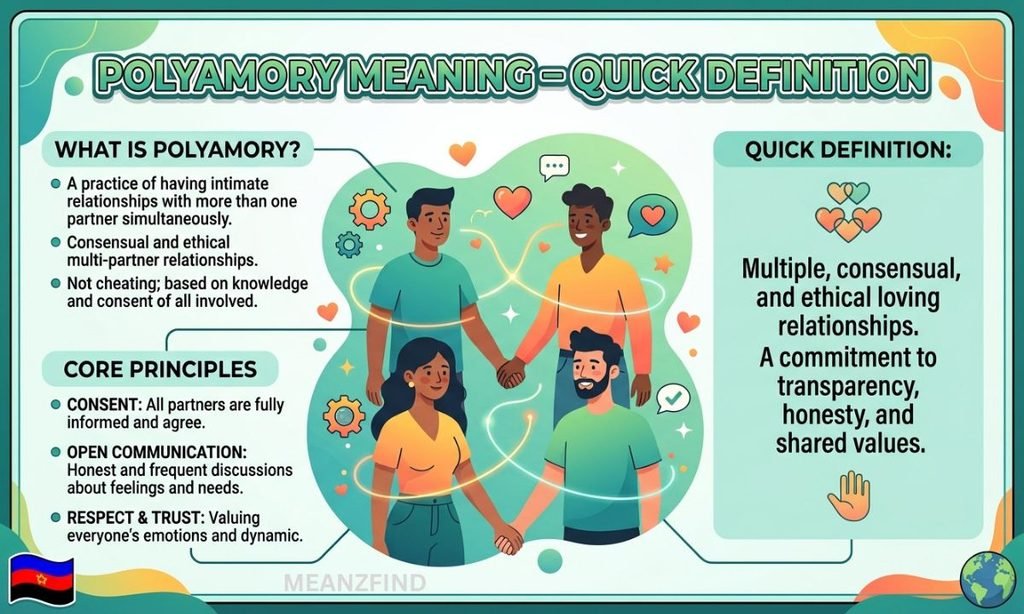
Polyamory means having more than one romantic relationship at the same time, with the full knowledge and consent of everyone involved.
The word comes from two old words. “Poly” means many. “Amor” means love. So polyamory simply means “many loves.”
The most important part is honesty. Nobody is lied to. Nobody is kept in the dark. Every partner knows the truth and agrees to the setup.
Short Examples
Here are a few simple examples of what polyamory can look like:
- Sara is dating Ali and Hamza. Both men know about each other. Everyone is fine with it.
- A married couple has a partner they both love. All three people talk openly about their feelings.
- Mina has one main partner and one close partner who lives in another city. Her partners know about each other.
- Two friends are dating the same person. All three are honest about it.
In each case, nobody is hiding anything. That is what makes it polyamory.
Origin & Background
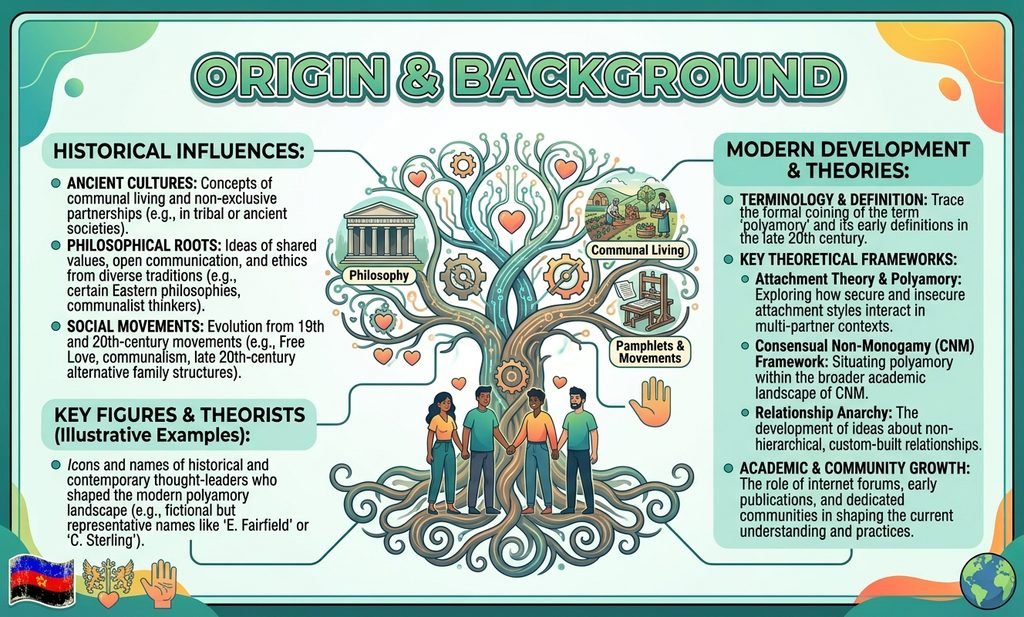
People have loved more than one person for as long as history goes back. But the word “polyamory” is quite new. It appeared in the early 1990s.
Writers and online groups in the United States began using the word. They wanted a name for honest, loving relationships with more than two people. Old words like “free love” or “non-monogamy” did not fit. Those words did not stress love and honesty enough.
Early online chat groups helped the word spread. Later, books, blogs, and podcasts did the rest. Today, social media has made the word known all over the world.
Why the Word Matters
The word gave people a clear way to explain themselves. Before it, many had no label for how they lived. Now they can say, “I am polyamorous,” and others understand the basic idea.
Polyamory Meaning in Relationship
In a relationship, polyamory means love is not limited to one person. A person can have deep feelings for more than one partner. Each bond can be real, serious, and long-lasting.
Polyamory is not a rule that says you must date many people. It is a way of seeing love. Some people have two partners. Some have three or four. Some have only one partner right now but are open to more.
Key Rules of a Healthy Polyamorous Relationship
Polyamory only works well when people follow some clear rules. These are the most important ones:
- Honesty: Tell the truth, even when it is hard.
- Consent: Everyone must freely agree. Nobody should be pushed.
- Open talk: Share your feelings, needs, and worries often.
- Respect: Treat every partner with care. Nobody is “less important” as a person.
- Clear boundaries: Decide what is okay and what is not. Say it out loud.
- Safe health habits: Talk about health and safety. Take care of each other.
- Time and fairness: Give each partner real attention. Love needs time.
- Handle jealousy: Jealousy is normal. Talk about it instead of hiding it.
Think of these as the “road signs” of polyamory. Without them, people get hurt.
Real-Life Conversations (How People Actually Use It)
People use the word in daily chats. Here is how it sounds in real life.
WhatsApp Chat
Zara: Hey, can I tell you something personal?
Dua: Of course. What is it?
Zara: I am polyamorous. I have two partners, and both know about each other.
Dua: Oh, okay. Thanks for trusting me. Can you explain a little more?
Zara: Sure! It just means I can love more than one person, and everyone is honest about it.
Instagram DMs
Ayan: Your bio says “poly.” What does that mean?
Hira: It means polyamorous. I date more than one person, and all of them know.
Ayan: Oh, so it is not cheating?
Hira: Nope. Cheating means lying. Polyamory means being open.
Text Message
Sam: Before we go further, I should tell you I am poly.
Noor: Thanks for being upfront. Can we talk about what that means for us?
Sam: Yes, I would like that. I want you to be comfortable.
Notice the pattern. These talks are calm, honest, and polite. That is how most healthy conversations about polyamory go.
Emotional & Psychological Meaning
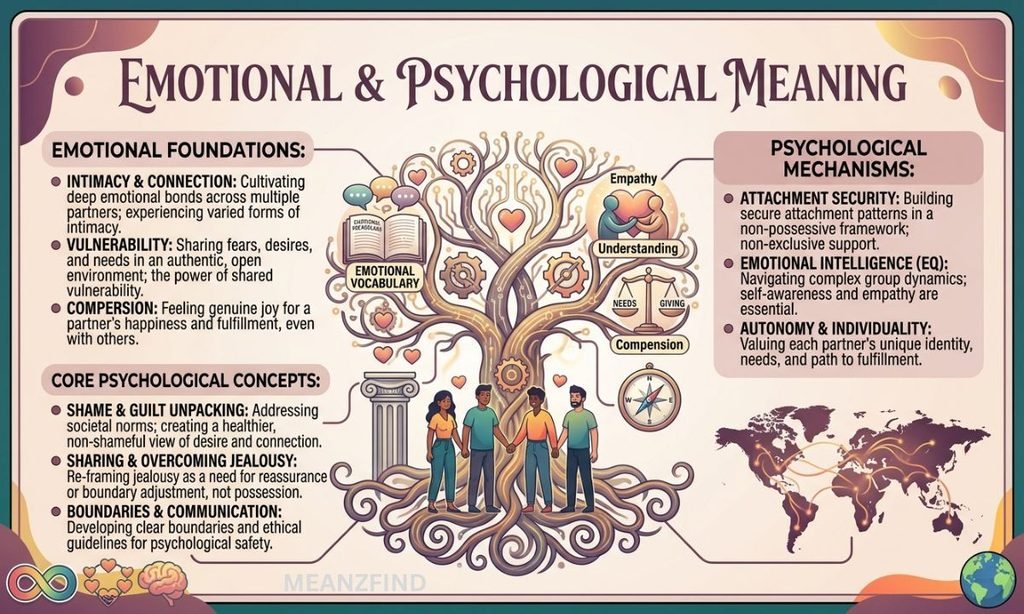
Polyamory is more than a relationship style. It also has an emotional side.
For many people, it feels natural. They feel they can care deeply for more than one person. They say monogamy never felt right for them.
Common Feelings in Polyamory
Polyamorous people often talk about these feelings:
- Freedom: They feel free to be honest about who they are.
- Joy for a partner: Some feel happy when their partner is happy with someone else. This feeling has a name: compersion.
- Jealousy: This is normal. It shows up in all kinds of relationships.
- Fear of being left out: Some worry that a partner will love someone else more.
- Growth: Many say polyamory teaches them to talk better and know themselves better.
What Experts Often Say
Relationship experts agree on one thing. The structure of a relationship matters less than the quality. Trust, care, and honest talk are what make any relationship healthy. That is true for monogamy and for polyamory.
Usage in Different Contexts
The word “polyamory” changes a little depending on where and how it is used.
Social Media
On social media, people often shorten it to “poly.” You may see it in bios, hashtags, and videos. Some creators share tips on jealousy, time, and communication.
Be careful, though. Online posts often make polyamory look easy or perfect. Real life is harder. It takes effort and honest talk.
Friends & Relationships
Among friends, the word is used to explain a relationship style. A person may say, “I am poly, so I have more than one partner.” Friends may have questions. That is okay.
In dating, many people say it early. It helps new partners know what to expect. Telling the truth at the start saves everyone from pain later.
Work or Professional Settings
At work, polyamory is a private matter. Most people do not need to share it. Your relationship style is not your boss’s business.
If you do share it, do it only with people you trust. Never use the word to joke or gossip about a coworker. Respect privacy at all times.
Casual vs Serious Tone
| Situation | Tone | Example |
| Chat with a close friend | Casual | “I’m poly, btw.” |
| Telling a new partner | Serious | “I want to be honest. I am polyamorous.” |
| Social media bio | Short and casual | “Poly |
| Family talk | Calm and serious | “I would like to explain how I live and love.” |
| Workplace | Private | Usually not shared |
Match your tone to the moment. A joke may fit a casual chat. It does not fit a serious talk with a partner.
Common Misunderstandings
Many people get polyamory wrong. Let us clear up the biggest myths.
“Polyamory is cheating.”
This is false. Cheating means breaking a promise and hiding the truth. Polyamory is the opposite. Everyone knows. Everyone agrees. If someone lies in a polyamorous relationship, that is cheating too. Lying is the problem, not the number of partners.
“It’s just about sex.”
This is not true. Polyamory is about love and deep bonds. Many polyamorous people have partners they are close to in a romantic and emotional way. Some of those bonds are not even sexual. The word “amory” points to love, not just physical closeness.
“It never works.”
This is too simple. Some polyamorous relationships fail. So do many monogamous ones. Both can work well when people are honest and kind. Both can fail when people lie or ignore each other. Success depends on the people, not just the style.
“People choose it because they fear commitment.”
This is also a myth. Many polyamorous people are deeply committed. They keep long-term bonds and work hard at them. Polyamory often needs more planning, time, and care than a single relationship. It is not an easy way out.
When It Should NOT Be Used
The word “polyamory” should not be used in the wrong way. Avoid it in these cases:
- To hide cheating. Saying “I’m poly” after you lied is not honest.
- To pressure a partner. Nobody should be forced into it. Consent must be free.
- As a joke about someone else. Do not label a person without asking.
- To excuse bad behavior. Polyamory does not mean you can ignore feelings.
- When you are not ready. If you have not talked to your partners, do not use the word as a shortcut.
- To “test” a partner. Do not use it to see if they will get jealous.
Polyamory only works with honesty and respect. If those are missing, it is not polyamory.
Comparison Table
Many people mix up polyamory with other terms. This table shows the difference.
| Term | Meaning | Everyone Knows? | Focus |
| Polyamory | Loving more than one person, with consent | Yes | Love and emotional bonds |
| Monogamy | One partner at a time | Yes | One committed bond |
| Cheating | Secret romance or sex that breaks a promise | No | Lying and betrayal |
| Open relationship | Partners may have outside sexual experiences | Yes | Usually more about sex |
| Polygamy | Being married to more than one person | Usually yes | Marriage |
| Swinging | Couples share sexual experiences with others | Yes | Mostly sex and fun |
Key Insight:
Polyamory is about honest love with more than one person. Cheating is about lies. The number of partners does not decide which one it is. Honesty does.
Variations / Types of Polyamory
There is no single “right” way to be polyamorous. People build different setups. Here are the most common ones:
- Hierarchical polyamory: Some partners are ranked as more important than others.
- Non-hierarchical polyamory: No partner is ranked above another.
- Kitchen table polyamory: Everyone is friendly and can sit at one table together.
- Parallel polyamory: Partners know each other exist but stay apart.
- Solo polyamory: A person values freedom and lives independently, with several partners.
- Polyfidelity: A closed group where all members stay loyal to one another.
- Triad (or “throuple”): Three people in one relationship.
- Relationship anarchy: No fixed rules or labels. People set up each bond freely.
ENM Polyamory Meaning
ENM stands for ethical non-monogamy. It is a large umbrella term. It covers any relationship style where people have more than one partner with everyone’s consent.
Polyamory is one kind of ENM. Open relationships and swinging are also ENM. So all polyamory is ENM, but not all ENM is polyamory.
The word “ethical” is key. It means honesty, consent, and respect come first.
Hierarchical Polyamory Meaning
In hierarchical polyamory, partners are placed in levels. A “primary” partner often comes first. They may share a home, money, or children. A “secondary” partner gets less time or fewer shared decisions.
Some people like this setup because it feels stable. But it can hurt. A partner may feel less valued. If you choose this style, talk openly. Make sure every person is happy with their place.
Kitchen Table Polyamory Meaning
This style gets its name from a simple picture. Imagine all partners and “partners of partners” sitting at one kitchen table. They share food and talk easily.
In kitchen table polyamory, people try to be friendly or at least polite with each other. They may spend time together as a group. It works best when everyone feels safe and respected.
It does not work for everyone. Some people prefer more distance. That is okay too.
How to Respond When Someone Says They’re Polyamorous
Someone may trust you enough to share this. Your reply matters. Here are some ideas for different moods.
Casual Replies
- “Okay, thanks for telling me!”
- “Got it. How does that work for you?”
- “Cool. Thanks for being open with me.”
Funny Replies
Use humor only if you know the person well and the mood is light.
- “So your calendar must be crazy busy, right?”
- “You must be great at planning dates!”
- “Wow, that sounds like a lot of birthday gifts.”
Keep jokes kind. Never make fun of them.
Mature / Confident Replies
- “Thank you for sharing this. I would like to understand more.”
- “I respect your honesty. What does a healthy relationship look like for you?”
- “I may not know much about it, but I am happy to listen.”
Private / Respectful Replies
- “Thanks for trusting me. I will keep this between us.”
- “I will not share this with anyone.”
- “You can talk to me anytime, and it stays private.”
What to Avoid Saying
- “That is just cheating.”
- “You will get tired of it.”
- “That is not normal.”
These replies sound unkind. They close the door on a real talk.
Regional & Cultural Usage
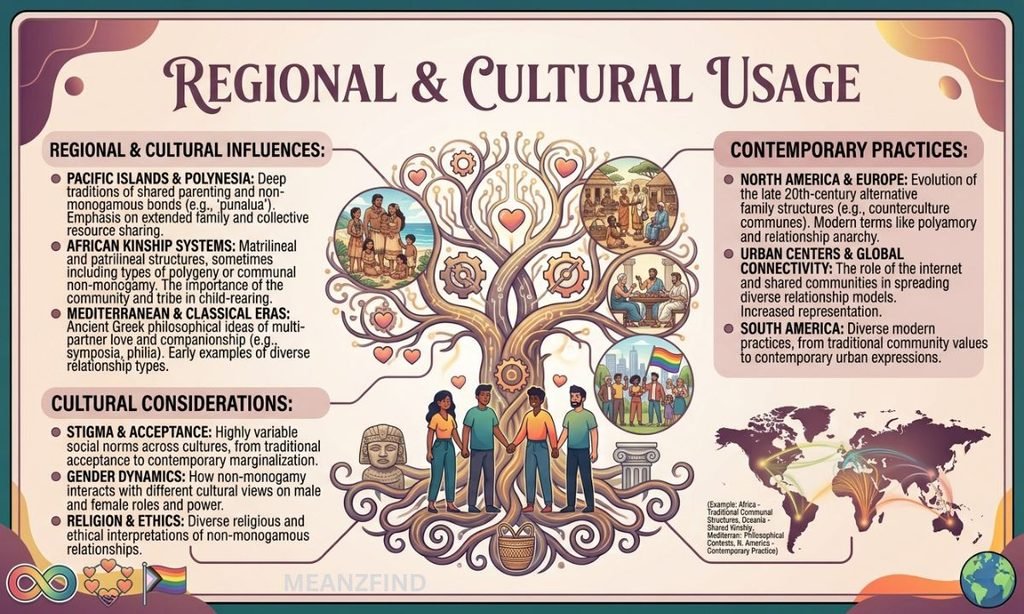
Ideas about love and marriage change from place to place. The way people see polyamory changes too.
Western Culture
In Western countries, polyamory is talked about more openly. There are books, podcasts, support groups, and online communities. Many people know the word. Some still misunderstand it, but open talk is more common.
Laws in these places usually recognize marriage between two people only. Polyamorous partners often have to use other ways to protect each other, like legal agreements.
Asian Culture
Asia is a huge region with many beliefs. Family, tradition, and religion play a big role in how people see relationships. In many places, people expect marriage between two people and strong family approval.
Because of this, many polyamorous people keep their lives private. Talk about it is growing, mostly on social media and in big cities. Still, many people in the region do not know the word or see it as against their values.
Middle Eastern Culture
In the Middle East, religion and family traditions strongly shape views on love and marriage. Polygamy is a different thing and is part of the law or custom in some countries. Polyamory, as people use the word today, is not the same. It is often seen as outside tradition and, in some places, against the law or social rules.
Because of this, open talk is rare in public. Some people talk about it only online or in private.
Global Internet Usage
The internet has helped the word spread worldwide. People in many countries learn about it through videos, forums, and social media. Some find it helps explain how they feel. Others find it confusing or against their beliefs.
Respect matters most. People hold different views about love, faith, and family. You can disagree and still be kind.
| Region | General Attitude | Open Discussion |
| Western | More known and talked about | Common |
| Asian | Mixed; often private | Growing online |
| Middle Eastern | Often seen as outside tradition | Rare in public |
| Global internet | Spreads fast; many views | Very common online |
FINAL WORDS
Polyamory means loving more than one person with the full knowledge and consent of everyone involved. It is built on honesty, not secrets. When all partners know the truth, trust can grow in a healthy way.
The key rules are simple. Be honest, ask for consent, talk openly, and respect each person’s limits. Set clear boundaries early and review them often. Rules can change as people and feelings change, so keep the talk going.
Polyamory is not for everyone, and that is okay. It takes time, patience, and emotional maturity. If you want to try it, go slow and treat every partner with care. Strong relationships come from respect, no matter how many people are in them.
FAQs
What Does It Mean if Someone Is Polyamorous?
It means they are open to loving more than one person at the same time. Everyone involved knows about it and agrees to it.
How Is Polyamory Different From Polygamy?
Polyamory is about having more than one romantic partner, and marriage is not required. Polygamy means being legally or religiously married to more than one person at once.
Is Polyamorous a Part of LGBTQ?
No, polyamory is a relationship style, not a sexual orientation or gender identity. Many LGBTQ people are polyamorous, so the two communities often overlap.
Can Polyamory Be Married?
In most countries, a person can legally marry only one partner at a time. Polyamorous people often have commitment ceremonies or legal agreements to protect each other.
Do Poly Couples Sleep in the Same Bed?
It depends on the people involved, because there is no fixed rule. Some share a bed, some take turns, and some prefer separate beds.
Who Is the Most Famous Person Who Has Been Polyamorous?
There is no official “most famous” person. Singer and actor Willow Smith is one public figure who has spoken openly about being polyamorous.
How Long Do Poly Couples Last?
There is no set time, and it is different for every couple. Like any relationship, it lasts when there is trust, honesty, and care.
What’s the Difference Between Cheating and Polyamory?
Cheating means breaking a promise and hiding the truth. Polyamory is open and honest, and every partner knows and agrees.