
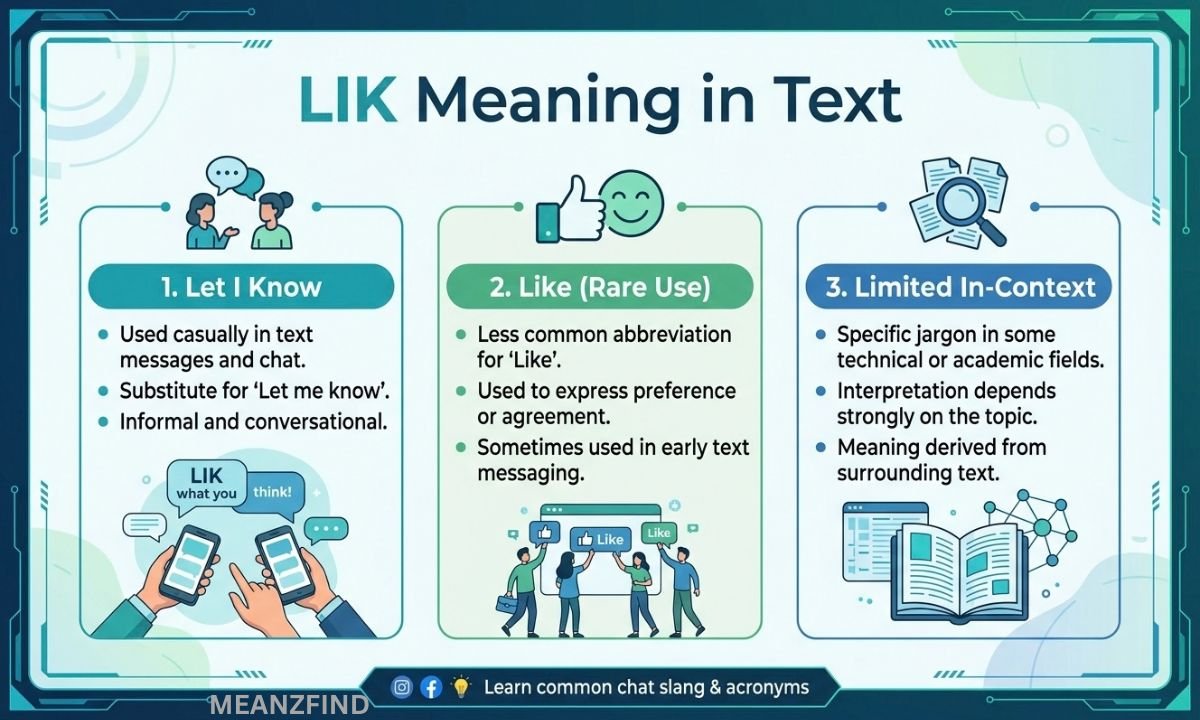
You got a text with “LIK” in it, and now you’re stuck. It’s not a word you learned in school. It looks like a typo, but it might not be.
Good news: it’s simple once you know it. Most of the time, “LIK” is just a fast or misspelled version of “LYK.” And LYK almost always means “let you know.”
In this guide, we’ll break down what LIK really means. We’ll show you real examples from real texts. We’ll also cover a few alternatives you can use instead, so you always sound natural when you reply.
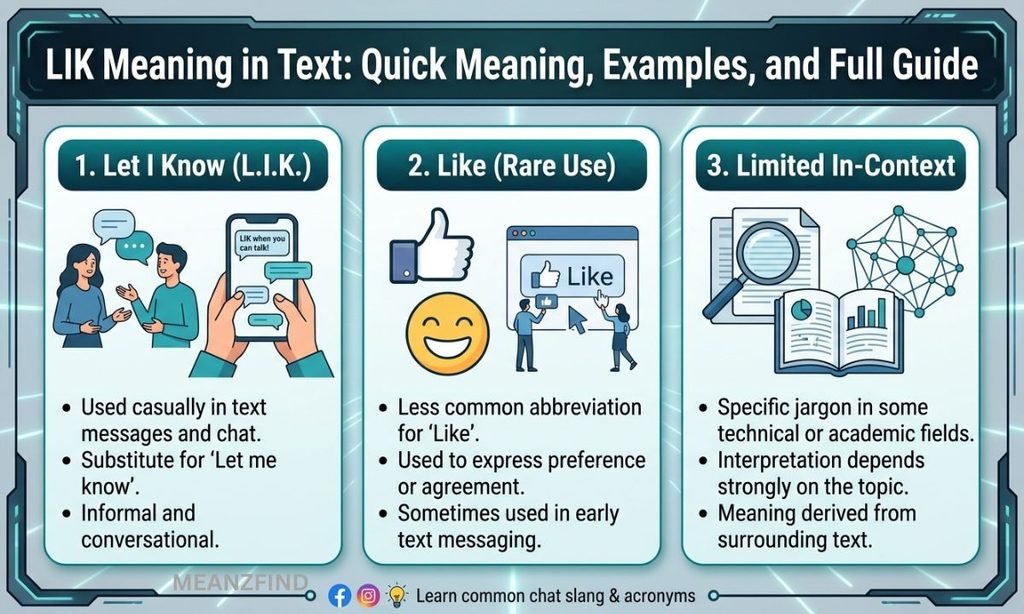
LIK Meaning in Text – Quick Meaning, Examples, and Full Guide
Quick Meaning
Simple meanings:
LIK is short for a few different things, and the meaning always depends on the chat.
- Let you know – the most common use. Someone types LIK instead of typing the full phrase.
- Like – a quick, casual way to type “like” when texting fast.
- A playful typo – some people type LIK by mistake when they mean LYK.
Here is the simple version:
| Meaning | How It Is Used |
| Let you know | “I’ll LIK after work” |
| Like | “I LIK this song” |
| Typing shortcut | Fast texting on a small keyboard |
You do not need to overthink LIK. Most of the time, it is just a shortcut. People use it to save time and keep the chat moving.
Think of it like other short forms you already know. “Brb” means “be right back.” “Omw” means “on my way.” LIK works the same way. It saves a few seconds of typing without losing the message.
That is really the whole point of texting slang. It is not about being fancy or secretive. It is about speed. When people are busy, walking, or on a small phone screen, short forms like LIK make chatting easier.
Quick examples:
Here are a few short examples so you can see LIK in real sentences.
- “I’m not sure yet. LIK by tonight.”
- “That movie was good. I LIK it a lot.”
- “LIK when you land.”
- “She said she’ll LIK tomorrow.”
Notice how the meaning changes with the sentence. That is normal for texting slang. Context always tells you what the sender means.
Here is a simple trick that always works. Read the words right before and after LIK. If the sentence is about waiting for news, LIK means “let you know.” If the sentence is about liking a song, photo, or idea, LIK means “like.”
This small habit takes only a second, but it removes almost all confusion. Once you practice it a few times, you will read LIK correctly without even thinking about it.
Origin & Background
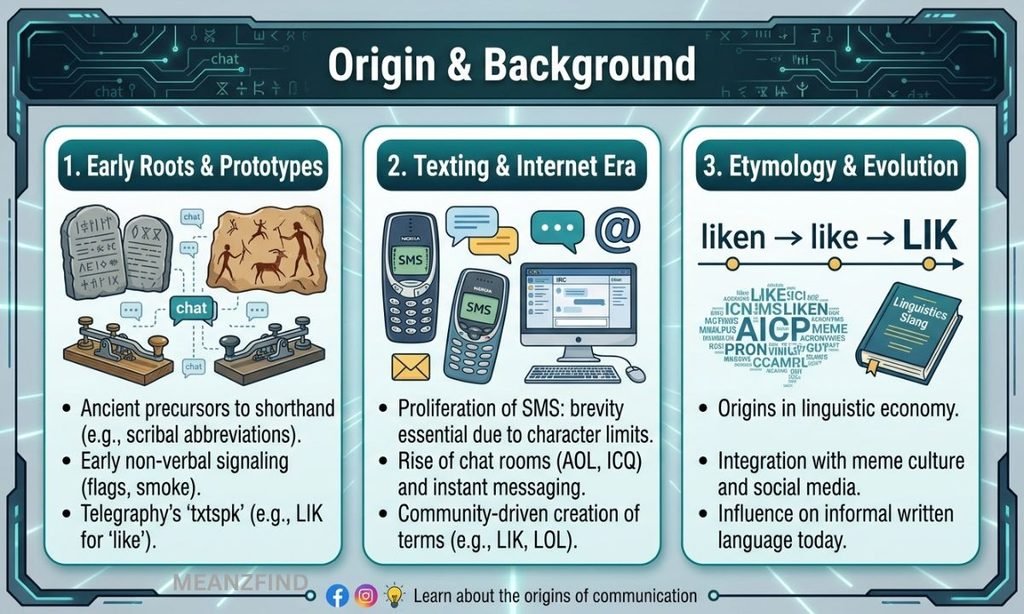
How it developed:
Texting slang grew fast once phones became common. People wanted to type quickly, so they shortened words and phrases.
LIK likely grew out of LYK, which stands for “let you know.” Over time, some people typed LIK by accident. Others kept using it on purpose because it felt quicker or looked different.
Fast typing on phones led to many small changes like this. Letters get swapped. Vowels get dropped. New short forms appear every year. LIK is one small piece of that bigger trend.
Social media made it spread faster. Once a few people use a short form in comments or captions, others copy it. That is how internet slang usually grows.
Here is a simple timeline:
- People started shortening common phrases for faster typing.
- LYK became popular as short for “let you know.”
- LIK appeared as a variation, sometimes by typo and sometimes on purpose.
- Social media apps helped it spread to more users.
- Now it shows up across chats, comments, and captions.
This kind of slang usually has no single inventor. It grows because many people use it the same way at the same time.
No dictionary sat down and created LIK on purpose. It formed slowly, through millions of small text messages sent by ordinary people. That is how most modern slang works. It is built by everyday use, not by a single rule book.
This is also why LIK can feel a little flexible. Different people picked it up in slightly different ways, so its exact use can shift a little from person to person. But the core idea, quick and casual communication, stays the same everywhere.
Real-Life Conversations
LIK Meaning in Text
In a normal text message, LIK almost always means “let you know.” It shows up when someone is waiting for information or making a plan.
Example:
- Person A: “Are we still meeting at 6?”
- Person B: “Not sure. LIK in an hour.”
This use is simple and clear once you know the shortcut.
WhatsApp Chat
WhatsApp chats are often longer and more personal. LIK fits naturally into these conversations.
Example:
- “Hey, checking on the tickets. LIK if they’re still available.”
- “I’ll ask my mom and LIK.”
People on WhatsApp often mix slang with full sentences. LIK blends in easily here.
Instagram DMs
Instagram DMs are usually short and fast. LIK shows up when people are chatting quickly between other apps or tasks.
Example:
- “LIK if you’re free later.”
- “Saw your post, LIK your song choice.”
In the second example, LIK stands for “like,” not “let you know.” This shows why context matters so much.
TikTok Comments
TikTok comments are short, quick, and often playful. LIK sometimes appears as a fast way to say “like.”
Example:
- “LIK this if you agree.”
- “I LIK this trend so much.”
On TikTok, people often type fast without checking spelling. This is one place where LIK and LYK blend together the most.
Text Message
Basic text messages use LIK the same way as WhatsApp. It works as a quick promise to share information soon.
Example:
- “Talking to my manager now. LIK soon.”
- “Waiting on the doctor. Will LIK after.”
This use is common in daily life, especially for plans, schedules, and quick updates.
Text messages tend to be shorter than app chats because many people still pay attention to character limits or just prefer quick exchanges. LIK fits perfectly into this style. It lets someone promise an update without writing a full sentence.
Parents and teens often use this shortcut too. A simple “LIK when you’re home” is common in family texting, showing that slang is not only for close friends but for everyday family life as well.
Emotional & Psychological Meaning
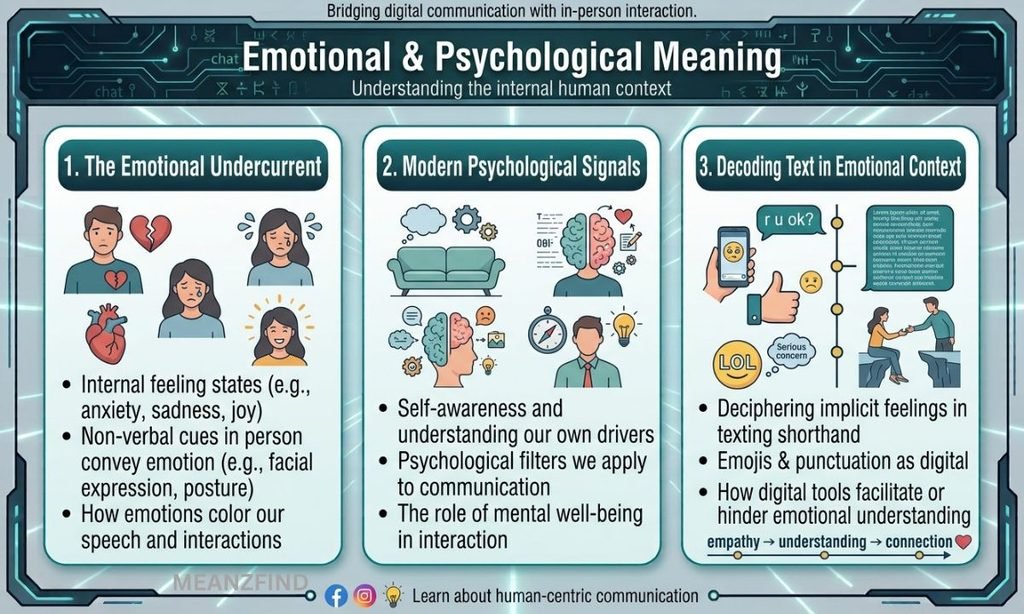
What it reveals:
Short texting slang like LIK often shows how a person is feeling in the moment. It is not just about saving letters.
- Busy mindset – Short replies often mean someone is multitasking.
- Comfort level – People use casual slang more with friends than with strangers.
- Quick thinking – Fast typing can show excitement or urgency.
- Low pressure – Slang keeps the mood light and relaxed.
When someone uses LIK, they usually are not trying to be rude. They are simply moving fast through their day. Texting slang lets people stay connected without slowing down.
It can also show trust. People often drop full grammar rules with those they feel close to. Typing “LIK” instead of a full sentence can be a small sign of comfort in the relationship.
Think about how differently you text a close friend compared to a new manager. With a friend, you might type “LIK” without a second thought. With a manager, you likely write the full sentence. That small choice reveals how relaxed or careful someone feels in that moment.
Short slang can also protect feelings. Sometimes people use quick, light words like LIK to avoid sounding too serious or too emotional. It keeps the conversation easy, even when the topic underneath is important.
Usage in Different Contexts
1. Social Media
On social media, LIK appears in captions, comments, and quick replies. It fits the fast-paced nature of these platforms.
- Comments under posts
- Story replies
- Quick captions
People rarely explain slang on social media. They expect the reader to already understand it from context.
2. Friends & Relationships
Between friends, LIK is very common. It fits naturally into daily back-and-forth chats.
- Making weekend plans
- Confirming small details
- Casual updates throughout the day
Close friends often use more slang because there is less need to sound formal.
3. Work or Professional Settings
LIK is less common at work, but it still shows up in casual work chats like Slack or informal texts between coworkers.
- “LIK when the report is ready.”
- “Waiting on IT. Will LIK once it’s fixed.”
Even so, it is best to avoid slang in formal emails or client messages. Save it for casual, internal chats only.
A good rule is to match your workplace’s normal texting culture. Some teams are relaxed and use slang all day. Others prefer full sentences, even in quick chats. Watching how coworkers already write is the easiest way to know what fits.
When in doubt, it is always safer to write the full phrase at work. “I’ll let you know” never confuses anyone, while slang can sometimes feel too casual for certain coworkers or clients.
4. Casual vs Serious Tone
The tone of a conversation changes how LIK feels to the reader.
| Tone | Example | Feeling |
| Casual | “LIK if you’re free 😂” | Light, relaxed |
| Serious | “LIK once you land safely.” | Caring, practical |
The same three letters can feel very different depending on the situation around them.
Common Misunderstandings
1. Thinking It’s Always Slang
Some readers assume LIK is always trendy internet slang. In reality, it is often just a quick shortcut for a normal phrase.
2. Assuming It Has a Hidden Meaning
LIK does not carry a secret or dramatic meaning. People sometimes overthink short texts, especially in new or uncertain relationships.
3. Confusing It With Intentional Style
Some think LIK is always used on purpose. In truth, it is sometimes a simple typo for LYK that stuck around in daily use.
4. Using It Everywhere
Not every message needs slang. Using LIK in serious or formal settings can confuse the reader instead of helping.
These misunderstandings usually come from reading too fast or reading too much into a short message. Slang words like LIK are meant to be light and simple, not loaded with hidden meaning.
A helpful habit is to imagine the sentence written out in full. If “let you know” makes sense, that is the meaning. If “like” fits better, go with that instead. This one simple check clears up almost every confusing message.
Here is a quick checklist to avoid these mistakes:
- Read the full sentence before deciding on the meaning.
- Do not assume hidden emotions behind short replies.
- Match your reply to the tone of the conversation.
- Save slang for casual chats only.
Comparison Table
| Term | Meaning | Common Platform |
| LIK | Let you know / Like | Texts, Instagram, TikTok |
| LYK | Let you know | Texts, WhatsApp, Discord |
| LMK | Let me know | Texts, Email, Work chats |
| IDK | I don’t know | All platforms |
| NGL | Not gonna lie | Social media, texts |
Key Insight:
LIK, LYK, and LMK often get mixed up because they look similar and mean nearly the same thing. The small difference is usually about who is doing the informing.
- LIK / LYK = I will let you know
- LMK = You let me know
Remembering this small difference clears up most confusion.
It also helps to notice who is speaking. If you are the one waiting for news, you might say “LMK” to ask someone else to update you. If you are the one holding the news, you would say “LIK” or “LYK” to promise an update yourself. Keeping this direction in mind makes texting conversations flow much more smoothly.
Variations / Types of “Lik”
Slang often has small variations depending on the user and platform. Here are common ones seen with LIK:
- lik – lowercase, casual style
- LIK – all caps, more direct or urgent
- lyk/lik mix – some people switch between both without noticing
- lik u – short for “like you,” seen in flirty or friendly texts
- ill lik – short for “I’ll let you know”
None of these variations change the core meaning much. They mostly reflect personal typing habits.
Some people always type in lowercase because it feels more relaxed and friendly. Others use all caps when they want to sound urgent or excited. Neither style is wrong. It simply reflects each person’s own texting personality.
Over time, you will notice patterns in how your friends and family use these variations. Once you learn someone’s typical style, reading their messages becomes even easier and faster.
How to Respond When Someone Uses It
Casual Replies
- “Okay, sounds good!”
- “Cool, waiting on you.”
- “No rush, just LIK whenever.”
Funny Replies
- “LIK before I explode from waiting 😂”
- “You better LIK or I’m assuming the worst.”
- “LIK asap, my patience is gone.”
Mature / Confident Replies
- “Sure, take your time and update me when you can.”
- “No problem, I’ll wait for your update.”
- “Thanks for keeping me posted.”
Private or Respectful Replies
- “Understood, thank you.”
- “Okay, I appreciate you letting me know.”
- “That works, talk soon.”
Matching your reply style to the sender helps keep the conversation smooth and natural.
Before choosing a reply, think about your relationship with the sender and the mood of the chat. A joke works great with a close friend but might feel out of place with someone you barely know. Reading the room, even in text form, always leads to better conversations.
It also helps to think about timing. If someone seems in a hurry, a short and simple reply works best. If the chat feels relaxed and playful, there is more room for jokes or longer, friendly responses.
Regional & Cultural Usage
Western Culture
In the US, UK, and similar regions, LIK fits into everyday fast texting. It blends easily with other common shortcuts like OMW, NGL, and IDK.
Asian Culture
In many Asian countries, English texting slang mixes with local languages. LIK often appears in English sentences within chats that switch between two languages.
Middle Eastern Culture
In the Middle East, English slang like LIK often appears among younger users who text in English alongside Arabic or other local languages. It is common in casual chats between friends.
Global Internet Usage
Because social media connects people worldwide, slang like LIK spreads quickly across borders. A term used in one country can appear in another within weeks, especially through trends and viral posts.
Viral videos, popular influencers, and trending comments help push small slang terms into global use. A phrase that starts in one small online community can end up appearing in comments from completely different countries within a short time.
This is part of what makes internet slang so interesting. It does not belong to just one place. It grows and changes as more people from more backgrounds start typing it into their own daily conversations.
LIK Meaning in Text Funny
People often turn LIK into a joke, especially among friends.
- “LIK when you find your missing sock 😂”
- “LIK once aliens land, deal?”
- “I’ll LIK… in the year 3000.”
This playful use shows how flexible slang can be. It is not always serious information. Sometimes it is just a fun way to tease a friend about being slow to reply.
Humor is a big part of how slang spreads. When a short phrase like LIK gets turned into a joke, people remember it more easily and start using it themselves. This is one reason funny texting trends spread so quickly among friend groups and online communities.
You can even create your own funny version. Adding a joke, an emoji, or an exaggerated wait time turns a plain shortcut into something memorable and shareable.
LIK Meaning in Text Urban Dictionary
Urban Dictionary style definitions usually describe LIK in a casual, community-driven way rather than a strict dictionary rule. Common informal definitions include:
- A shortcut for “let you know”
- A fast or lazy way to type “like”
- A playful typo that became normal slang
These definitions are not official, but they match how most people actually use the term daily.
Community-driven slang sites work differently from traditional dictionaries. Instead of one expert deciding the meaning, thousands of everyday users add their own explanations and examples. This is why definitions there can vary slightly from person to person.
Even so, these informal definitions are often the most accurate reflection of how a word is really used in daily texting, since they come straight from the people using it.
Tips For LIK Meaning in Text
- Always read the full message before guessing the meaning.
- Match the tone of your reply to the tone of the sender.
- Avoid slang in formal work emails or client messages.
- Don’t overthink short replies from friends or family.
- Use LIK only in casual chats, not serious documents.
- If confused, simply ask, “Do you mean let you know?”
These small habits help you use and understand LIK the right way, without confusion or awkward misunderstandings.
Texting slang is meant to make communication easier, not harder. Once you get comfortable with terms like LIK, reading and replying to casual messages becomes almost automatic.
The more you text, the more naturally these small shortcuts will fit into your own style. Soon, you will use them without even thinking, just like the people around you already do.
FINAL WORDS
So, that’s LIK in a nutshell. It’s not some secret code or hidden meaning. It’s just a quick, informal way to say “let you know.” Most people type it fast and never think twice about the spelling.
Context is still your best friend. If someone says “I’ll LIK tomorrow,” they’re promising an update, not confusing you on purpose. Read the sentence around it, and the meaning almost always clicks into place.
Don’t stress about getting it perfect. Texting slang is casual by nature, and small typos like this happen all the time. What matters is that you understood the message and replied naturally.
Next time LIK pops up in a chat, you’ll know exactly what’s going on. No more guessing, no more awkward pauses. Just read it, reply, and keep the conversation moving.
FAQs
What is the meaning of lik?
“Lik” is internet slang, usually short for “let you know” or a fast way to type “like.” The exact meaning depends on the sentence around it.
What does “lik” mean in texting?
In texting, “lik” almost always stands for “let you know,” as in promising to send an update soon. Sometimes it’s used instead of “like” when typing quickly.
What is lik short for?
“Lik” is most commonly short for “let you know.” It can also be a quick, informal way to type “like.”
What does “lick” mean in a chat?
Spelled with a “c,” “lick” in casual chat is often part of the slang phrase “hit a lick,” meaning to get money fast. On its own, “lick” can also just mean the literal action.
How do you spell lik?
“Lik” is typically spelled with just three letters: L-I-K. It’s a shortened, informal spelling and not a standard dictionary word.
What does “hit a lik” mean?
“Hit a lick” (often misspelled “lik”) is slang for making a quick score of money, often through a hustle, scam, or theft. It’s commonly used in rap lyrics and street slang to describe sudden financial gain.
What does “lick” mean in slang?
In slang, “lick” usually refers to a quick, often risky way of making money, as in “hit a lick.” It can also appear in unrelated casual phrases depending on context.
Is “lik” a word?
No, “lik” is not a standard English word or dictionary entry. It’s internet and texting shorthand that exists only in informal chat.
What does “lick” mean?
Literally, “lick” means to pass the tongue over something. In slang, it takes on the separate meaning of a fast money-making move, as in “hit a lick.”
What is I Lyk?
“I lyk” usually means “I let you know” or “I like,” written in fast, informal texting style. The missing letters are simply dropped for speed.